
When Gramophone came to Shure in 1964, the oldest and longest surviving record review magazine connected with the world’s oldest operating microphone company. Gramophone was a British magazine cofounded by novelist and writer Sir Compton Mackenzie and broadcaster Christopher Stone. Published monthly since 1923, it was a privately owned business with a circulation that had reached 75,000 in 1960.
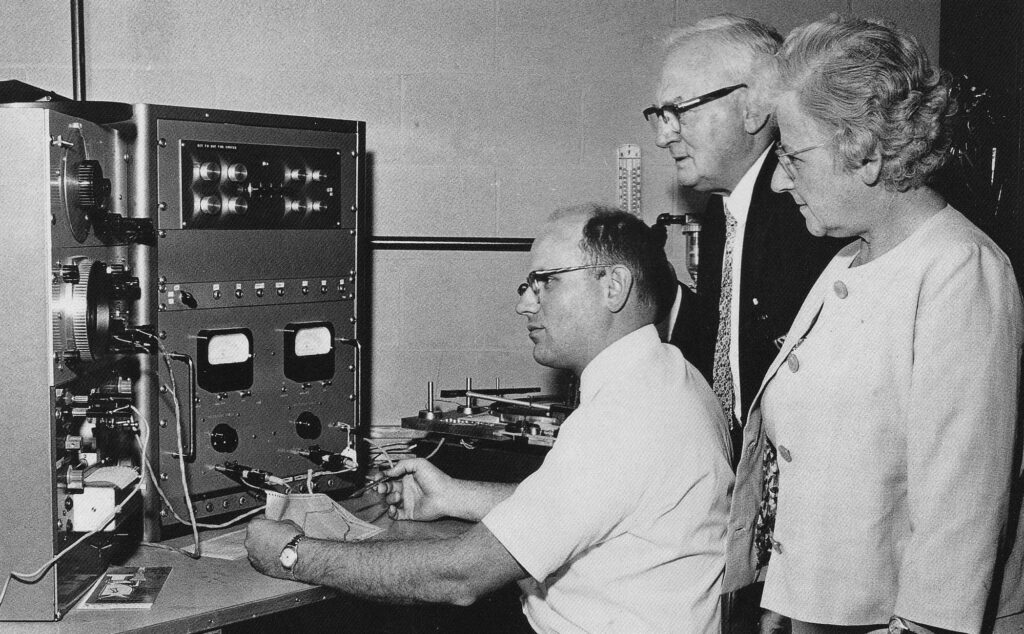
As part of a tour of the Shure plant in Evanston, Illinois, in 1964, Percy Wilson and Mrs. Wilson watch as Roger Anderson, Manager of Shure’s Research and Development Section, runs a tracking capability test on one of the Company’s advanced Stereo Dynetic Phonograph Cartridges.
Percy Wilson, the Technical Editor of Gramophone, was one of the foremost authorities on a growing segment of the industry called “high fidelity.” Following his 1964 visit to Shure, Mr. Wilson reported in Gramophone:
“Mention of the word ‘consistency’ immediately switches my mind to what I saw at the Shure plant in Evanston, Illinois. In all my visits, in whatever country, I have never seen so [many] pains taken in production to secure just that elusive virtue. And, as my wife remarked, the Shure plant is the cleanest she has ever seen. Dust is taboo, and white coats abound. It was of special interest to me to see how the tiny components of the microphones and pickups, after being fabricated by precision machines, were checked and counterchecked in assembly. I recall, for example, three anechoic chambers for checking microphones during assembly. A calibrated speaker system was installed in the chamber, and each microphone was placed in front of it by the operator, who then went outside and proceeded to apply a gliding tone signal to the speaker. The output from the microphone was then observed on a ’scope, on the face of which tolerance lines had been inscribed in accordance with the specification. If the signal trace fell outside these lines at any part of the scale, the microphone was rejected. To my surprise, in all the examples, I saw the trace come bang in the middle!
“Another example of this production technique was seen in the shadowgraph instruments for ensuring that the cantilever angles in pickups [phonograph cartridges] should be accurately set. Again, though tolerance lines were shown, I found that, in each case, the girls [doing the assembly] were getting the shadow dead central.
“There were many more intriguing devices that I could mention. My special interest was aroused by the consideration that the more checks of this kind that are applied in the course of assembly, and not merely to test the end product, the more likely is the final consistency, in agreement with specification, to be maintained over a period of time.
“Although my main interest in the visit to Shure was productionwise, I also spent quite a [long] time in the research and design section. Naturally! There, let me confess now (although I didn’t at the time!) I got some new and stimulating ideas. Their method of measuring the effect of alteration of recording/reproduction rake, for example. I made some (what I then thought to be devastating) remarks on the subject in these pages over two years ago. Since then, the question has become one of great interest, and a little controversial over here in America. It is gratifying to know that at any rate Shure, amongst pickup manufacturers, has the matter well in hand.”
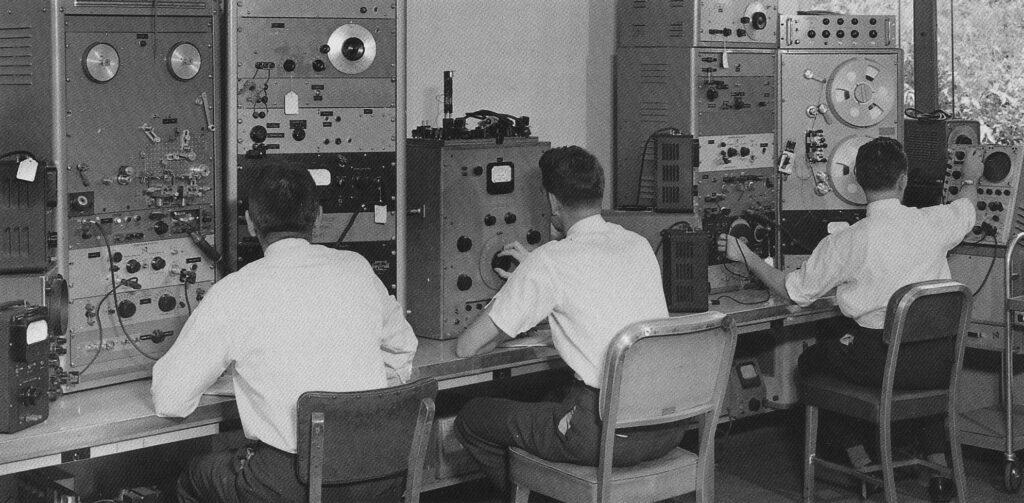
In the Shure testing lab in the 1960s, engineers use standard and custom-designed equipment to test microphones and phonograph cartridges.
