
From 1942 through 1945, Shure manufactured military grade microphones and headphones for the Allied Forces. During World War Two, the T-17 was the most widely used microphone, as the HS-33 was for headphones. Each device played a vital role when connected to communication gear made by Motorola, Western Electric, Hallicrafters, Crosley, and others. In this Tech Tip, we explore an example of such gear, the Crosley RM-29 Remote Control Unit.
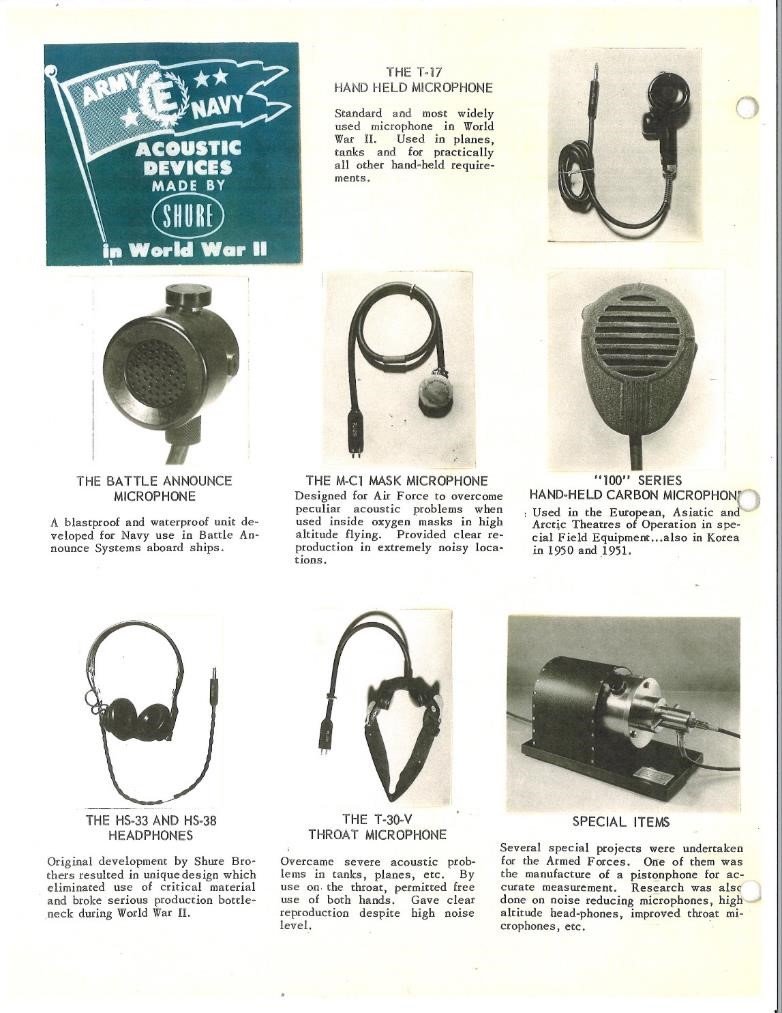
Military acoustical devices made by Shure
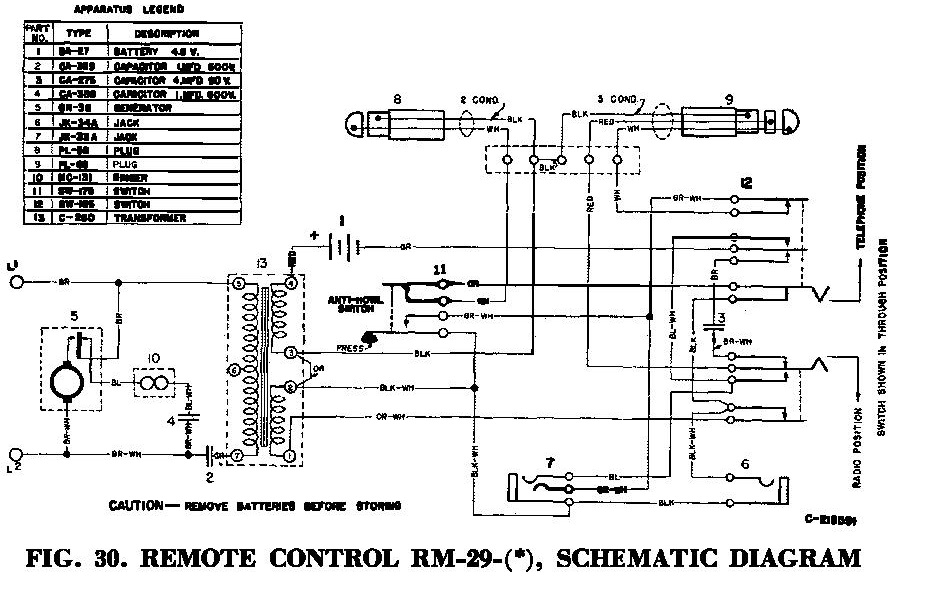
During World War Two, battlefield voice traffic traveled via radio [wireless] or field telephone [wired]. Field commanders needed a link between the radio network and the field telephone network. Enter the Crosley RM-29. Developed for the Allies, the RM-29 acted as an interface between a two-way radio transceiver [transmitter/receiver] and a wired field telephone line. Our T-17-B mic and HS-33 headphones were commonly deployed with the RM-29.
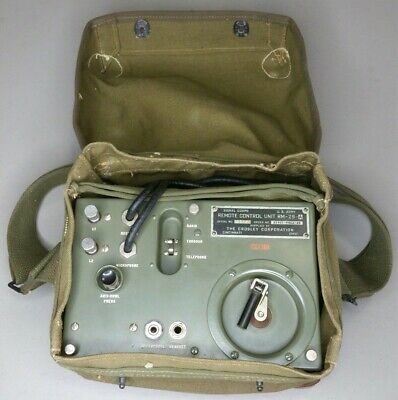
Crosley RM-29 Remote Control Unit
How was the RM-29 utilized? A squadron leader at the front line employed an EE-8 field telephone to communicate with support staff at the rear. A twisted pair of copper wires carried the voice signal for a maximum of seven miles from the EE-8 phone to the RM-29. In this scenario, the RM-29 served as a terminal [one end] of a wired private telephone line.
D cells [flashlight batteries] powered the EE-8. It housed a hand-cranked AC generator [90 Vac] to activate a ringer inside the RM-29. The same type of bell-ringing generator was also on the RM-29 allowing the user to signal the field telephone. Note the hand crank, lower right corner, in the photo above.
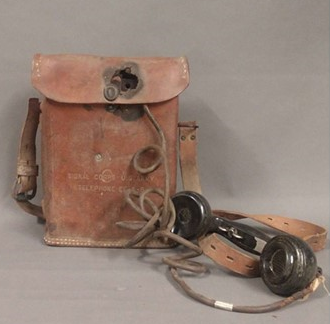
EE-8 field telephone
As a second function, the RM-29 could “patch through” the EE-8 wired telephone signal to a transceiver allowing the front line squadron leader to communicate with others via radio. This function extended the voice comm network far beyond the seven mile limit previously mentioned.
The third function of the RM-29 was to provide basic control of a high-powered radio transceiver.
In modern terminology, the RM-29 essentially acted as a dongle, permitting the operation of a wired communication link, or a wireless communication link, or both in tandem.
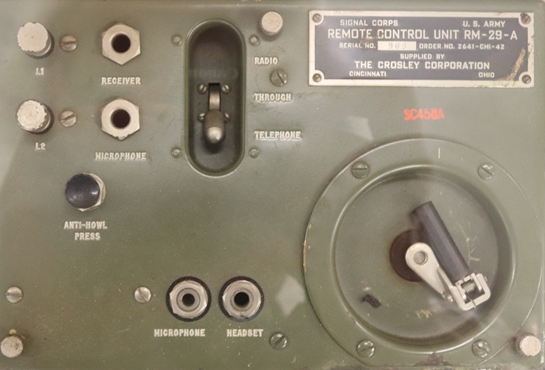
Control panel of Crosley RM-29
The Shure archive holds an operational Crosley RM-29 Remote Control Unit.
Related information: Crosley Corporation in World War Two
Hallicrafters Company, Chicago
Arcana – mysterious or specialized knowledge
Schematic diagram of the RM-29:
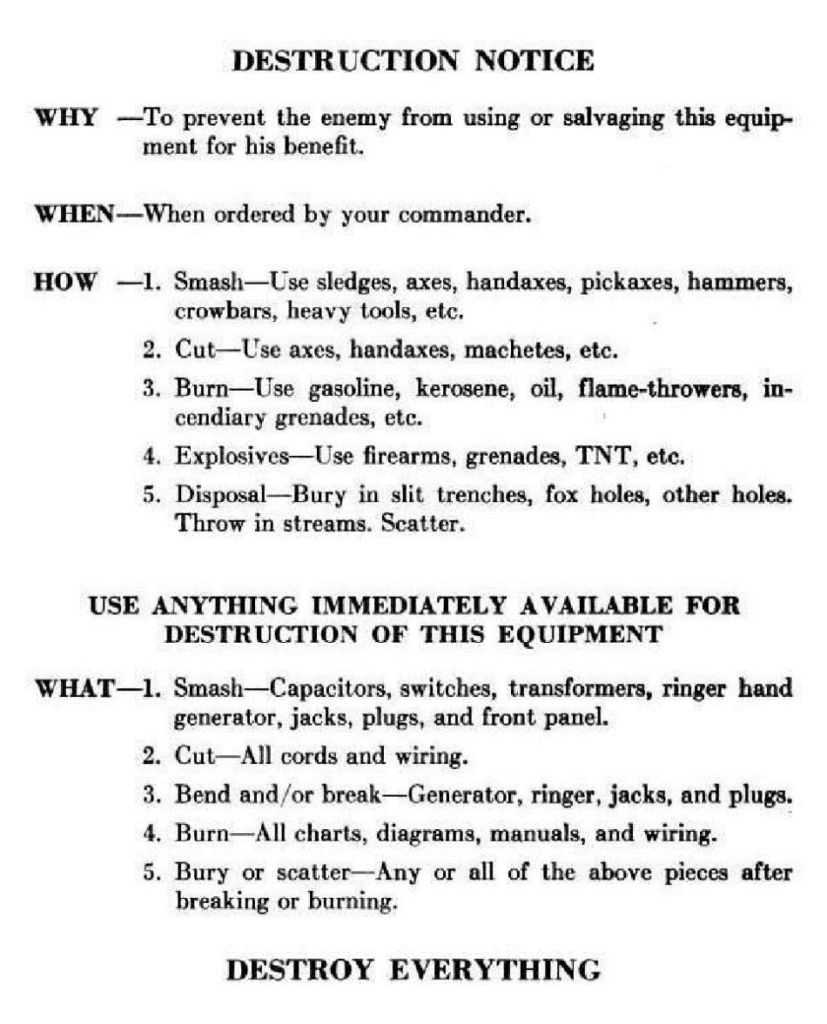
A page from the RM-29 Operational Manual:
***
Some readers may be wondering, “As the T-17-B is a carbon mic, it requires a DC source to operate. Did the RM-29 provide DC power?” Yes it did, from a 4.5 Vdc battery located inside the RM-29.
***
The first design of the T-17-B mic featured an outer housing made of metal. A second design replaced the metal with Bakelite, an early form of plastic. Metal, essential for manufacturing weapons and munitions, was too valuable to be employed for microphone cases. Another attribute of Bakelite was it was cooler to the touch when the microphone was used in the desert of North Africa or in a hot engine room.
***
Each HS-33 headphone set included an over-the-head band, made of metal and leather, to hold the balanced-armature drivers, while the HS-38 model consisted of only the drivers as these were fitted into a leather or cloth helmet.
***
Every HS-33 driver and HS-38 driver was marked “ANB-H1.” ARMY NAVY BRITISH HEADPHONE ONE
The “HS” in HS-33 and in HS-38 stands for “Head Set.”
The “T” in T-17-B stands for “Transmitter.” In a telephone circuit, the transmission [sending] portion begins at the microphone. In early telephones, a microphone was referred to as a transmitter.
***
Kellogg Switchboard & Supply Company was one of the manufacturers supplying the EE-8 field telephone. Kellogg, like Shure Brothers Company, was in Chicago.
