
Category: Tech Topic
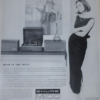
Apps Tech Tip #619: The Tale of Shure M100L Portative Stereo System
Introduced in 1964, the Shure M100L Portative Stereo System consisted of a DUAL model 1009 automatic turntable, a Shure V15 phonograph cartridge, a solid-state [transistorized] preamp/power amplifier, and two “total range loudspeakers.” Controls were Volume, Balance, Treble, Bass, Input Selector for Phono/Tuner/Microphone, and Stereo/Monaural switch. The M100L did not contain an AM/FM tuner, only an input for an external one. The microphone input [an RCA phono jack] was an unusual feature, perhaps meant to encourage the sale of a Shure… -more-
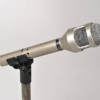
Apps Tech Tip #238: Shure SM53: Precursor to the KSM8
Is the KSM8 the first Shure unidirectional moving coil microphone with controlled/reduced proximity effect? It is not; that honor goes to the Model SM53 introduced in the early 1970s.
Model SM53
Note the “porthole” openings near the XLR connector. By positioning these rear-entry acoustical ports far away from the mic element, proximity effect is reduced. Electro-Voice used a similar principle for its “Variable-D” microphones. Soon after the SM53 was introduced, the model SM54 debuted with the sole difference being a… -more-

Apps Tech Tip #618: The Unisphere Trademark
Our Unisphere trademark dates to the mid-1960s when Shure was defining the appearance, language, and identity of professional vocal microphones. Unisphere was first used April 6, 1966. We then filed for a United States trademark on April 20, 1966; the trademark was registered August 1, 1967. As of June 2026, Unisphere remains registered to Shure Incorporated.
The Unisphere trademark applied to a subset of our Unidyne family of products. Introduced in 1966 like the SM58, Unisphere models featured a ball-shaped… -more-

Apps Tech Tip #617: Own Shure History and Build Roads To It
The title of today’s Tech Tip was written by Mark Brunner, departed friend and colleague, who created the Shure Historian role for your author. This eight-word sentence is my inspiring job description.
“Own Shure History” = make certain Shure history is accurate via thorough ongoing research.
“Build Roads To It” = establish methods to deliver Shure history to all who find it of interest.
One of the many roads is YouTube which hosts videos describing aspects of our history. One… -more-
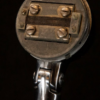
Apps Tech Tip #616: Oh, What A Tangled Web We Weave…
In May 2026, a vintage microphone collector generously donated a rare Model 50C, manufactured in 1940, to the Shure archive. The Model 50 line of “Rocket” microphones employed ribbon elements, though we called them moving conductors.
Model 50 mic & S36 mic stand
The interior of the Model 50 is simplicity defined. There is a metal ribbon (the moving conductor), a magnetic structure, a signal step-up transformer, and an output connector. Not much to fail.
Model 50 ribbon element
Thus, it was… -more-
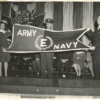
Apps Tech Tip #233: Army-Navy “E” Award – Excellence in Production
Shure’s worldwide reputation for quality and reliability may be traced back to 1940s when we produced communication devices for the Allied Forces. Meeting “Mil-Spec” (Military Specifications) was only the first step to being considered one of the best manufacturers during World War II.
The U.S. Military celebrated outstanding materiel suppliers by the presentation of the Army-Navy “Excellence in Production” awards. Shure Brothers Company won this Army-Navy “E” Award three times.
Magazine ad, 1942
To understand the “E” Award’s historical significance,… -more-
Apps Tech Tip #615: M615AS Analyzer System and SR107 Equalizer – A Dynamic Duo
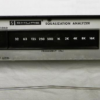
Today’s Tech Tip is the 615th issue. This numeral reminded your author of the long-forgotten Shure device, the M615AS. So, let’s go back in time nearly 50 years…
In 1977, we introduced the M615AS Analyzer System, priced at $515, or $2,950 in 2026 currency. Developed to work in conjunction with our SR107 octave-band equalizer, the Analyzer System consisted of the M615 unit, the ES615 omnidirectional measurement microphone, and a rugged carrying case. According to the User Guide, the M615AS Equalization Analyzer… -more-
Apps Tech Tip #614: Industrial Design of the Unidyne III Model 545/SM57
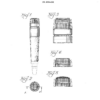
In addition to the utility patents (how a product operates) for the Unidyne III microphone, there was a design patent (the appearance of a product) for our Unidyne III, introduced in 1959 as the Model 545.
Unidyne III design patent, July 1961
Bob Dechamps (day-shaw) created the appearance of the Model 545/SM57. Deschamps was not a Shure employee, but a partner at a product design studio located in a Chicago suburb. He provided industrial designs and architectural designs for Shure… -more-
Apps Tech Tip #613: Why is an A.I. Chatbot named Claude?
Claude is a conversational A.I. chatbot developed by Anthropic. Designed for text-based interactions, it performs tasks like summarization, editing, Q&A, and coding. Claude can maintain context over long conversations, process up to 75,000 words, and analyze uploaded files, such as images and PDFs. Claude is known for its human-like language, though it can occasionally make mistakes, like mere mortals do.
Why name this program “Claude?” To honor Claude Rains? Or perhaps Claude Cat?
Claude Rains and Humphrey Bogart, Casablanca, 1942… -more-
Apps Tech Tip #231: Shure Magazine Ad from 1942
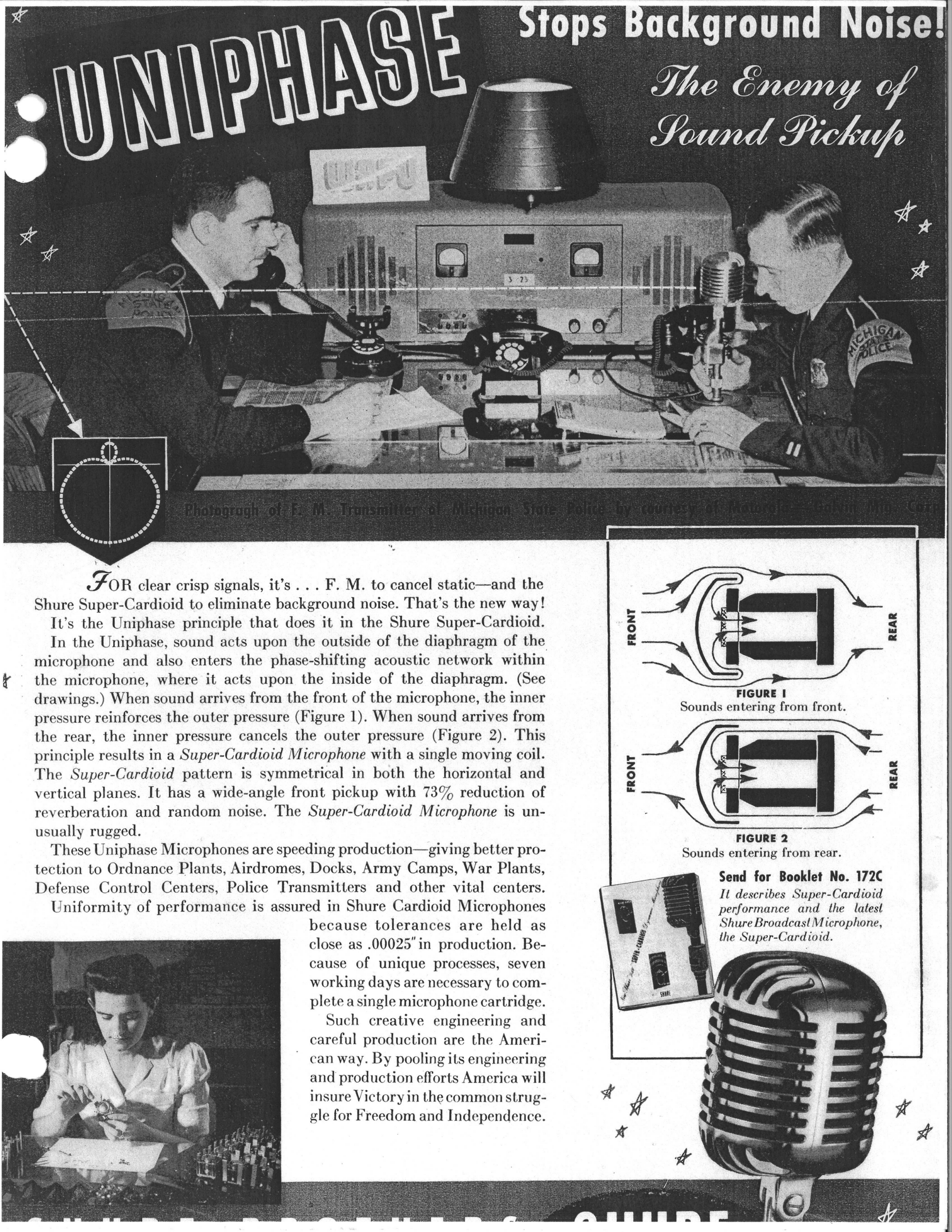
The U.S. entered World War Two in December 1941. The following Shure advertisement debuted in 1942. Of particular interest is this sentence from the ad – “Because of the unique processes, seven working days are necessary to complete a single microphone cartridge.”
Note: Unfortunately, the sole archival copy of this 1942 ad is truncated at the bottom.
Our Unidyne Model 55, introduced in 1939, was the first microphone to have a unidirectional cardioid using only a single moving coil dynamic… -more-