Today’s Tech Tip is the 615th issue. This numeral reminded your author of the long-forgotten Shure device, the M615AS. So, let’s go back in time nearly 50 years…

In 1977, we introduced the M615AS Analyzer System, priced at $515, or $2,950 in 2026 currency. Developed to work in conjunction with our SR107 octave-band equalizer, the Analyzer System consisted of the M615 unit, the ES615 omnidirectional measurement microphone, and a rugged carrying case. According to the User Guide, the M615AS Equalization Analyzer System “permitted rapid and accurate adjustment of the frequency response of a sound reinforcement, monitoring, or playback system.”
The M615 unit provided a pink noise output signal, adjustable in level, via a male XLR connector, a 1/4” phone jack, and an RCA phono jack. The pink noise was sent to the input of the sound reinforcement system, so the noise could be heard through the room loudspeakers. [Pink noise is a test signal with equal energy in each octave band. It sounds like a large choir hissing “Shhhhhh.”]
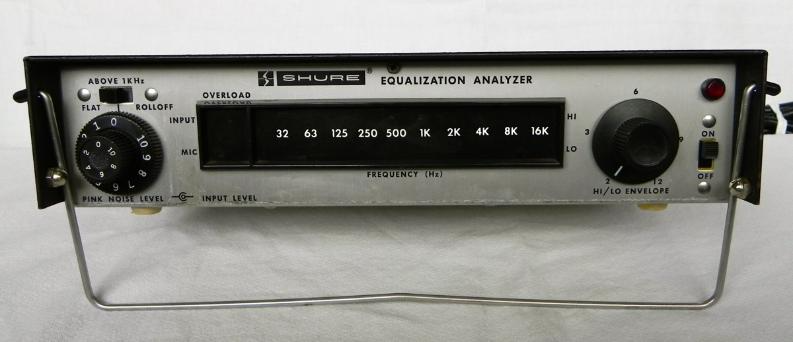
M615 front panel
The ES615 microphone would be placed in a central listening position within the room. The mic picked up the pink noise emitted from the loudspeakers, with the resultant signal returned into the female XLR input of the M615. The M615 then compared the pink noise source to the pink noise returned from the microphone. Differences between the two pink noise signals were caused by the room acoustics and/or the sound system components.
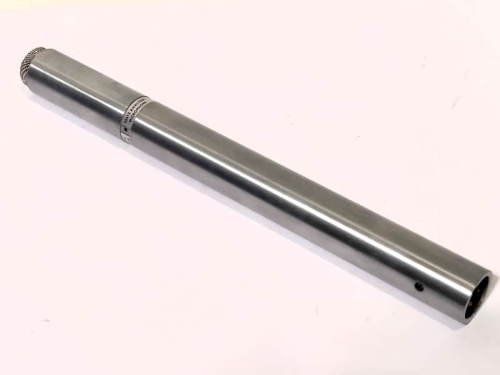
ES615 microphone
The M615 measured the comparative sound energy for each of ten octave bands. The lowest band had a center frequency of 32 Hz, the highest had a center frequency of 16,000 Hz. The ten center frequencies were 32 – 63 – 125 – 250 – 500 – 1,000 – 2,000 – 4,000 – 8,000 – 16,000 Hz. Each center frequency appeared as a white number on the M615 front panel. An excess of sound energy in a band illuminated a red LED above the center frequency number. A lack of sound energy illuminated a red LED below the center frequency number.
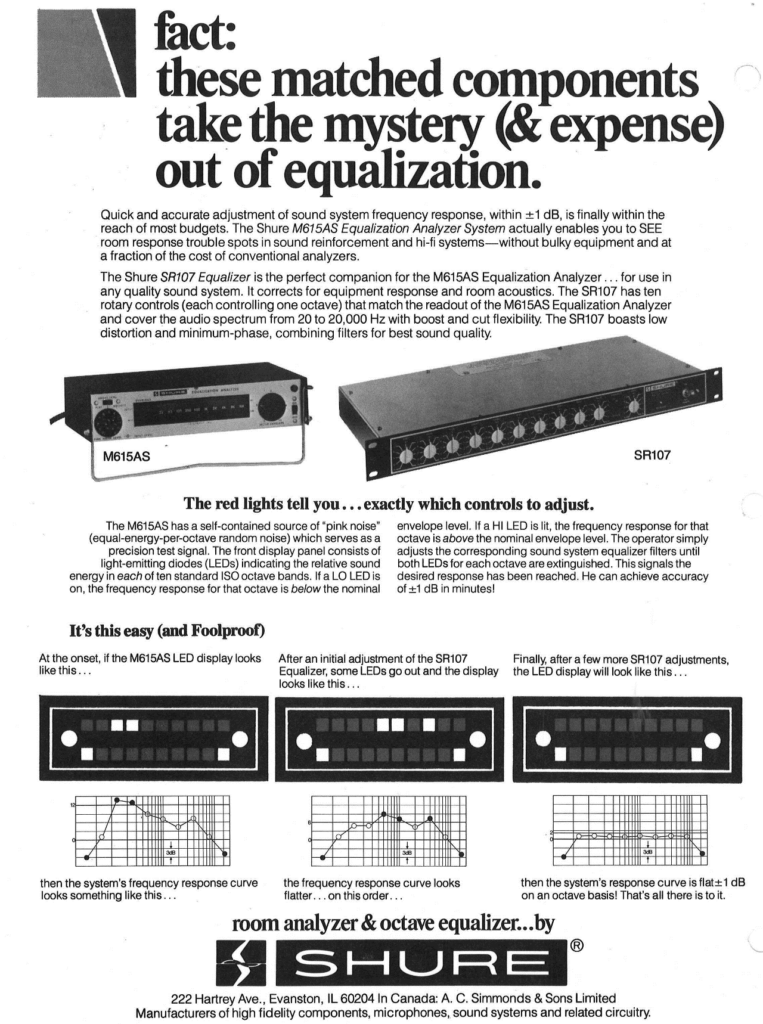
A Shure SR107 equalizer, whose output fed the power amplifier, altered the frequency response of the sound system. The SR107 had ten octave band adjustments matching the M615 octave bands. By judicious adjustment of the equalizer controls, each octave band would be increased/decreased in level until each M615 LED was extinguished, indicating the frequency response of the sound system was then equalized. The following ad explains the process.
Shure discontinued the M615AS in 1983, recycling the M615 concept into the Feedback Finder feature of the PA consoles ProMaster 700 (1979; $990) and ProMaster 706 (1981; $1,190). If acoustic feedback occurred, a string of red LEDs illuminated and stopped above a specific equalizer fader. This provided a visual cue for the sound engineer to adjust the identified fader and stop the feedback.
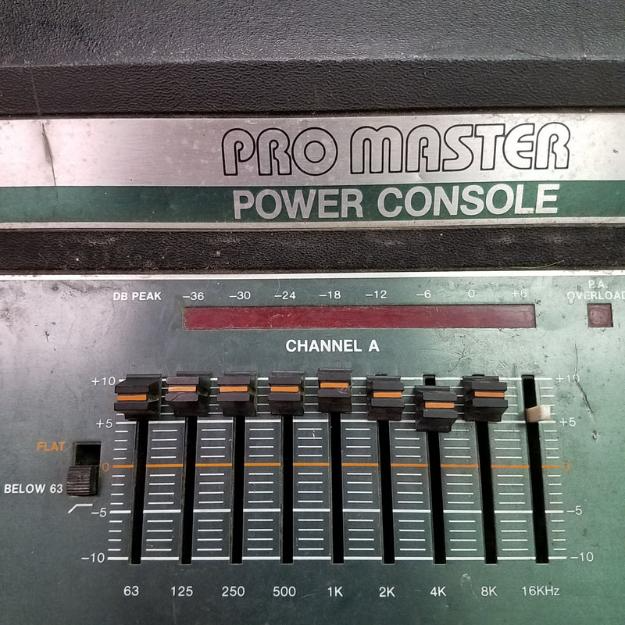
Feedback Finder and graphic equalizer, Shure ProMaster, 1979
Advancements in signal processing brought about Shure Digital Feedback Reducers: the DFR11EQ (1996; $660) and the DFR22 (2003; $999.) Both models automatically provided rapid feedback analysis and resolution.
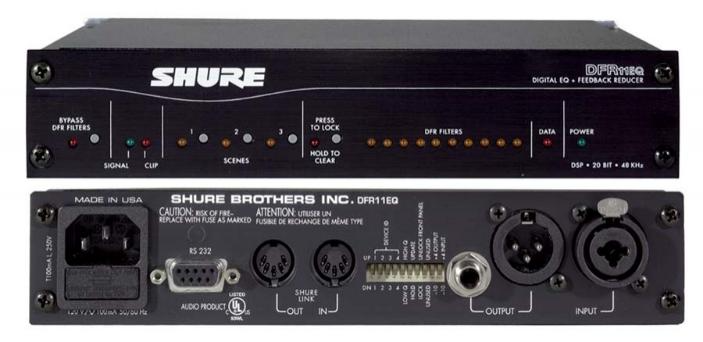
Shure DFR11EQ, 1996

Shure DFR22, 2003
Today in 2026, feedback recognition and reduction is integrated into Shure’s IntelliMix software, but it all began with the M615AS in 1977.
Related information: M615AS User Guide
Apps Tech Tip #285: Sound Reinforcement (SR) Line of Products – Equalizer and Monitor Mixer
Arcana – mysterious or specialized knowledge
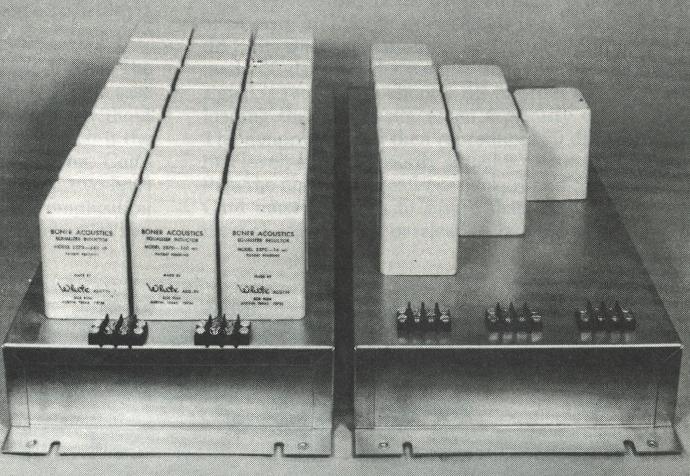
Modern sound system equalization is rooted in the research of acoustical consultant Charles Paul Boner, who pioneered this field in the 1960s. Dr. Boner developed a technique for room equalization and acoustic feedback control by employing passive narrow-band notch filters. He garnered three patents for this process. Dr. Boner also authored the seminal white paper on potential acoustic gain in a sound system, i.e., what level of loudness will a sound system provide before feedback occurs.
AES Equalization Paper by C.P. Boner
The Gain of a Sound System by C.P. Boner
***
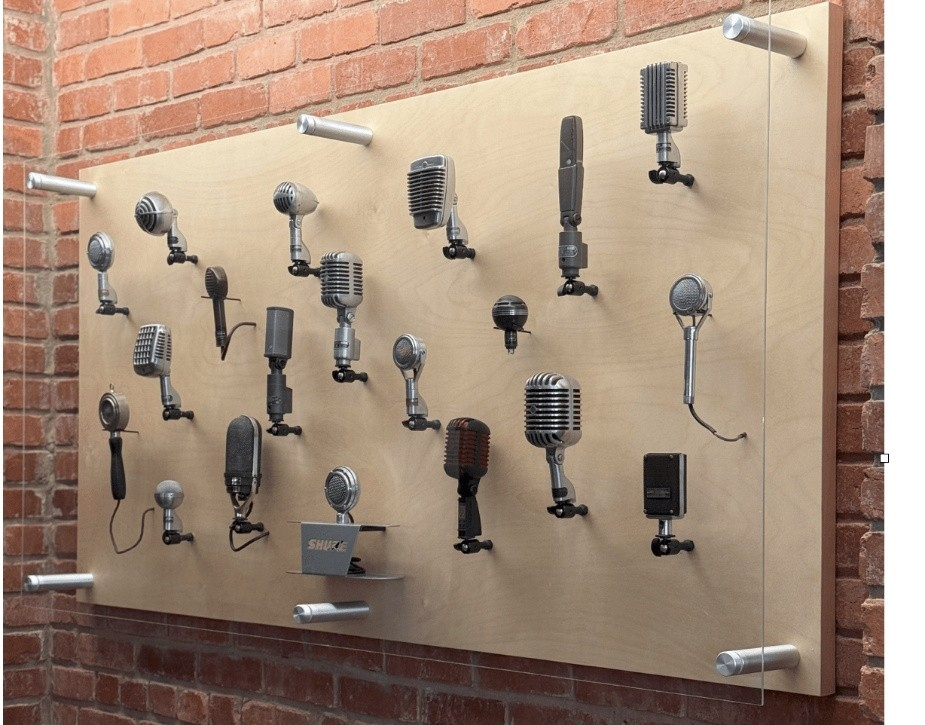
Display of vintage Shure mics in Tulsa, Oklahoma