
Our Unisphere trademark dates to the mid-1960s when Shure was defining the appearance, language, and identity of professional vocal microphones. Unisphere was first used April 6, 1966. We then filed for a United States trademark on April 20, 1966; the trademark was registered August 1, 1967. As of June 2026, Unisphere remains registered to Shure Incorporated.
The Unisphere trademark applied to a subset of our Unidyne family of products. Introduced in 1966 like the SM58, Unisphere models featured a ball-shaped grille with internal foam to attenuate wind noise and P-popping. The Unisphere trademark, though never attached to the SM58, captured this design concept in a single word, i.e., a unidirectional microphone with a spherical grille.
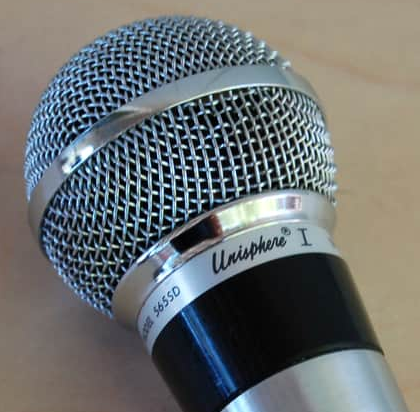
The Model 565 debuted as the Unisphere I. [“I” like the Roman numeral “one;” not the capital letter “I.”] The target markets for the Model 565 were public address and recording in theatres, clubs, convention venues, auditoriums, stadiums, and houses of worship. At that time, Shure Marketing had positioned the SM58 as a handheld interview mic for television and radio reporters. Live sound engineers had yet to discover the SM58.
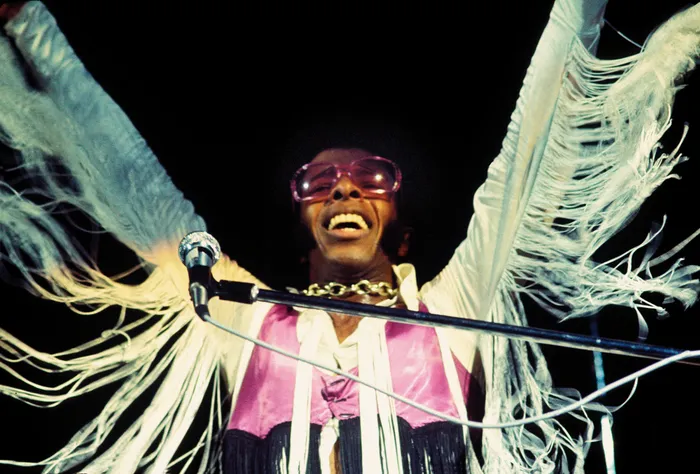
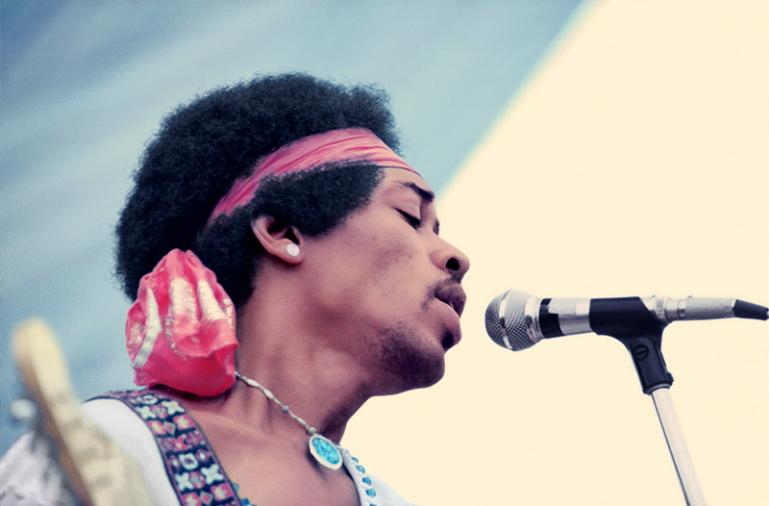
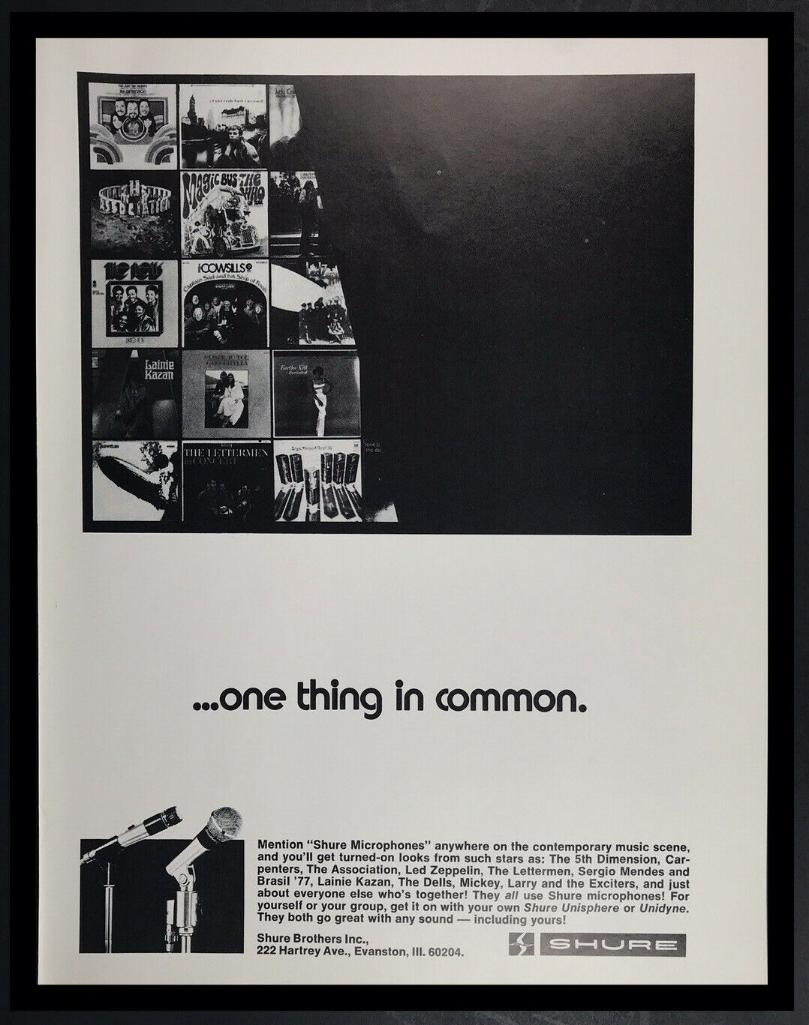
The Woodstock Music Festival of August 1969 assured the Unisphere I its place in music history as the 20+ stage microphones were solely the Model 565 – each modified with a Switchcraft adapter to change the Amphenol female mic connector into a male XLR connector. Because of the exclusive use of the Model 565 at Woodstock, Shure was well-positioned for the rapid emergence of large-scale outdoor rock concerts.
The second member of the Unisphere family was the Unisphere A Model 585. Available as a low-impedance model or a high-impedance model, the Unisphere A was 60% of the Unisphere I retail price, thus bringing the Unisphere line into a lower cost category sold primarily by music stores. Your author’s first Shure microphone was the Model 585SA, purchased from Koster Guitar Center, Rockford, Illinois. By 1969, our Unisphere B models, the 588SA and 588SB, had hit the market.
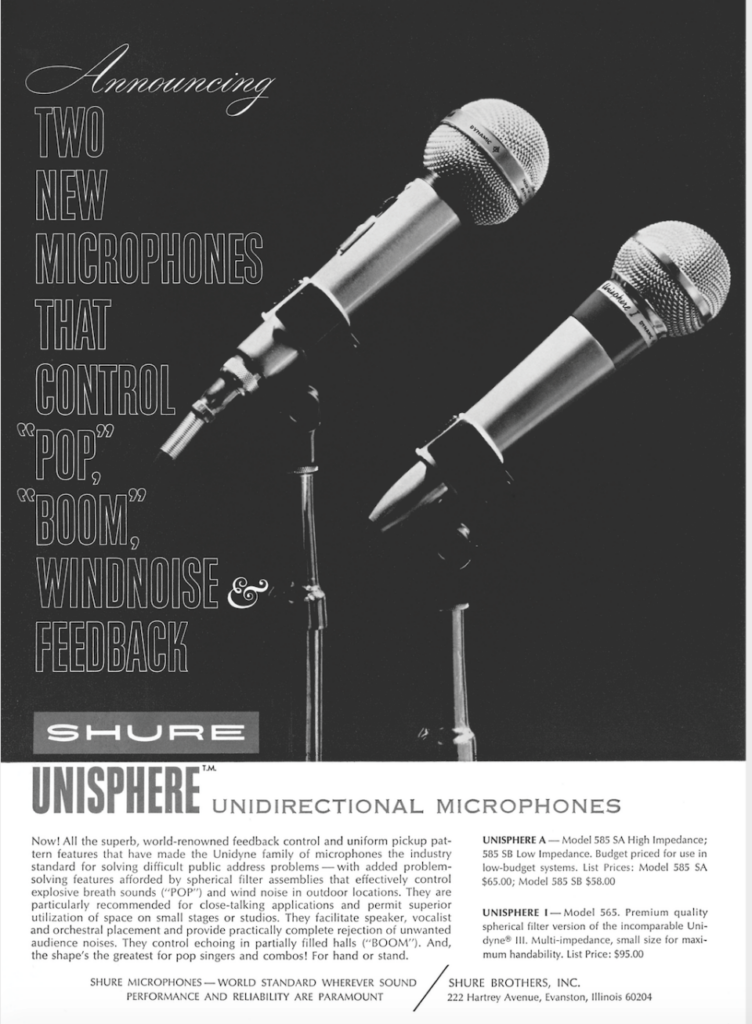
Unisphere joined Shure’s “UNI-lexicon” for key microphone innovations, e.g., Uniphase, Unidyne, Uni-Ron. The word Unisphere implied directionality, spherical grille design, and “UNI-versal” utility for professional applications. The trademark called attention to our moving-coil dynamic microphones having ball-shaped grilles during an era when live sound, public address, and televised performances increasingly wanted rugged mics that could be positioned close to the mouth, resisted feedback, and were attractive on camera.
The Unisphere term delineates a crucial moment in Shure history when our transducer development, industrial design, marketing converged to create the modern handheld vocal mic. Six decades later, Unisphere remains part of our trademark portfolio – a reminder of the Company’s role in shaping the appearance and performance characteristics of professional vocal microphones.
Related information: 1967 Shure catalog
Shure Apps Tech Tip #368: Shure At The Woodstock Music Festival
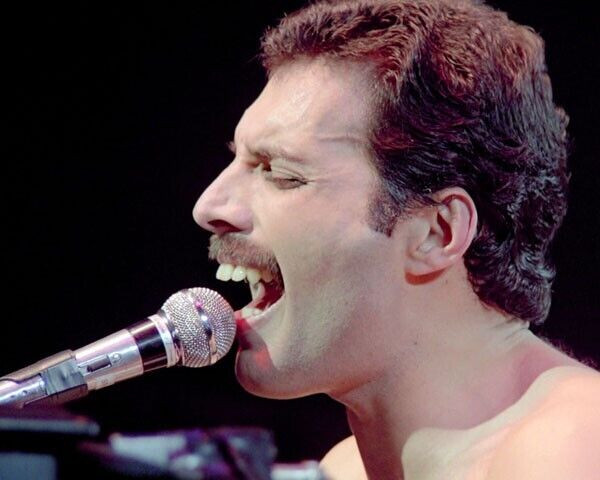
Shure Apps Tech Tip #522: The Saga of Bohemian Rhapsody
Shure Apps Tech Tip #527: Performers Who Declined To Appear At Woodstock
Arcana – mysterious or specialized knowledge
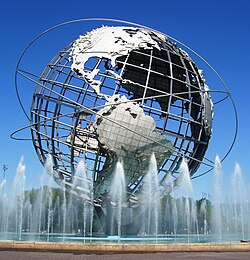
In addition to Shure, other companies have employed Unisphere as a trademark. Dell Incorporated uses Unisphere for cloud and storage systems management. United States Steel Corporation used Unisphere for a metal monument constructed at the 1964 New York World’s Fair. The original trademark for the structure was filed in the 1960s but has expired.
***
The same word can be employed as a trademark in different industries. UNIDYNE, as an example, is also used by Daikin Industries for oil and water repellents applied to textiles, carpets, and non-woven fabrics.
***
The mic element inside the Unisphere I is the Unidyne III.
***
The last of the Unisphere mics, the Model 565SD, was discontinued in 2026.
S = Switch.
D = Dual impedance.
