
Allow me to begin with a statement: Today’s Tech Tip is purely hypothesis, created to explain why “55” was used as the model number for the Unidyne microphone introduced in 1939. I encourage readers to poke holes in this hypothesis with facts I may have overlooked.
One of the questions most frequently asked of the Shure Corporate Historian (me) is: Why was 55 used as the Unidyne model number?
The candid answer is – I don’t know. I’ve never found the reason in archived documents, including the lab notebooks of Ben Bauer, inventor of the Unidyne. Foolishly, I never asked Mr. Shure or Mrs. Shure. However, I do have a plausible theory based on research into microphones from the 1930s. In the following paragraphs, note the double digits of each model number referenced.
In 1932, Shure debuts the Model 44 condenser mic ($250). This model number was likely inspired by the RCA Model 44 ribbon mic ($125) from 1931 – a microphone that quickly gained popularity in radio and recording studios.
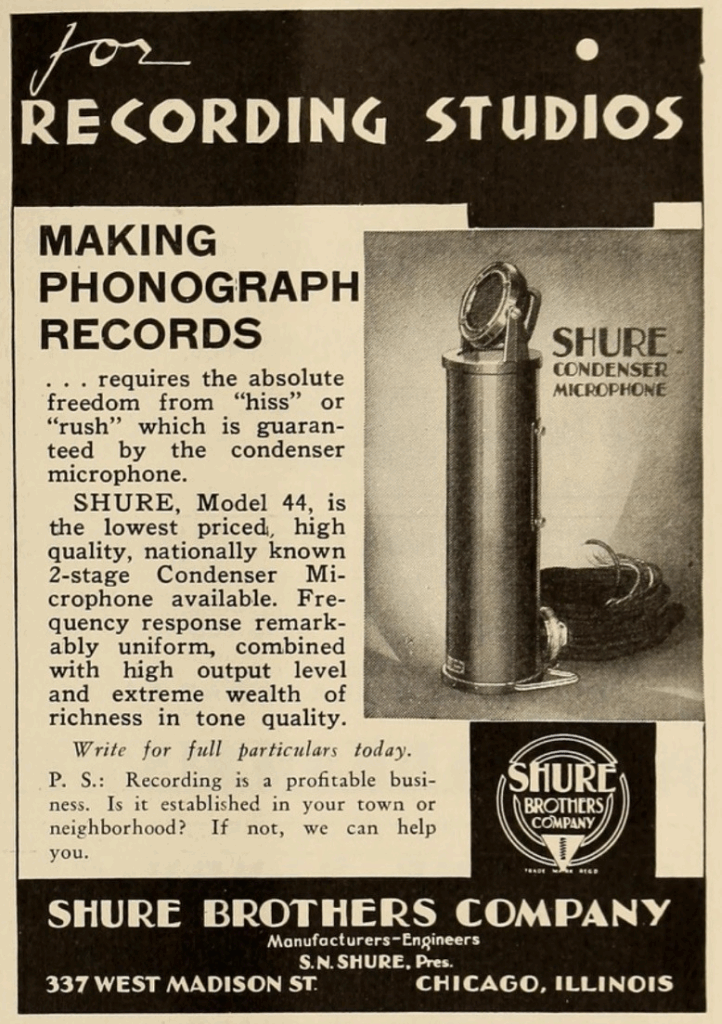
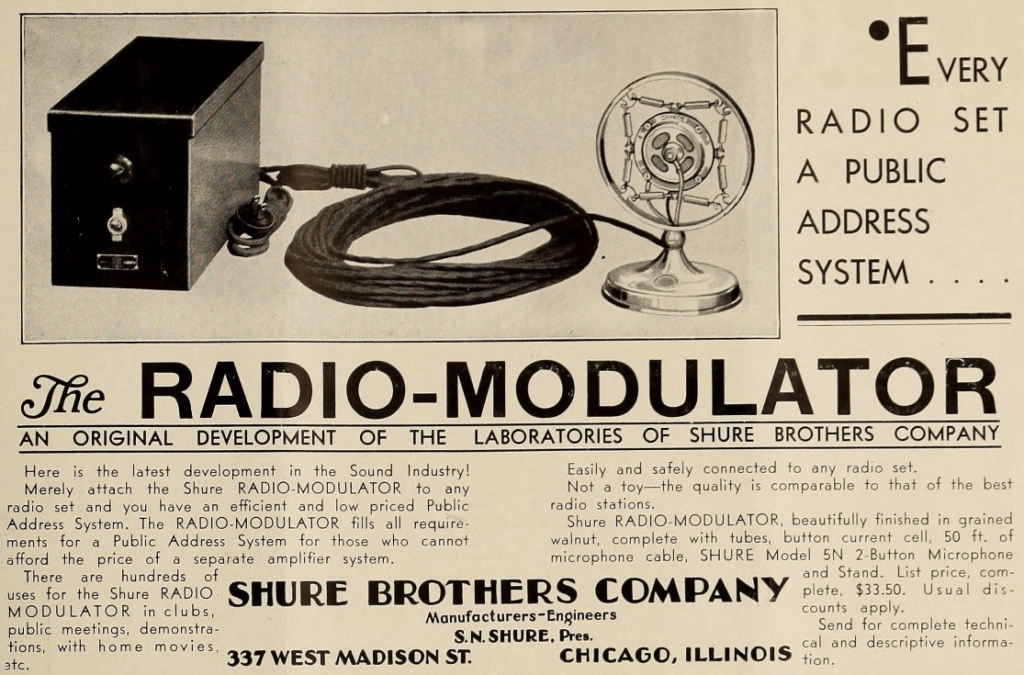
In 1933, Shure introduces the Model 11N carbon mic ($15), the Model 22N carbon mic ($25), and the Model 33N carbon mic ($50). Our Model 99 Radio Modulator also was introduced that year.
In 1936, Shure premieres the Model 77D crystal mic ($150).
In 1938, we debut the Model 66 Stethophone ($35) and we recycle 99 for a new $12 phonograph tonearm.
In 1939, the nascent Unidyne needs a model number. Perhaps for a long-forgotten marketing reason, a double-digit model number is desired. However, these model numbers are already taken: 11, 22, 33, 44, 66, 77, 99.
That left only 55 or 88.
What looks and sounds better – Unidyne Model 55 or Unidyne Model 88? Maybe Mr. Shure opined, “I like the sound of fifty-five.” Or maybe Ben Bauer rejected 88 as this number might have misled the customer into thinking the Unidyne had a figure-8 (bidirectional) pattern. Whatever the rationale, the decision was made to go with 55 for the Unidyne, while the number 88 remained unused until 1953 when it was assigned to our Vagabond wireless microphone system.
From the Unidyne Model 55 sprouts the Unidyne II 55S (1951), then the Unidyne III SM56 (1964), Unidyne III SM57 (1965), Unidyne III SM58 (1966), und so weiter.
In the 1930s, were double-digit model numbers the cat’s pajamas? Again, I don’t know. But if double-digits were the rage, we found ourselves painted into the proverbial corner in 1939 with only 55 or 88 as choices for the revolutionary Unidyne microphone.
Was 55 or 88 the better choice? What’s your opinion?
Related information: Vintage Shure catalogs
History of the Shure Unidyne microphone
Arcana – mysterious or specialized knowledge
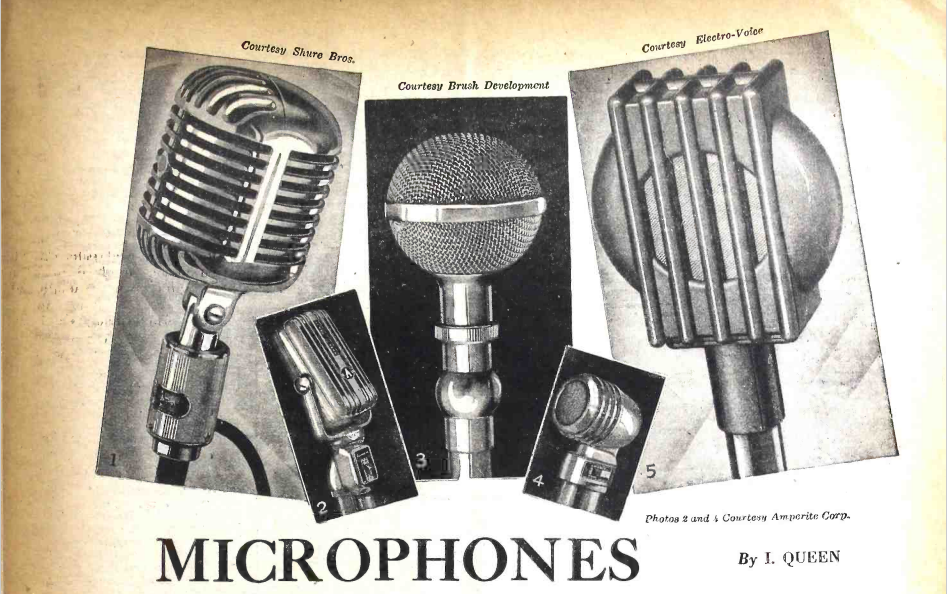
From a 1944 article in Radio-Craft magazine: Microphones are now in wide used by the public and find application in connection with recording, home movies and small group entertainment. In the post-war period we may expect an enormous increase in microphone applications for home, intercommunication, and small group use.
***
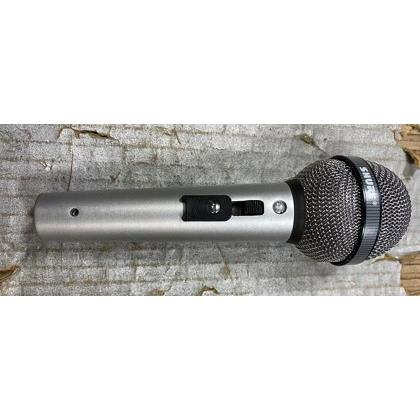
For Tech Tip #586, let’s look back at the Unisphere A Model 586 microphone. Introduced in 1982, the mic carried a $91.50 user net price; $310 in 2025 currency. The 586 series replaced the 585 series, but when comparing the two models, your author cannot find a single significant difference – except the updated Shure logo. Seems strange to create a new model number for a logo change…
***
The biopic A Complete Unknown documents Bob Dylan’s rise to fame in the 1960s. Before filming commenced, lead actor Timothée Chalamet made studio recordings of every song scheduled for the movie. Was his studio vocal mic a vintage German mic? Sorry, Neumann….it was a Shure SM7.

***
Here is a link to a 13-minute audio segment that aired May 24, 2025, on CBC Newfoundland Radio. It came about after Canadian Broadcasting Corporation producer Melisa Tobin viewed an Instragram video featuring Shure archivist Julie Snyder. Julie told of how an abused SM58 microphone found on a Canadian highway in 2005 made its way to the Shure archive in Niles, Illinois. Intrigued by the tale, Melisa contacted Shure to obtain the rest of the story. CBC Radio story about a damaged SM58.
-Michael Pettersen
