
Starting in 1937, Shure advanced concepts that shaped the direction, curve, tilt, and angle of phonograph “record reproducer” design. In an article titled “A Record-Saving Pickup,” printed in the February 1937 issue of Electronics magazine, Shure Chief Engineer Ralph Glover discussed the importance of record wear in the design of a pickup. “Design…in the past seems to have been based on frequency response and output voltage requirements. The amount of wear on the record, however, is a highly important consideration.… For low record wear, the needle pressure and needle impedance should be low, and the horizontal projection of the needle should be tangent to the record groove at all times.”
The challenge to control record wear would become central to the design of phonograph cartridges for decades to come, and Shure was a leader in introducing designs that minimized record wear while improving sound reproduction. In the Electronics article, Mr. Glover acknowledged the assistance of a fellow Shure engineer, Ben Baumzweiger (who later changed his name to Ben Bauer), for his development of the “needle-tilt” principle, another important Shure engineering concept that shaped phonograph cartridge design.
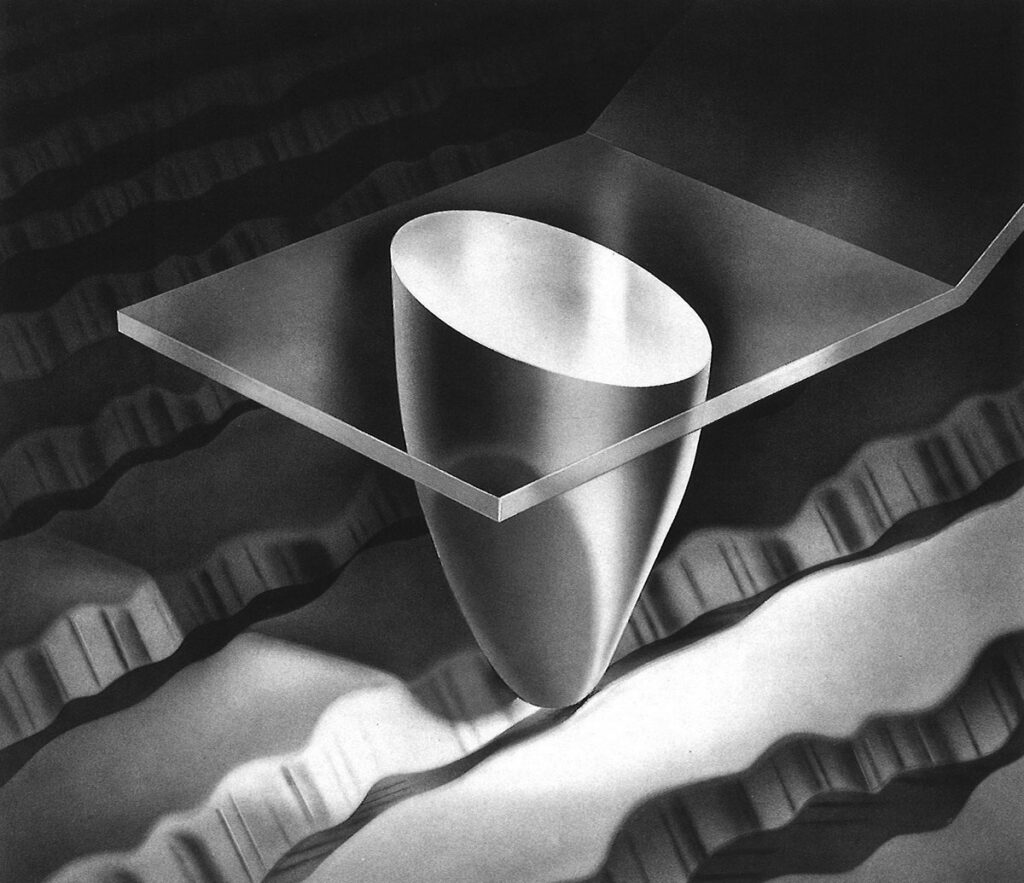
Nearly 30 years later, another Shure engineer advanced an issue that was critical to the evolution of cartridge design. In a research paper titled “TRACKability,” published in Audio magazine in November 1966, Jim Kogen, then Chief Engineer, Research and Development, wrote: “The word ‘subtle’ has proved to be a relative one in the history of high-fidelity reproduction. There have been times when many in the hi-fi community were certain that we had reached the ultimate. Each time the subtle difference changed to an obvious difference when better equipment came along.”
According to Mr. Kogen: “A phonograph cartridge with good trackability will follow the modulation in the groove, no matter how wild the undulation. A phonograph stylus with poor trackability will lose contact with the record and, therefore, be unable to perform its function.”
With “trackability,” Shure defined a new standard for performance, and Shure created the first generation of cartridges that was “always in the groove.”
