I can envision the puzzlement of many readers. “How can this be? A microphone emits a mic level signal, not a line level signal. Besides, why make such a device? Who needs a mic that emits a line level signal?”
First, a quick review. A mic-level signal is around 1 millivolt = 0.001 volt = -60 dbV. A line-level signal is 1,000 times greater, or around 1,000 millivolts = 1 volt = 0 dbV. There is a nominal 60 dB difference between mic level and line level. An input circuit designed to accept a mic level signal distorts severely if fed by a line level signal. Conversely, feeding a mic level signal into a line level input produces a barely audible signal.
When Shure introduce the unidirectional SM82 line level microphone for broadcasting in late 1974, it truly was a breakthrough. With the SM82, audio, direct from the microphone, could be sent from the field to the radio/television station via a telephone line. To do so, the SM82 emitted a line level signal (line level to drive the telephone line) with the proper 600-ohm impedance to satisfy the phone circuit. The mic featured an internal power source, a 9.8V battery that looked like an AA cell, and a built-in limiter to prevent overloading the phone line. In essence, the SM82 was a miniature broadcast studio that a reporter could hold in her hand.
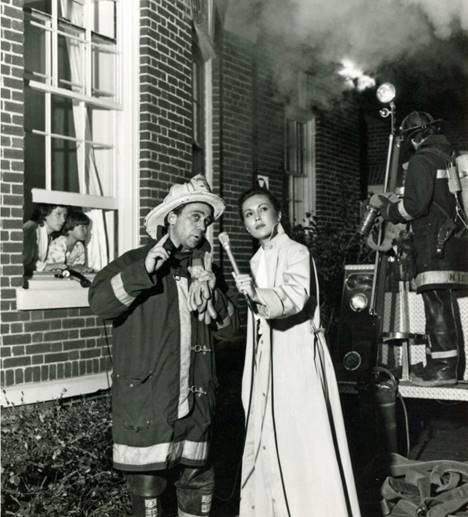
In 2018, it is extremely rare for a broadcast engineer to employ a twisted-pair of telephone wires to carry an audio signal from point A to point B. However, from the 1920s to the 1990s, telephones wires were an essential highway for broadcast audio. Bell Telephone (Ma Bell), later AT&T, made millions of dollars annually by leasing telephone circuits to radio and television stations. Engineers called this type of broadcast-phone circuit a “dry pair” because the central telephone office did not place voltage/power on the wires. When a telephone circuit did carry voltage/power to operate the handset, or to ring the handset, it was a “wet pair.”
Inside the SM82 were multiple “firsts” for a Shure product: 1) first electret condenser mic element; 2) first onboard mic circuit using germanium transistors, 3) first male XLR connector with a power on/off feature – when a cable was connected, pin 1 pushed inward to switch the battery to “on.”
A 1974 Shure white paper stated, “A high-quality unidirectional line-level microphone for broadcast applications consists of an electret condenser transducer, a line-level amplifier, a peak limiter, and a rugged stainless steel housing to ensure stable operation over a wide range of temperature and humidity. Applications include single-channel remote broadcasts over dialed-up or rented telephone lines, long distance signal runs over unshielded cables, and applications where “gain riding” by a sound engineer would be impractical. The microphone is powered by means of an internal battery or by phantom (simplex) power over the microphone interconnecting cable.”
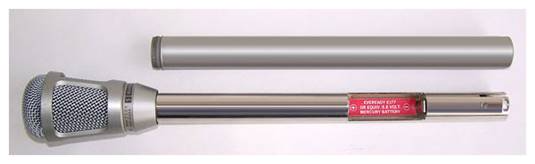
Handle removed to show battery compartment
At its 1974 introduction, the SM82 U.S. retail price was $175 = $930 in 2018 dollars; at its discontinuation in 1989, it was $410. The SM82 never sold in large quantity. A broadcast station only required one or two units as the SM82 was a specialized tool. Extremely durable, the same SM82 units appeared repeatedly on TV at sporting events and at breaking news stories. This gave competitors the impression that Shure sold thousands of SM82 mics annually. This was not the case. When Electro-Voice learned of the SM82 demise in 1989, they quickly swooped in with a newly developed line level microphone to fill this enormously profitable sales void. Boy, were they in for a surprise…
Related information:
Arcana – mysterious or specialized knowledge
Germanium is an element. Its symbol is Ge and has an atomic number 32. Germanium is a lustrous, hard, grayish-white metalloid in the carbon group. Chemically, it is similar to its periodic table neighbors of tin and silicon. Unlike tin, pure germanium is a semiconductor like silicon.

Plura Arcana
Eighty years ago, on Sunday night, March 13, 1938, after Adolf Hitler’s Germany had annexed Austria in the Anschluss, CBS newsman Robert Trout hosted a shortwave “roundup” of reaction from multiple cities in Europe—the first such multi-point live broadcast on network radio. The special gave Trout the distinction of being one of broadcasting’s first true “anchormen”, in the sense of handing off the airwaves to someone else as if it were a relay race baton. It became the inspiration for the CBS World News Roundup, which began later in 1938, and to this day airs each weekday morning and evening on the CBS Radio Network.