
In the 1930s, manufacturers began connecting the cable to the microphone, so that the consumer could use the unit right out of the box. This was one of the early innovations in microphone technology. More than 50 years later, history reversed course, and wireless microphones began appearing on store shelves without cables again.
The first modern wireless microphone system designed and manufactured entirely by Shure was the L Series, which debuted in 1990. This series used the VHF (Very High Frequency) radio band and featured Shure’s proprietary MARCAD diversity circuitry. MARCAD minimizes “dropout” and extraneous noise. It improves operating range by combining audio signals from two independent receiver signals. Another distinct advantage was using the famous SM58 and SM87 Microphone heads.
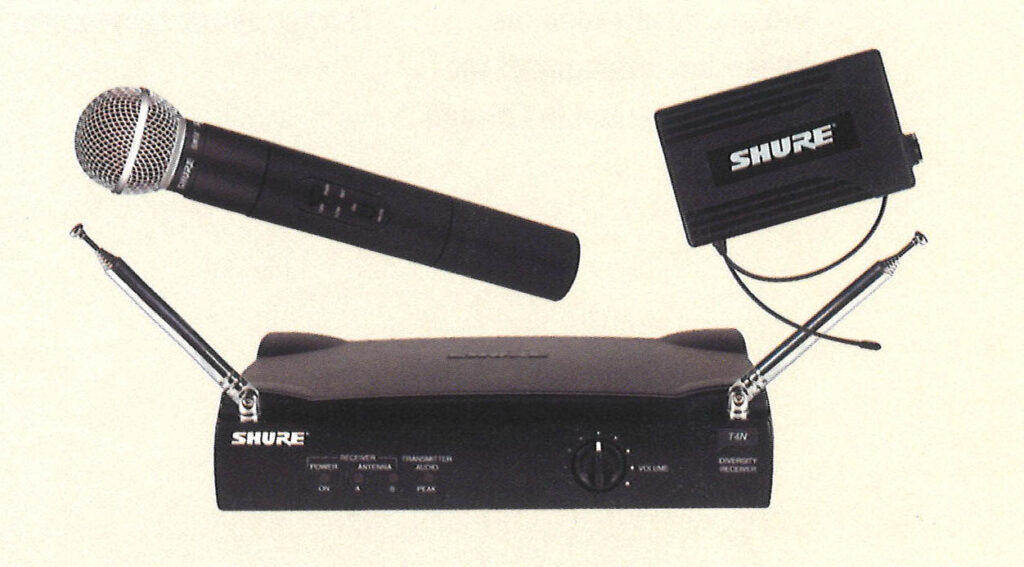
By offering superior performance and legendary reliability at a competitive price, L Series Wireless Microphone Systems became popular among musicians and sound system installers, establishing Shure as a leader in the fast growing wireless microphone market.
High-profile debut in Europe
Then Shure took wireless microphones overseas with a new system that met the stringent radio frequency standards of European government regulations. The EC Wireless Microphone Series made its official debut in 1993, but the system appeared on European stages months earlier, during Michael Jackson’s 1992 Dangerous tour.
Mr. Jackson’s sound team tested EC prototypes in June 1992. His experts determined that it was the only wireless microphone system that would work properly in the complex stage environment designed for the tour, which included steel and aluminum scaffolding, moving performance areas, and highly reflective surfaces. To have the products available for the first tour date, Shure manufactured eight custom-made EC Systems in seven days, in Wheeling and El Paso, and the Artist Relations Manager personally delivered the equipment.
Shure expanded its line by introducing three VHF systems in 1994 and 1995: the T Series, aimed at entry-level markets; the VP Series, targeted to semi-professional videographers; and the LX Series, a next-generation L Series that was smaller and delivered better performance.
Configuring new production solutions
The demands of providing wireless microphone systems with a multitude of configurations for different frequencies throughout the United States and other parts of the world put a strain on Shure’s production schedule. By 1996 the Company was offering so many product configurations that it was difficult to maintain an inventory to meet the variety of customer requirements. The solution, developed through the Total Quality program, was to “build to order” rather than “build to inventory.” This required rearranging
manufacturing facilities, from handling raw materials to the flow of production. The results were right on target, enabling the Company to continue to expand its wireless microphone line and meet customer needs.

In 1997, Shure made its first entry into the UHF (Ultra High Frequency) market with its UHF Series. With almost 200 adjustable frequencies, the UHF Series is ideal for use in areas where the VHF range is cluttered with signals from broadcast stations and mobile communications of all kinds. Another important feature is a patented “Wireless Electronic Power Defeat,” which can lock or “defeat” the power switch, so that it cannot accidentally be turned off during a performance.
The UHF Wireless Microphone System could also be controlled by computer, demonstrating Shure’s capability in integrating circuitry products and computer software. These advantages made the UHF Series popular with prominent personalities such as Jay Leno, Wynonna, Buddy Guy, Jenny Jones, and David Letterman. The system also opened opportunities in Japan, where all wireless products are required to operate in the UHF band.

In 1998, AV/Video Magazine honored the UHF Wireless Microphone Series with its Platinum Award for Outstanding Achievement in the microphone category during the National Association of Broadcasters Convention in Las Vegas, Nevada.
Another leap forward in wireless microphone system technology came in 2000 with the UP Series, which incorporated the Company’s patented Predictive Diversity technology. Then, at the end of 2001, Shure started shipping the groundbreaking ULX Wireless Microphone System. This system features Automatic Frequency Selection, a technology that automatically selects the right frequency in any environment. As opposed to other wireless microphone systems, which are preconfigured for a specific environment, ULX Systems can be moved from city to city and operate effectively in areas where the radio frequency spectrum is crowded.
The ULX is the culmination of Shure’s experience in modern wireless microphone technology. This is the first system to truly match the audio performance of wired microphones. It is interesting to note that after the long era when only wired microphones encumbered by cables were available, wireless microphone
systems have returned to the mobility of the first sound reinforcement—the megaphone.
