
2026 is the 60th anniversary of the Unidyne III SM58. A Unidyne III microphone element is also in our SM57 and SM7B. This is the first of a three-part series.
The revolutionary Unidyne III diaphragm, developed by Shure engineer Ernie Seeler, was patented in 1964 – U.S. patent number 3,132,713. A patent can be difficult to understand as the language is part legal and part scientific. Also, the same invention feature is often described multiple times using slightly different words to broaden the patent. Let’s simplify the important parts of the Unidyne III microphone diaphragm patent.
Here is the first paragraph: “The present invention relates to a microphone diaphragm and, more particularly, to a diaphragm which has uniform deflection characteristics over a wide frequency range without ‘break-up’ and without rocking the diaphragm.”
In other words, the Unidyne III diaphragm moves [deflects] in a consistent manner, no matter the incoming audio frequency – bass, mid, treble. It moves uniformly – all diaphragm sections move as one piece; it does not “break-up” with one section moving more, or less, than another section. It does not “rock” the voice coil side to side; the voice coil moves only up and down.
A top view of the diaphragm taken from the patent:
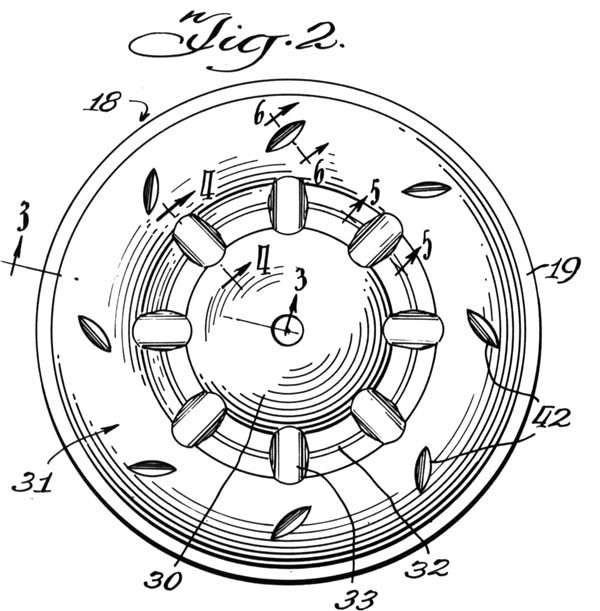
The diaphragm is the size of a U.S. quarter dollar [24 mm]. Viewed edgewise, it looks like a doughnut, sliced in half, with a raised dome in place of the doughnut hole. For New York readers, it looks like a sliced bagel. The raised dome is #30 in the diagram. The outer ring of the bagel is #31. The flat edge of the outer circumference #19, is glued to the microphone structure allowing the diaphragm to bounce [deflect] like a tiny trampoline.
Molded into the outer ring of diaphragm are thirty-one wedged-shaped depressions #42. These add rigidity to the outer ring. Why thirty-one wedges? Thirty-one is a prime number. Development engineer Ernie Seeler understood that a prime number, which can only be divided by one or by itself, reduces asymmetric modes, i.e., when the diaphragm does not vibrate as a unified whole.
Note the eight spokes #33, which radiate out from the diaphragm center #3. Each spoke is a short tunnel between the inner dome and the outer ring providing a path for air movement behind the diaphragm and above the voice coil. Joining the air spaces behind the diaphragm improves the unidirectional pattern.
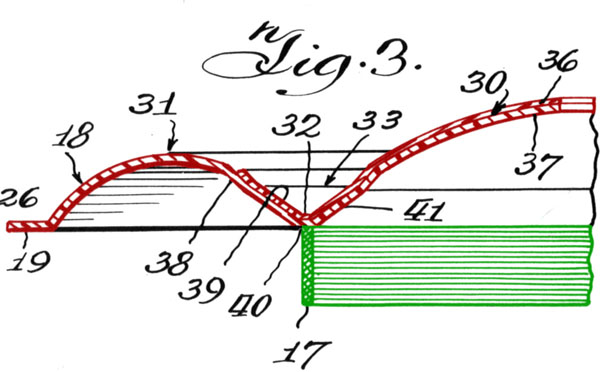
Mylar plastic is used for the Unidyne III diaphragm because of its relative stiffness, low mass, and tensile strength. Mylar is tough and easily fabricated into the desired shape using heat. The voice coil is adhered to the diaphragm where there is maximum rigidity; this is the circle #32. Below is a cross-section view of the diaphragm assembly illustrating the outer ring #31 and the inner dome #30. The voice coil is #17. The horizontal green lines indicate the Alnico magnet.
The multiple steps to fabricate a Unidyne III diaphragm are trade secrets.
And you thought it was just a thin piece of molded plastic…
Related information: Unidyne III Patents
Bruce Dickinson of Iron Maiden compliments the SM58
In the link above, start at time 1:39:15
Arcana – mysterious or specialized knowledge
Mylar is often used generically to mean polyester film or sheet plastic. However, Mylar is a registered trademark, owned by DuPont, for a specific family of plastic products made from the resin Polyethylene Terephthalate. Mylar is ideally suited for packaging, printing, die-cutting, electronics, protective overlay, barrier protection, and, thankfully, microphone diaphragms.
Here is a 24-minute film from 1955 about DuPont Mylar.

***
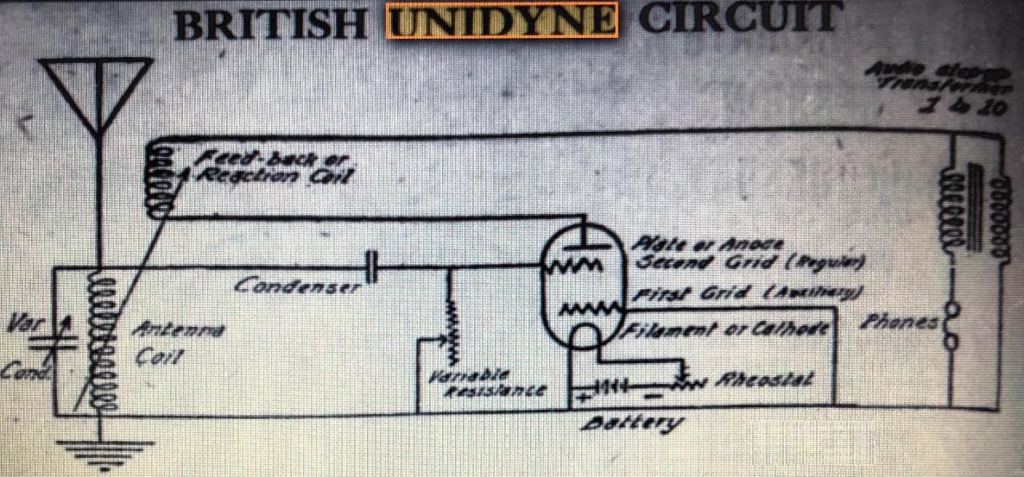
What is the inspiration for the Unidyne name? Perhaps from a British radio circuit developed in the early 1920s. Remember, our initial business name was Shure Radio Company.
***
Trivia Quiz
What was the first Shure model to feature the Unidyne III element? In what year was this model introduced?
Answers: Model 545 in 1959
