
2026 is the 60th anniversary of the Unidyne III SM58. A Unidyne III microphone element is also in our SM57 and SM7B. This is the second of a three-part series.
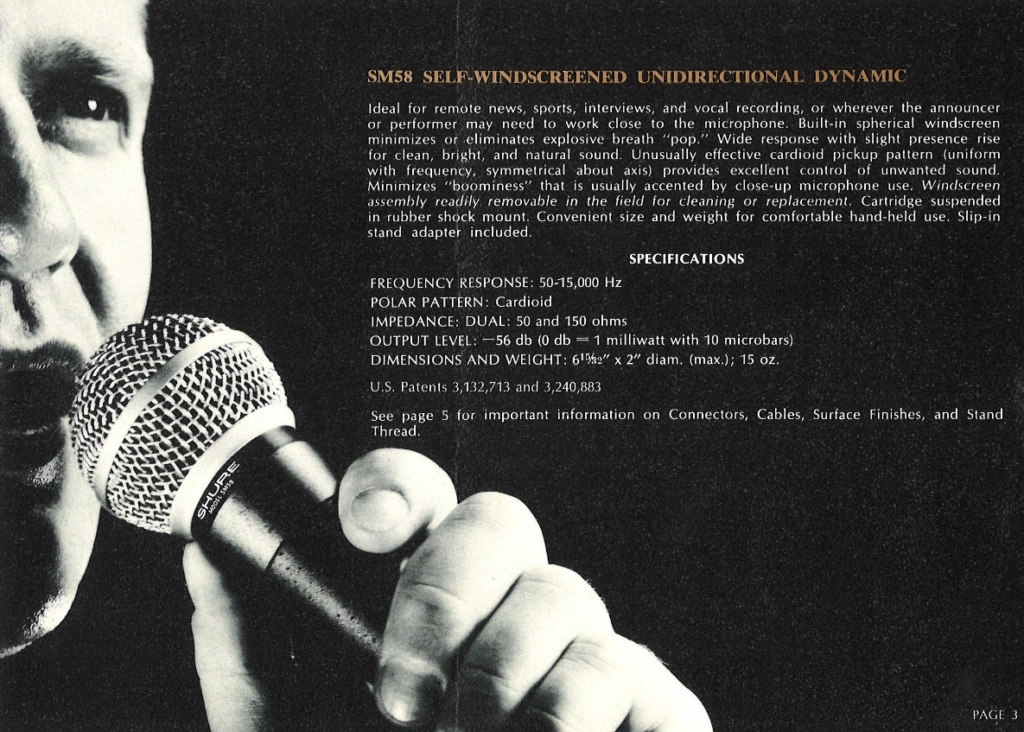
When Shure engineers Ernie Seeler and Ben Bauer began developing the Unidyne III in 1956, they created a list of practical improvements over the popular Unidyne II Model 55S. This “new microphone for public address” would have these features:
- Small size to be unobtrusive
- Suitable frequency response
- High resistance to plosives [P-popping]
- Unidirectional cardioid pattern
- Uniform polar pattern at all frequencies to reduce acoustic feedback
- Uniform polar pattern of rotational symmetry along the major axis of the mic, so that positioning of the microphone, in relation to the loudspeaker, is less critical
- Stable acoustic phase shift network to ensure reliable performance throughout the lifetime of the microphone.
- Low sensitivity to mechanical noise and vibration
- Low impedance output and high impedance output
Quite a challenge. The task became tougher for Seeler when Bauer, inventor of the Unidyne I and Unidyne II, left Shure in 1957 to work at CBS Laboratories. But Ernie met the challenge and exceeded all expectations with our Unidyne III.
The first Unidyne III microphone was the Model 545 introduced in 1959. Shure filed the Unidyne III patent in May 1961; it was granted in March 1966 as U.S. Patent 3,240,883. The sole inventor listed is Charles Ernest Seeler.
The first paragraph of the Unidyne III patent is: The present invention relates to a microphone structure and more particularly to a new and improved microphone having unidirectional properties. Nothing earth-shaking in this statement. In fact, it could be the first paragraph of many microphone patents. Further on, it becomes more interesting: This invention provides for uniform polar response over substantially the entire audio spectrum. Acoustic feedback at frequencies normally favored by the mechanical properties of a microphone is avoided. The polar pattern is rotationally symmetrical about the major axis of the microphone. The phrase “is avoided” should have been replaced by “is substantially reduced.” It is apparent that the Shure patent attorney was aiming high.
Below is a cutaway illustration of the Unidyne III transducer [mic element/cartridge] from the U.S. patent. Refer to the list above as the transducer design affects Features 1 – 7. Features 8 and 9 will be the focus of the next Tech Tip.
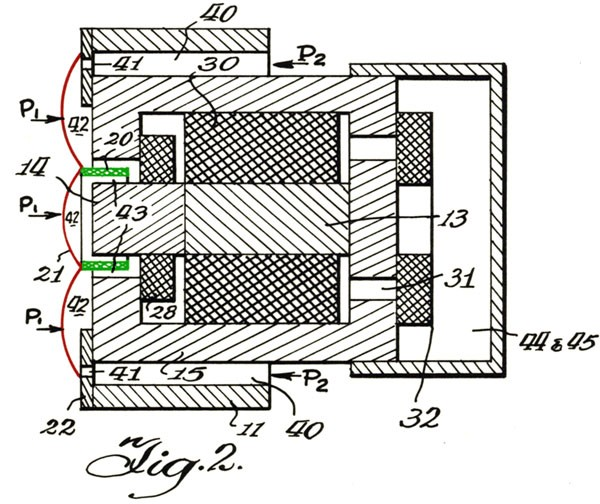
Using the above illustration, let’s summarize the transducer design as claimed in the patent:
At one end, the microphone has a diaphragm #21 with an attached voice coil #20. The voice coil sits within a magnetic field provided by permanent magnet #13. The primary acoustic path #P1 to the diaphragm is through the perforated metal grill screen [not shown] at the front of the microphone.
The secondary acoustic path #P2 leads to the rear of the diaphragm; this path is necessary for the microphone to have a unidirectional pattern. The path leads through acoustic chamber #40, into acoustic aperture [hole] #41, and into acoustic chamber #42 directly behind the diaphragm.
There are four P2 paths in the Unidyne III transducer, separated by 90 degrees, arranged symmetrically around the diaphragm center. The distance from the P2 openings to the diaphragm is less than 2 mm.
When a sound wave approaches from the rear, it enters the four P2 openings. The sound wave attempts to push the diaphragm outward – to the left in the drawing. The sound wave continues onward to the front of the microphone and attempts to push the diaphragm inward – to the right in the drawing. As the P2 openings are separated by only 2 mm from the diaphragm, the pushing on both sides occurs essentially at the same time, and the diaphragm barely moves. How long does it take a sound wave to travel 2 mm at 70 degrees Fahrenheit? A mere 0.06 millisecond, i.e., 0.00006 of a second.
Envision a swinging door with a person on each side, pushing at the same time, with the same force. The door stays motionless. Two equal forces on opposite sides cancel each other. The same principle applies to the Unidyne III diaphragm whenever a sound wave approaches from behind the microphone. Though this principle works well for low frequencies and mid frequencies, it is not effective at high frequencies. To provide directionality at higher frequencies, the Unidyne III handle shape, grille dimensions, cavities, screens, felt pieces, felt washer, cloth washer, recesses, and openings all form an acoustical network, providing the desired unidirectional characteristics.
More about the Unidyne III housing and its shape in the next Tech Tip.
Related link: Unidyne III Patents
Arcana – mysterious or specialized knowledge
During the 1920s, both Ernie Seeler and Ben Bauer were in Havana, Cuba. Seeler was born in Havana to German parents. Bauer resided in Havana while in his teens, having emigrated from Ukraine, via Poland and England. Debe haber algo en el agua.

***
January 11, 2026, marked the 105th anniversary of Mrs. Shure’s birth. Born Rose Langer in Dubuque, Iowa, she joined Shure Brothers Company in 1949. She married S.N. Shure in May 1954. Following his death in October 1996, Mrs. Shure led our Company until she passed in January 2016.

***
Trivia Quiz
A key component of the Unidyne III is the Alnico magnet. What three elements are key components?
Answer: Aluminum. Nickel. Cobalt.
