2026 is the 60th anniversary of the Unidyne III SM58. A Unidyne III microphone element is also in our SM57 and SM7B. This is the third of a three-part series.

In the previous Tech Tip, we discussed the Unidyne III transducer design and how it provides these improved features:
- Small size to be unobtrusive
- Suitable frequency response
- Unidirectional cardioid pattern
- Uniform polar pattern at all frequencies to reduce acoustic feedback
- Uniform polar pattern of rotational symmetry along the major axis of the mic, so that positioning of the microphone in relation to the loudspeaker is less critical
- Stable acoustic phase-shift network to ensure stable performance throughout the lifetime of the microphone.
- High resistance to plosives (P-popping)
The remaining improvements are provided by other parts of the Unidyne III design and will be explained in this document:
- Low sensitivity to mechanical noise and vibration
- Low impedance output and high impedance output
First, a bit more on Feature 5 above. The Unidyne III has a physical housing that is “symmetrical around the longitudinal axis.” In other words, insert a pencil down the length of the Unidyne III [skewer it!], then rotate the pencil while looking at the grill end of the mic. It looks the same as the mic rotates about the pencil. Prior to the Unidyne III, most mics were not “symmetrical about axis;” think of the Unidyne I and II. The Unidyne III symmetry provides the same path length around the microphone for sound waves approaching from the rear. This means the polar pattern remains uniform no matter how the microphone body is rotated or positioned. A uniform polar pattern directly translates into less acoustic feedback and more gain from the public address system.
With the Unidyne I or II, the polar pattern is not uniform as the mic housing is not symmetrical. In practice, controlling acoustic feedback with these earlier Unidyne models often meant positioning the microphone in a specific location/orientation in relation to the public address loudspeaker. Because the mic was fixed in position to control feedback, performers in the 1930s, 1940s, and 1950s were restricted in their movement, i.e., they stood in front of an immobile microphone on a stand. As rock and roll grew in popularity, performers wanted to move around on stage and not be restricted to a mic stand location. The introduction of the Unidyne III in 1959 allowed this change in performance to occur because its uniform polar pattern provided better control of feedback – the mic no longer had to remain in one location in relation to the loudspeaker. The Unidyne III symmetrical housing resolved the acoustic limitations of the Unidyne I and II asymmetrical design.
The thin, tapered shape of the Unidyne III let the performer comfortably hold the mic, plus the small size hid less of the performer’s face. Also, the Unidyne III weight was “just right,” not too heavy to hold and not too light to feel fragile. Nearly seventy years after introduction, the Unidyne III design characteristics seem obvious because most performance mics today are based on it. But in 1959, these features were breakthroughs for the professional audio market.
Now back to Unidyne III Features 8 and 9. Feature 8 is reduced low-frequency handling noise. This is accomplished by including an “air-filled shock absorber” within the Unidyne III handle. In the previous Tech Tip, we explored up to acoustic chamber #42. However, the acoustical network continues deeper into the Unidyne III interior. In the diagram below, chamber #42 leads into chamber #43, through cloth screen #28, to a larger acoustic chamber filled with felt #30, to a smaller acoustic chamber #31, through a felt washer #32, and then to acoustic chamber #44. Up to this location, the linear network of chambers, pathways, felt, and cloth, determine directionality in the middle frequencies and low frequencies.
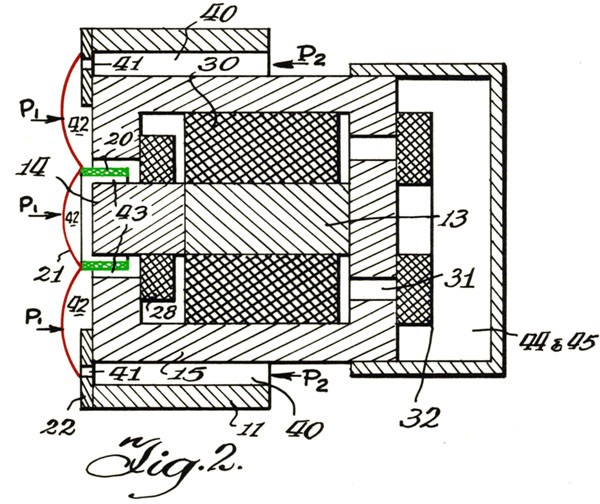
Our acoustical journey is not yet finished. In the diagram below, chamber #44 feeds into aperture [hole] #46, and the acoustic path finally ends in the large chamber #45, deep in the mic handle near the output transformer. These extensions of the acoustical network form a vibration isolation system [shock mount] that reduces audible handling noise. Rubber pads #25 and #26 function as flexible bumpers between the mic capsule and the outer mic housing. During manufacturing, the felt pads, washers, and air spaces within the mic capsule’s interior are “tuned” for optimal mechanical isolation by adjusting a nut located on threaded stud #27. A clever design aspect of the Unidyne III is how the air in chamber #45 is pumped toward chamber #42 when the mic is shaken. This “puff of air” momentarily stiffens the diaphragm to reduce its displacement [movement] from vibration.
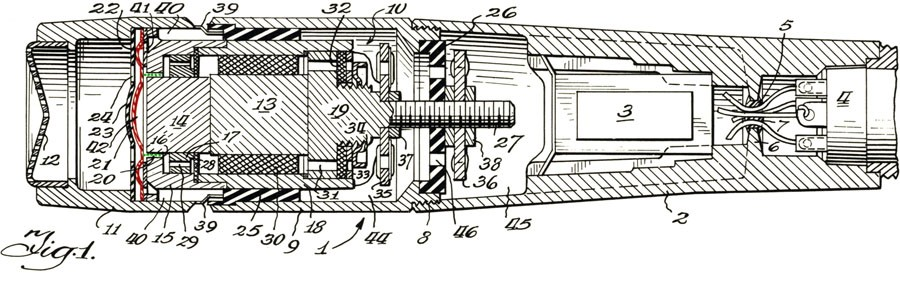
Unidyne III Feature 9 is the low impedance 250-ohm output and high impedance 15,000-ohm output. This is provided by transformer #3 with two output windings. The 1959 version of the Unidyne III had a four-pin Amphenol output connector #4. Pin Three and Pin Four provided a balanced low impedance output; Pin Two and Pin One was an unbalanced high impedance output. Neither the SM57 nor the SM58 had a high-impedance option; until the 1980s, these models featured a transformer with a 50-ohm winding and a 250-ohm winding. The output impedance could be internally changed by the end user.
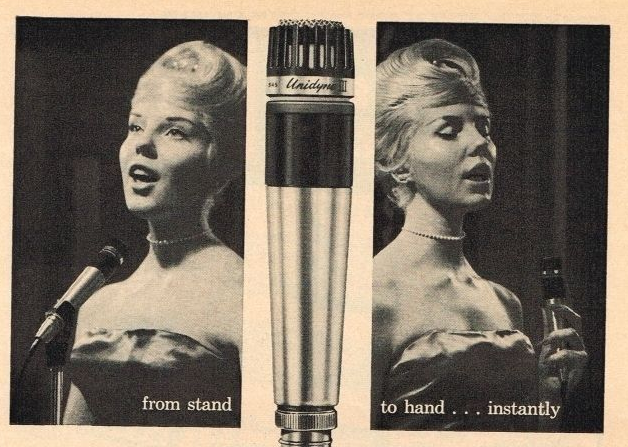
The July 1960 print ad for our Unidyne III reads:
From hand to stand instantly. Introducing the world’s smallest cardioid dynamic microphone.
Everything you want in a cardioid mic and then some! Compact size…modern design…wide response…superior feedback suppression…uniform cardioid pattern…ruggedness…reliability. You name it, Shure has designed it into the dramatic new Unidyne III. 50% smaller – less than 6” x 1.25” and 0.6 lb.! $50 Professional Net Price
Perfection in performance: moving coil design with truly uniform cardioid pick-up pattern. Response 50 to 15,000 Cycles per Second. Up to 75% greater distances from sound source. Impressive feedback suppression.
Maximum versatility: unobtrusive size, dual impedance, light weight, instant change from stand to hand, and wide-range response make it ideal for faithful reproduction of voice or music, indoors or out, for Public Address, tape recording…anywhere fine quality is required.
Rugged and reliable: Famous Shure quality. Takes 6-foot drop-tests and still performs according to specifications.
Readers may ponder, “Why have there been three sequential Tech Tips about the Unidyne III microphone?” Because this transducer’s performance remains a pro audio touchstone in 2026…six decades after introduction.
Related information: Unidyne III Patents
Ernie Seeler white paper about the Unidyne III
Did the Beatles use Unidyne microphones?
Arcana – mysterious or specialized knowledge
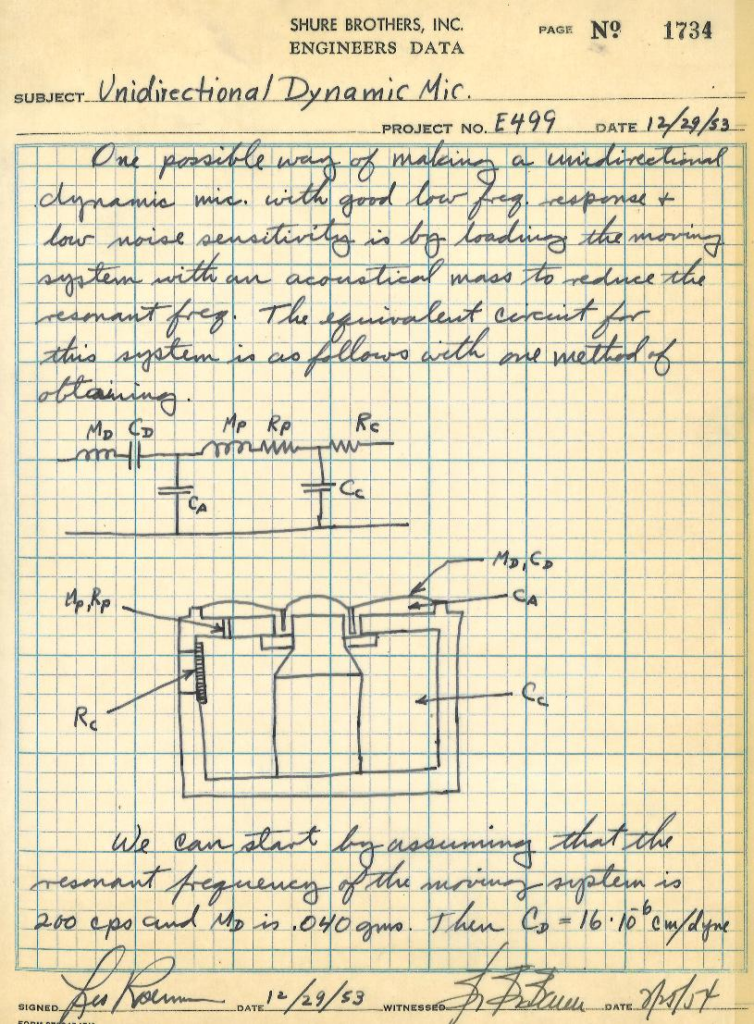
The idea for utilizing air trapped inside the handle as part of the vibration isolation mechanism was put forth in 1953 by development engineer Leo Rosenman.
***
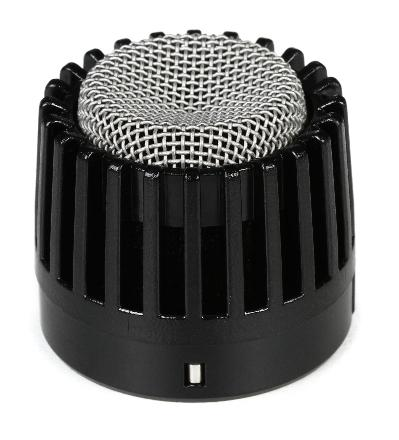
The SM57 grille is supplied “pre-dented”. Why? The inward dimple tightly stretches the metal screen. In doing so, the material gains tensile strength, making it more difficult to damage.
***
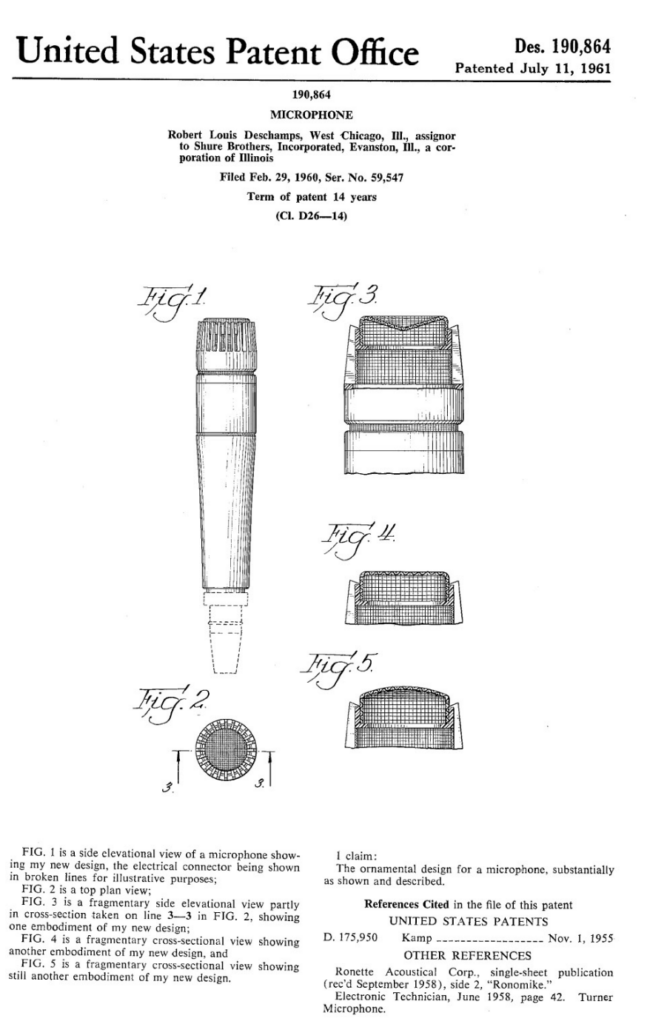
An industrial design patent for our Unidyne III was granted in 1961. Note how Figures 3, 4, and 5 illustrate different shapes for the grille.
***
During his 2025 tour of North America, Sir Paul McCartney sang into a wired SM58. An inquiry to the global corporation that supported Sir Paul’s tour uncovered an interesting fact: the mics on the tour were owned by McCartney – not the touring company. One of the most famous and richest musicians on the planet chooses to own and use the SM58 – a mic with a current street price of a modest $109 U.S. Quite the endorsement of Shure durability, reliability, and audio quality. Thank you, Sir Paul.