
From 1925 to 1928, the Company grew from one person to more than 75 employees. The first department Mr. Shure set up was the Service Department, and Harry Lea was named the first Service Manager. In recalling the importance of service in the early years of the Company, Mr. Lea wrote in 1943: “The founder of Sears, Roebuck began by selling watches to railroad workers, one at a time. Shure began with a Service Department. The idea of service was and is fundamental.… An inferior product is soon discarded and forgotten, and the maker as well. A truly good product that can be properly repaired and serviced…makes permanent friends and customers.”
In 1928, one of the new recruits was Mr. Shure’s younger brother, Samuel J. Shure. Although he graduated from the Massachusetts Institute of Technology with a Masters degree in Heating and Ventilation Engineering, Mr. Shure asked him to join the growing Company as its first engineer. Shure Radio Company was renamed Shure Brothers Company.
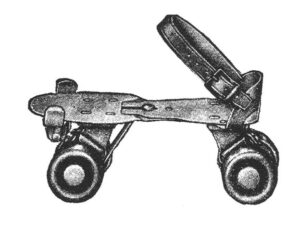
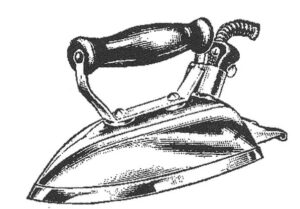
Later that same year, the Company moved to more spacious quarters at 335 West Madison Street in Chicago, and Shure purchased the parts and accessory division of Hudson-Ross, Inc., a competitor. In the letter announcing the acquisition to customers, Mr. Shure wrote: “Our Advertising Department is working hard preparing our big annual fall catalog.…In the meantime, there’s plenty of good weather left for the sale and use of sporting goods, camping equipment, portable phonographs, and many other lines of summer goods shown in our summer catalog.” For a short time, Shure used the catalog to sell a wide variety of consumer products and sporting goods as well as radio parts. With colorful descriptions, vivid images, and money-back satisfaction guarantees, the Shure Shots Catalog reflected Mr. Shure’s talent for promotion and his commitment to service. While Shure was establishing itself in a growing radio parts market, competition from across the country was heating up. In 1929, there were more than 16,000 “radio and music stores” in the United States.
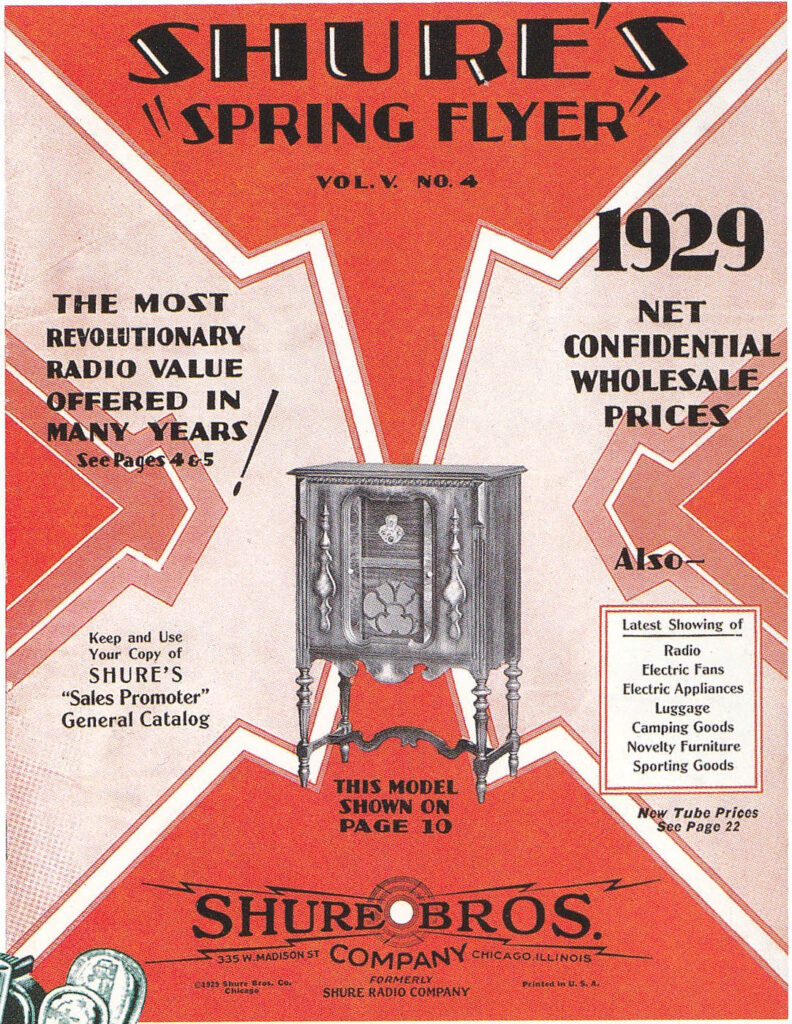
Shure’s 1929 Spring Flyer was one of the seasonal promotional catalogs issued by the Company during its early years. In addition to a wide selection of radio parts, Shure sold electric fans, electric appliances, luggage, camping goods, novelty furniture, and sporting goods. Shortly after this Flyer was distributed, the United States fell into a deep economic depression, forcing Mr. Shure to lay off nearly all of his 75 employees.
The year 1929 proved to be one of the most difficult in the nation’s history. A deep economic depression precipitated by a stock market crash as well as the entry of factory-made radios had a devastating impact on the radio parts distribution business. Mr. Shure had to lay off nearly all of his employees; and in 1930, Samuel J. Shure chose to leave, accepting a position with a prominent heating and ventilation firm in St. Louis, Missouri.
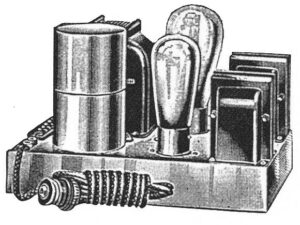
Economic conditions and the market shift from parts kits to fully assembled radios forced many radio companies out of business. Of the hundreds of radio manufacturing firms that were founded between 1923 and 1932, only 11 lasted for more than a decade. Determined to survive, Mr. Shure kept the Company going by selling parts to the few remaining firms that dominated the radio manufacturing business, including Zenith, RCA Victor, and Philco.
