
Within a few years of its opening, Shure had built a thriving wholesale catalog business, but factory-built radios were starting to replace radio parts kits; and larger manufacturers were pressuring parts wholesalers, like Shure, to reduce prices.
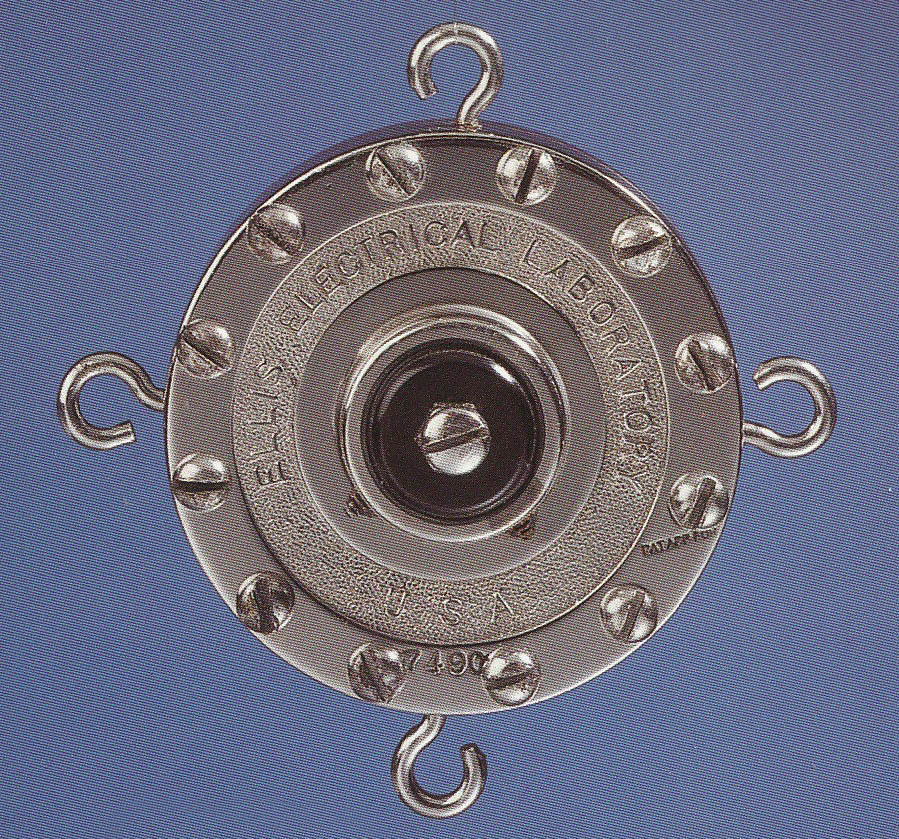
In 1931, Ellis Electrical Laboratory had a line of microphones and accessories that were marketed nationally by Shure. The line included microphone Models 10N, 12N, 20N, 29N, and 30N, along with transformers, stands, and cables. The 12N was a two-button carbon model for “home recording, industrial and home talking picture machines.” It sold for $25.
One of the products in the Shure catalog was a microphone manufactured by the Ellis Electrical Laboratory in Chicago. Ellis and Shure entered into a contract that made Shure the exclusive national distributor of all Ellis microphones and accessories. Ellis was a small but well-recognized engineering and manufacturing company that was founded around 1900. The company went into the microphone business when radio began to develop in the mid-1920s.
Shure promoted the Ellis line by advertising in radio trade magazines and direct selling through a network of audio dealers around the country.
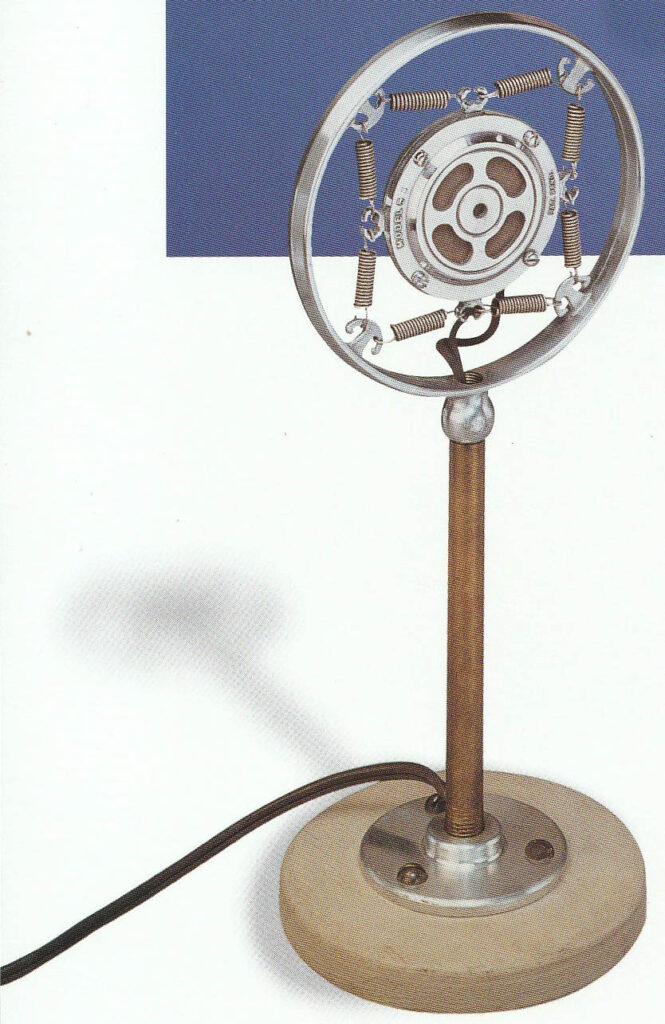
The Shure Model 5A was one of the first microphones Shure manufactured. It measured 3 3⁄4 inches in diameter and weighed 14 ounces. The microphone featured a screen-protected diaphragm and was finished in “triple buffed chromium plate over nickel.”
In an ad for Ellis microphones and accessories in 1931, Shure claimed: “The Ellis Demountable Microphone is easily and quickly removable from the supporting fixtures without, in any way, disturbing the mounting springs or the wire connections. It’s the ultimate in microphone convenience and safety.”
In 1931, Shure began an initiative to design and manufacture its own line of microphones and, in 1932, successfully brought to market the Shure 33N, a two-button carbon model. The Shure design advanced the aesthetic quality of early microphones and gave the Company an important marketing advantage in a small but growing field of microphone manufacturers.
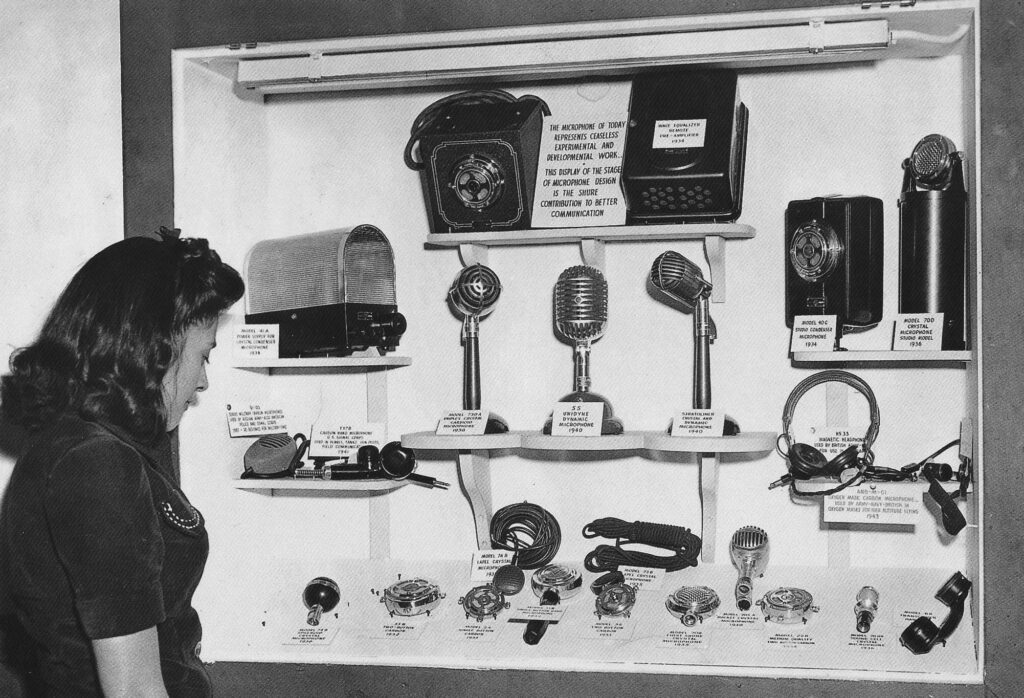
Connie Ramos, a Shure employee, looks at a display of Shure microphones introduced by the Company from 1932 to 1944. The display case, installed in the Shure plant located at 225 West Huron Street in Chicago, showed the wide variety of products developed for public address, broadcasting, live performance, and the military.
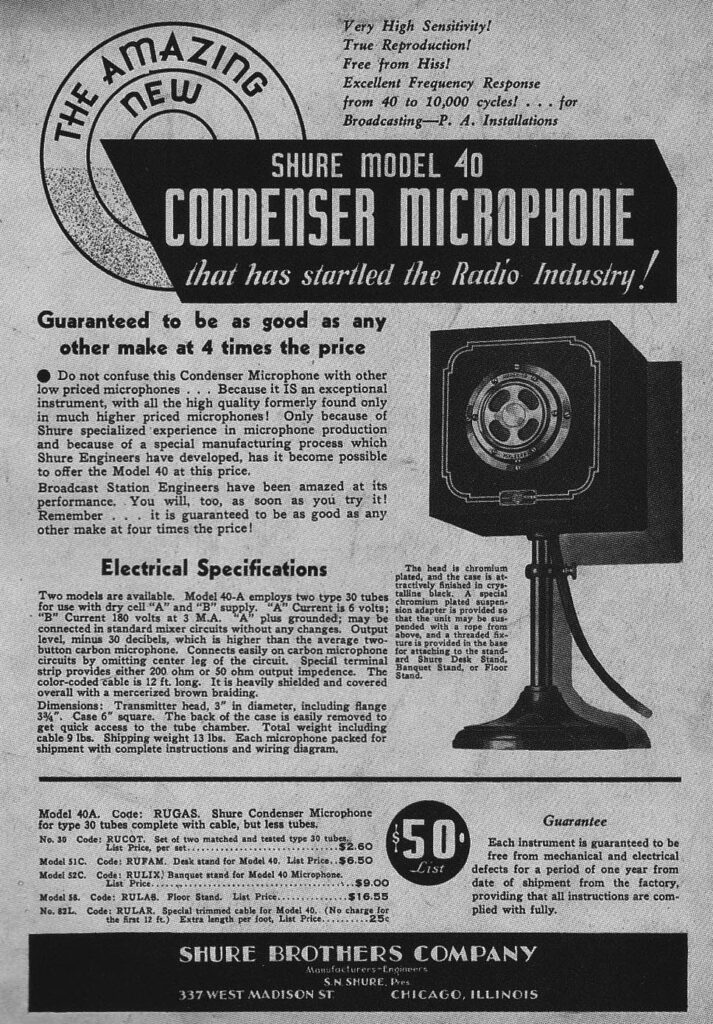
Ad for the Shure Model 40 Condenser Microphone designed for the broadcast studio, “where a finished modern appearance is desired along with excellent perform- SHURE Sound People, Products, and Values Volume 1 Beginning with Innovation ance and rugged mechanical construction.” The chromiumplated transducer featured an “air damped stretched diaphragm,” and the cast aluminum case housed a two-stage preamplifier. The six-pound microphone was guaranteed to be “as good as any other make at 4 times the price.” The price was $50, which included a suspension adapter, so that the unit could be suspended with wires or rope. Accessories for the Model 40 included a desk stand, floor stand, and banquet stand.
