
How do we fight feedback? Let me count the ways. Since the 1930s, Shure has waged a war on acoustical feedback.
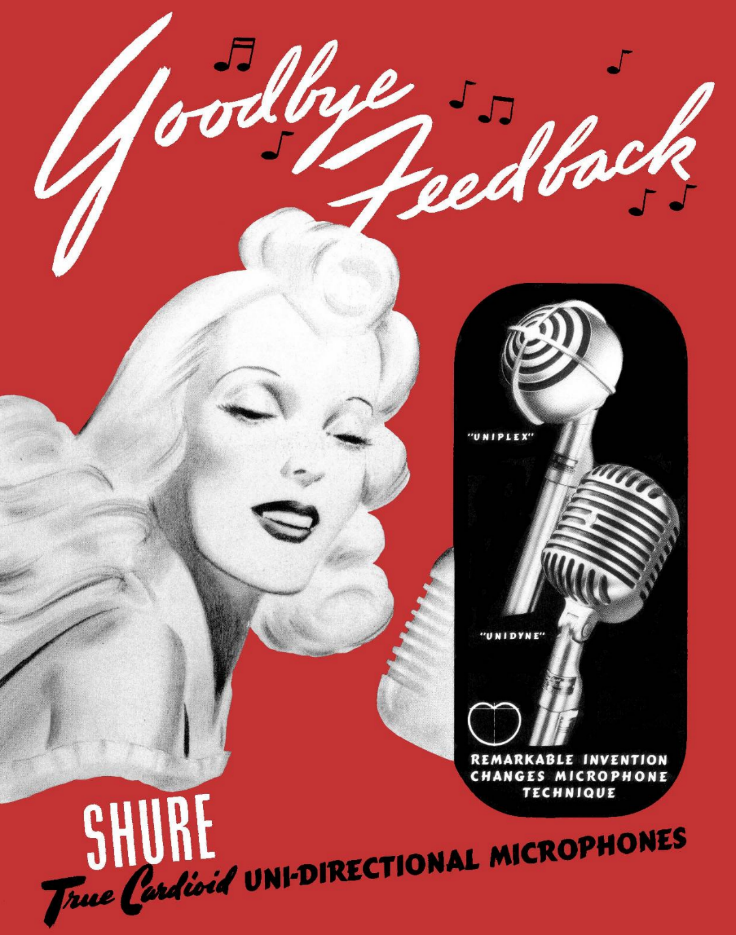
Sales flyer for Unidyne and the Uniplex microphones, 1939
For two decades, unidirectional microphones were the weapons of choice. Then in the 1960s, acoustical consultant Charles Boner researched the behavior of indoor sound systems focusing on the phenomenon of feedback. His findings culminated in utility patents covering the use of narrow band notch equalization as a method of feedback control. Modern audio equalizers are outgrowths of those patents.
Climbing on the equalization band(width) wagon, Shure introduced its first electronic feedback reducer in 1968 as a feature of the new Vocal Master system. The VM300 console, and it’s low-Z fraternal twin the VM302, contained four, count ‘em, four Anti-Feedback switches. Each switch activated a notch filter with a fixed center frequency: 5,000 Hz; 2,200 Hz; 1,000 Hz; 155 Hz.
The Vocal Master Anti-Feedback switches were – how shall I put this – modestly effective. The instruction manual advised:
If feedback occurs, locate the Anti-Feedback switch which eliminates the feedback. Gain may then be increased until another feedback pitch is apparent. One of the other filters may then be introduced, which will eliminate that feedback. IMPORTANT: No more than two filters should be used simultaneously. The effect of more than two filters is one of reducing overall gain, also the overall tonal quality of the system may be significantly affected.
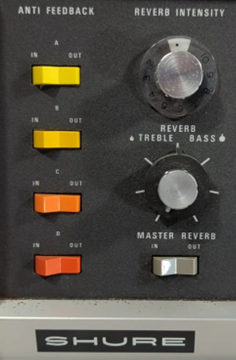
Anti-Feedback switches, 1968
Enter the Model M610 Feedback Controller in 1972. If four Anti-Feedback filters were good, then ten filters must have been fantastic as the change from four to ten was an improvement of 8 dB! [A joke, dear friends.]
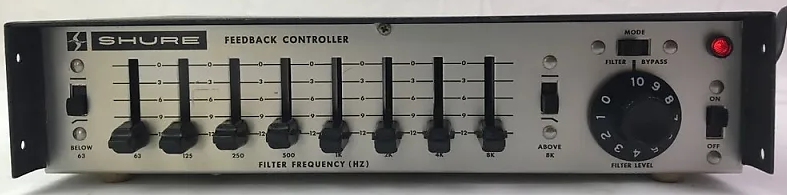
M610 Feedback Controller, 1972
The Model M610 permitted a user to smooth frequency irregularities found in the response of a sound system. The ten controls, eight faders and two switches, were cut-only; there was no ability to boost a frequency band. The faders were centered at 63 Hz; 125 Hz; 250 Hz; 500 Hz; 1kHz; 2kHz; 4 kHz; 8 kHz. The left switch provided a 6 dB per octave roll-off below 63 Hz. The right switch provided a 6 dB per octave roll-off above 8 kHz. Used judiciously, the unit would control feedback through the reduction of sound system resonances. The M610 was discontinued in 1984.
The professional audio market wanted an equalizer that could boost frequencies as well as cut them. In 1977, our SR107 equalizer debuted with its primary functions being feedback control and system equalization. Priced at $250 U.S. retail [$1,295 in 2024 currency], the SR107 had two unique features: rotary controls in place of faders, and it required only a single rack space.
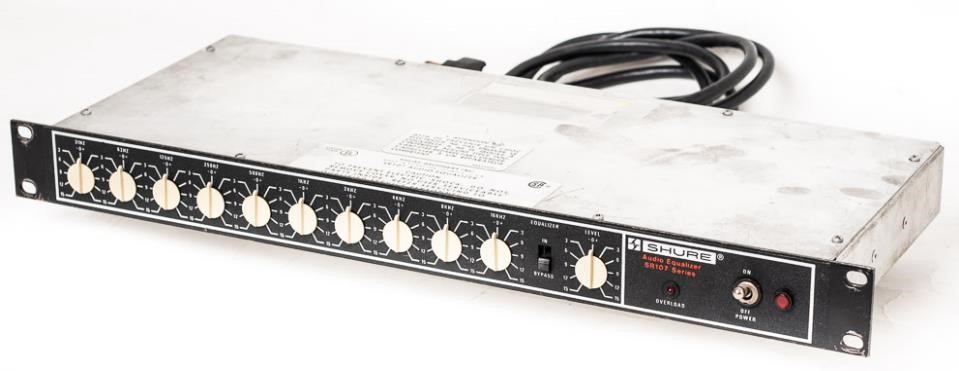
SR107 Audio Equalizer
Paired with the SR107 was the Shure M615-AS. This device, an audio spectrum analyzer operating in real time, assisted the user in adjusting the SR107 to provide a smooth frequency response for the sound system.
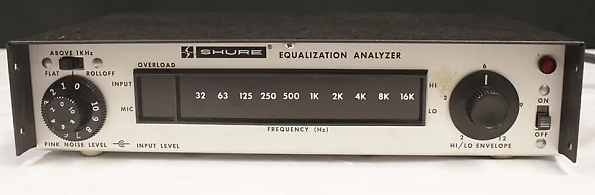
M615 Equalization Analyzer
Here is how it operated. The SR107 equalizer was inserted in the signal flow just before the power amp. The M615 fed a pink noise signal into a mixer input. The flat response ES615 microphone, supplied with the M615-AS, was placed in the audience area, with the mic output connected to the M615. With the sound system activated, the ES615 picked up the pink noise emitted by the loudspeaker. The M615 compared the captured loudspeaker pink noise to the pink noise being sent to the mixer. Frequency differences were displayed on the M615 front panel. If excessive audio energy appeared in the 250 Hz band, a red LED above 250 would illuminate. If a dearth of audio energy was noticed in the 1KHz band, a red LED below 1K would illuminate. The audio engineer adjusted the SR107 controls in order to extinguish each illuminated LED on the front panel. Once the front panel was dark, the sound system was equalized to a flat response within a 2 dB envelope…clever.
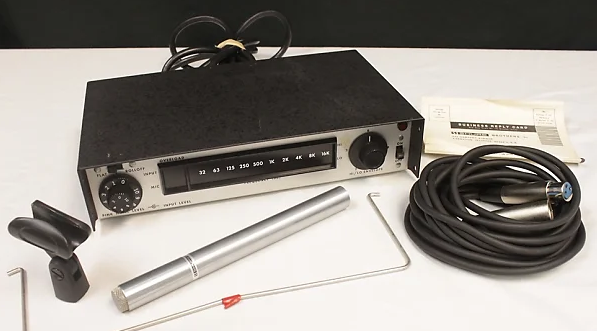
M615 with ES615 moving coil microphone
The aforementioned Vocal Master line was replaced by the Pro Master line in the early 1980s. The Pro Master console had a unique feature dubbed Feedback Finder. Feedback Finder employed an LED string [#6 in the photo below] as a quick method of determining the octave frequency band of a feedback tone. With the console set to Feedback Finder mode, the user slowly raised the master volume control until acoustic feedback/squeal/howl was heard. The LED string [#6] extended outward and stopped above the specific equalizer band [#8] where feedback was occurring. The user lowered the indicated equalizer fader until the feedback stop. Then the master volume would again be raised until feedback again appeared, and the process would be repeated. Thus, the Pro Master fought feedback by indicating the exact equalizer slider that required adjustment to stop the squeal/howl.
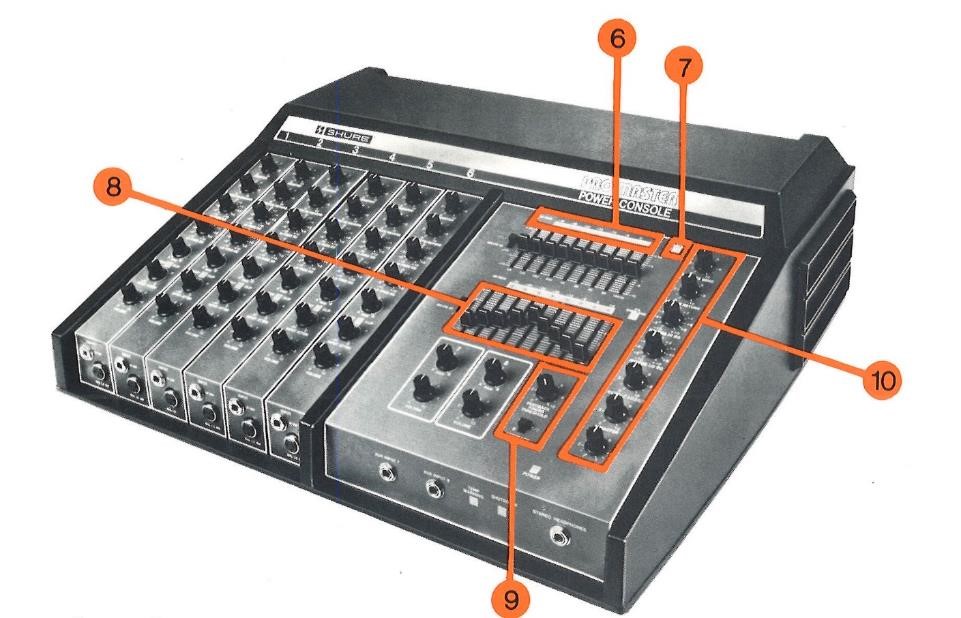
Pro Master 700 Console
The final stop in our fighting feedback historical tour is Shure’s first digital automatic feedback fighter, the DFR11EQ from 1996. Our Digital Feedback Reducer [DFR] was a one-in, one out [11] digital device with Equalization [EQ]. Like the SR107, the DFR11EQ was placed after the mixer and before the power amp. When feedback occurred, the DFR11EQ rapidly determined the offending frequency then inserted a narrow-band notch filter to quelch the squealing. Up to ten such filters could be automatically deployed. Using a computer with the DFR11EQ provided manual control of internal software equalizers [graphic and parametric] for overall tonal control of the sound system.
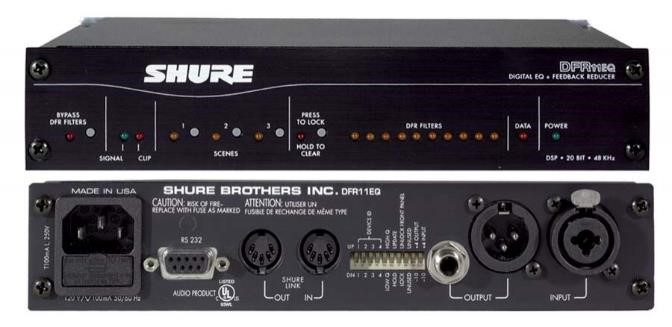
DFR11EQ
Since public address systems were first deployed in the early 20th century, acoustic feedback has tormented sound engineers. In 2024, has the pro audio world truly said Farewell to feedback? No, but it has said Auf wiederhören.
Related information: Vocal Master Console User Guide
Arcana – mysterious or specialized knowledge
Recently, I viewed a video hyping a software plug-in called “Feedback Hunter.” It touts “Effortless Feedback Control for Live Sound Engineers.” According to the software creator, Waves Audio Limited: The Feedback Hunter is an innovative new tool that is revolutionizing the way stage monitors and PA systems are optimized. With Feedback Hunter, users can achieve maximum gain before feedback in less than 30 seconds. The plug-in analyzes the mic and monitor’s response and creates an EQ curve that optimizes the relationship, ensuring clear sound with less risk of feedback.
As discussed in this Tech Tip, the concept of incorporating feedback reduction into a sound system is not novel. While software plug-ins are relatively recent, the science of fighting feedback is not.
***
An early effort at feedback fighting was the frequency shifter. This device claimed to provide up to 6 dB additional gain by raising all frequencies passing through the sound system by 5 Hz. For speech, a 5 Hz increase has no audible effect because the change in pitch is too small to be noticed. As one can imagine, a frequency shifter could not be used for music!
Unlike speech, a feedback howl passes through the sound system thousands of times in rapid succession. Each time, the frequency shifter raises the feedback howl by 5 Hz. The howl is shifted away from its resonant peak, eventually being pushed above the audible range. If system gain is raised to the feedback level, the sonic effect heard is a succession of beeps, each ascending in pitch.
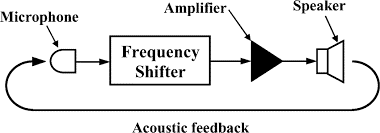
Have Tech Tip readers ever encountered such a device in a speech sound system? Likely not – the frequency shifter is not a particularly effective solution, unlike narrow band equalization.
***
For an overview of feedback fighting in the 20th century, refer to the book: Acoustic Feedback – How To Avoid It; by Vivian Chapel; copyright 1991; published by Bernard Babani Limited; ISBN 0-85934-255-7.
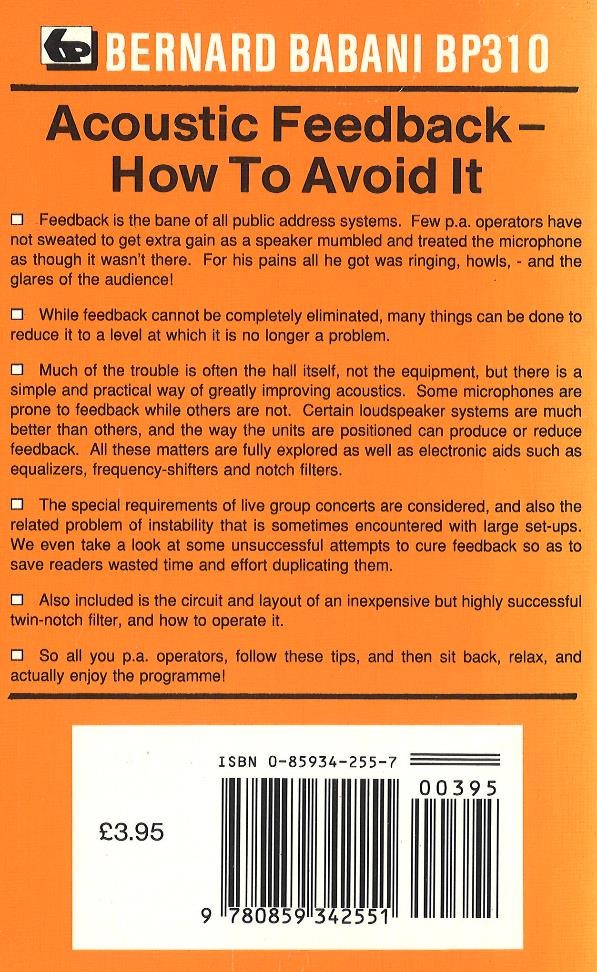
Back cover of the Vivian Chapel book
***
About the German phrase Auf wiederhören used above. The German phrase Auf wiedersehen means farewell but translates literally as until seeing you again. Auf wiederhören translates as until hearing you again meaning that feedback is always lurking within a sound system.
I thought this Teutonic turn of phrase might be amusing…perhaps not.
