
First and foremost, the Shure M-Series tone arm with phono cartridge is a work of art. The sleek appearance is an homage to Italian Mid-Century design. Long playing [LP] records were a nascent medium in the mid-1950s when Shure developed and marketed the M-Series tone arm – a stunning blend of new technology with up-to-date style and unique operational features.
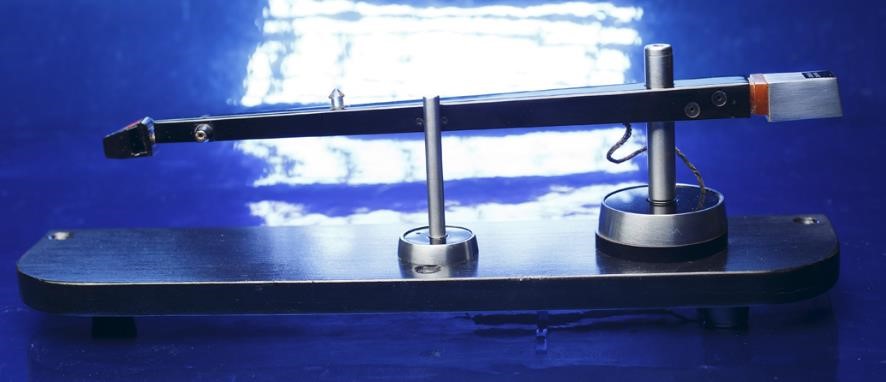
Shure M-Series Studio Dynetic Phono Reproducer
Photo by Stuart Van Dorn
The first M-Series model, the monophonic M16, was introduced in 1957. Targeting broadcast radio studios, it could play large 16-inch diameter transcription recordings. The tone arm came equipped with the M1 cartridge for LP records or the M2 cartridge for 78 RPM records.
In 1958, the M12 version debuted. Four inches shorter than the M16 and designed to fit home hi-fi turntables, the M12 played the 10-inch and 12-inch diameter records sold to the public.
A unique feature of the M-Series was the ability to track a record with a mere 1.5 to 2.5 grams of downward force in contrast to the 10 grams [or more] that was typical. This lighter tracking force meant substantially less damage to the record grooves. In order to obtain this negligible tracking force, it was necessary to integrate the tone arm and the phono cartridge as a matched pair – one component could not work without the other.
In the spring of 1958, the Long Playing stereo record format was launched by the recording industry. Shure responded in 1959 with the stereophonic M216 model and M212 model. Now supplied with a two-channel stereo phono cartridge, the number “2,” added to each model number, indicated stereo capability.
In 1963, the M226 and M222 appeared. The sole difference was an improved stylus assembly that would track a record with as little as 0.75 grams of downward force. Our sales flier boasted, “The Studio Stereo Dynetic tone arm’s no-scratch feature has been the talk of every hi-fi show since its introduction. Does away with the major cause of ruined records once and for all. Has actually been artificially stopped in tests to skip back and play the same groove over and over many thousands of times without audible damage to the groove.”
A quirk of the M-Series tone arm was that it moved solely in the horizontal plane. It could not be raised vertically to remove the stylus from the record surface. Instead, the user pressed downward on a lift button, found on the top of the arm, to raise the phono cartridge from the record. Releasing the button lowered the cartridge to the record surface to resume playback.
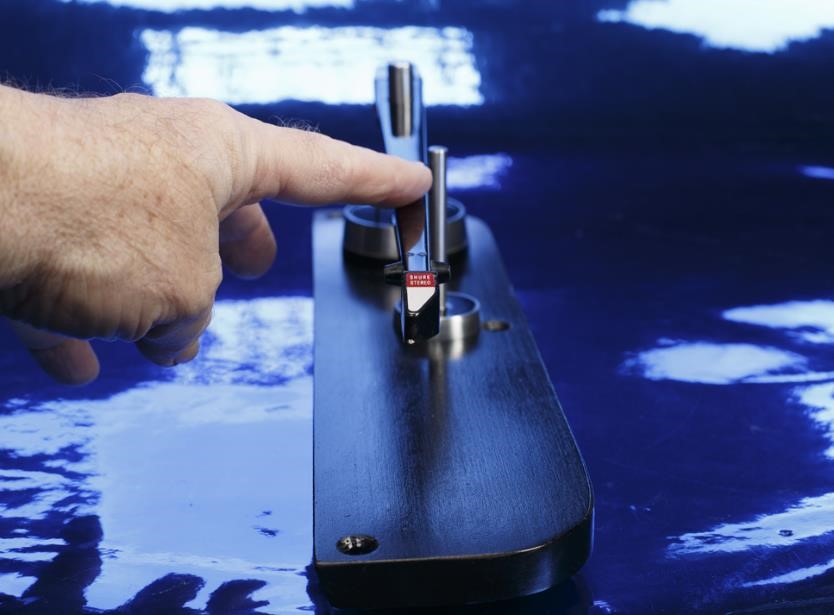
Raising the stylus tip from the record surface
Photo by Stuart Van Dorn
As the tone arm moved only side-to-side, it was necessary to invent a clever method to secure the arm when not in use. A side-mounted “low power” magnet was used to secure the tone arm to a ferrous vertical “hitching” post mounted on the turntable base. The magnet had enough strength to gently hold the arm against the post but would not interfere with the operation of the moving magnet cartridge.
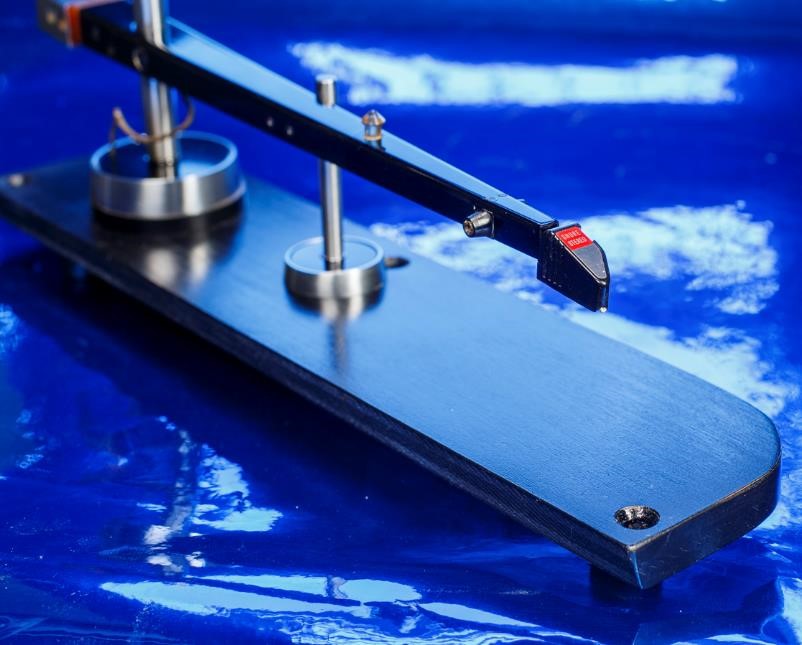
M-Series tone arm in the resting position
Photo by Stuart Van Dorn
The following photo calls out the primary features of the M-Series tone arm. Note the jewel bearings, [made of ruby] in the primary pivot post and in the secondary pivot that lifts the cartridge. Jewel bearings were commonly found in mechanical clocks and wristwatches.
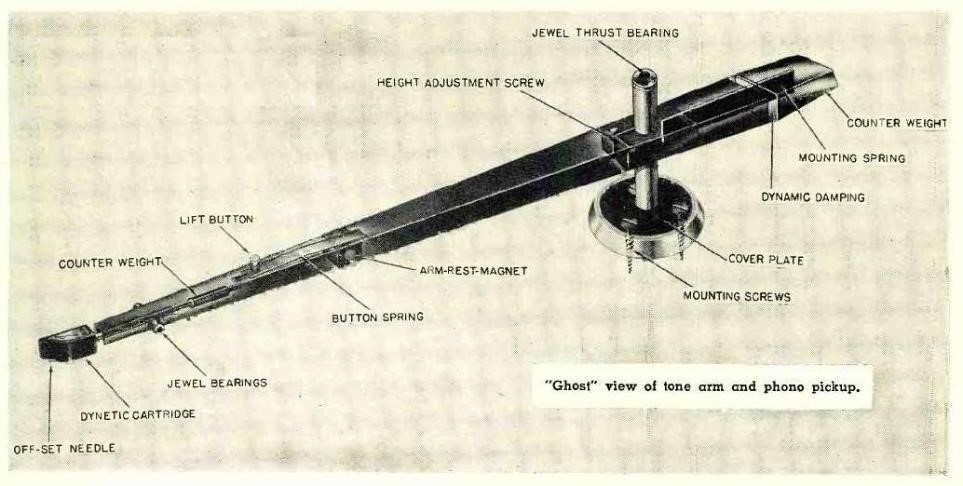
Parts of the M-Series tone arm
During the annual New York Hi-Fi Show, Vic Machin and Lee Gunter from Shure met with Milton Sleeper, publisher of Hi-Fi Music at Home magazine. Mr. Sleeper presented a technology award to Machin and Gunter for the M-Series Dynetic tone arm. At the time, vinyl record sales in the United States were exploding. The retail sales volume in 1957 was $460 million – twice the sales of 1955; $460 million equals $5.2 billion in 2024 currency. Put another way, every person in the United States purchased ten phonograph records in 1957. It is not surprising that our founder, S.N. Shure, decided to focus on the rapidly expanding market of home high fidelity.
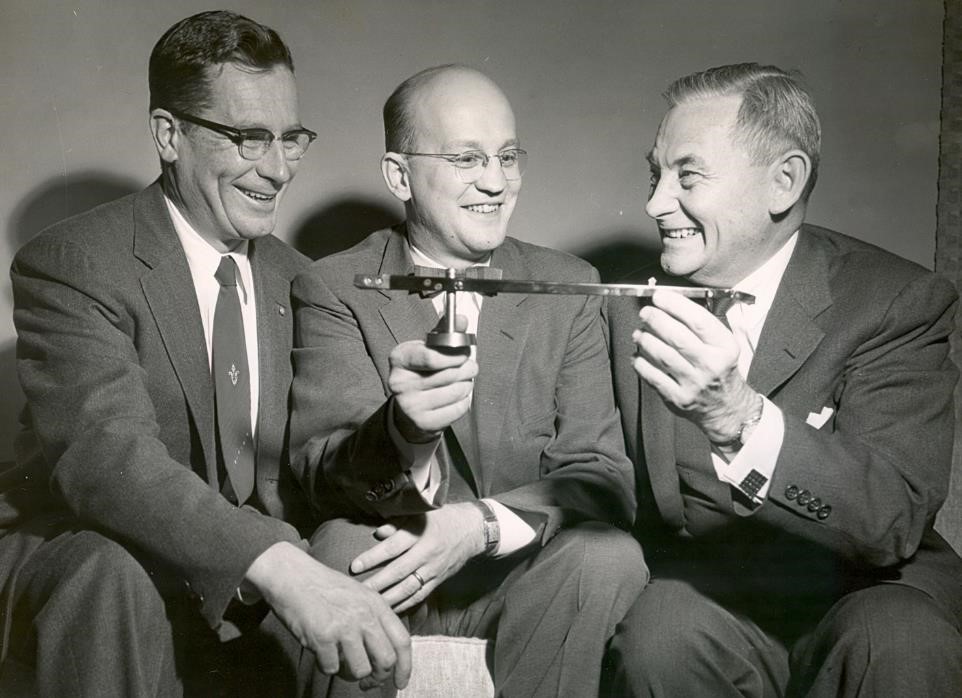
Vic Machin, Lee Gunter, Milton Sleeper, New York City, 1957
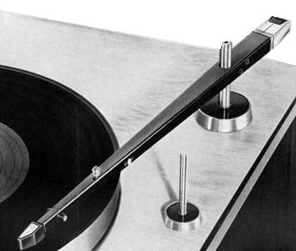
M216 tone arm in action
The M-Series tone arms last appeared in our 1966 catalog. By then, Shure had become the sole U.S. distributor of the quality SME line of tone arms manufactured in England. The performance and features of SME tone arms rendered the M-Series obsolete.
Related information: 1957 Shure catalog with M-Series tone arm
1968 Shure hi-fi catalog with SME product
Arcana – mysterious or specialized knowledge
In the 1950s, the types of phonograph cartridges employing a magnet were:
1) moving coil; or
2) moving armature/controlled reluctance/controlled magnetic; or
3) moving magnet
Moving magnet cartridges became practical as improved fabrication technology produced smaller magnets with increased field strength. Shure combined the word DYNE with MAGNETIC to coin DYNETIC; SHURE DYNETIC indicated a moving magnet phono cartridge.
The dyne is a unit of force. When one dyne of force acts on one gram of mass, the mass velocity increases by one centimeter per second every second. Shure engineers designing tone arms and phonograph cartridges employed the dyne for performance calculations.
***
Below is a hi-fi magazine advertisement for the M-Series tone arm.
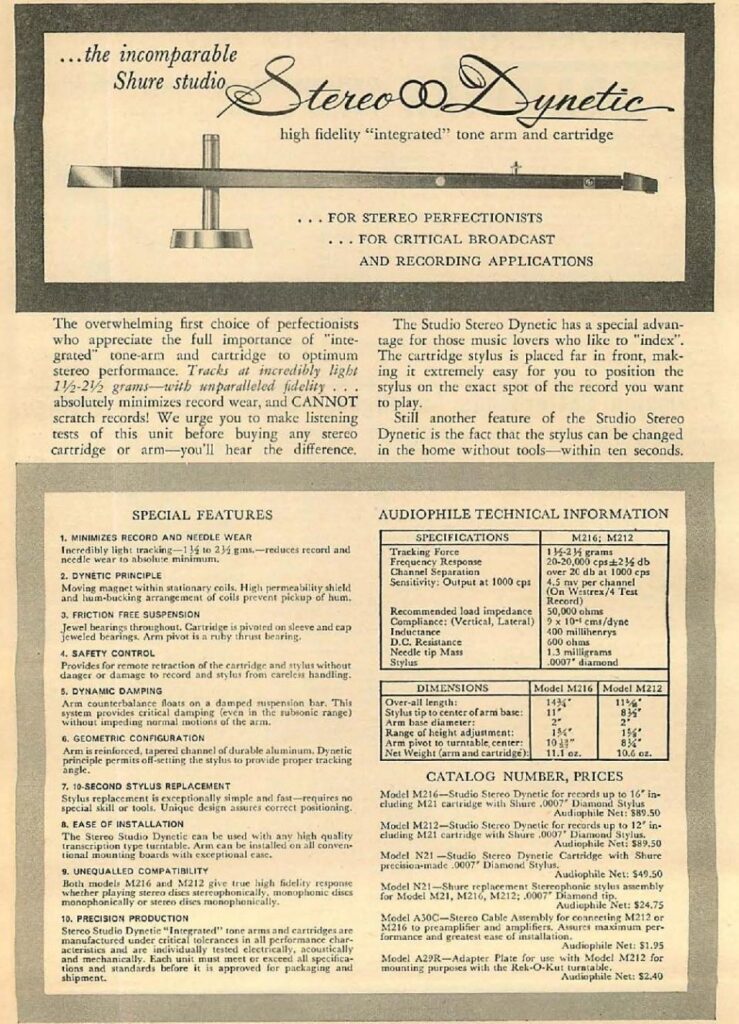
Magazine ad for the M-Series stereo tone arm, 1959
***
The U.S. Patent Office issued a design patent for the M-Series tone arm in August 1958. The designer, Joseph Palma, Jr., was not a Shure employee, but co-owner of a small industrial design firm frequently engaged by Shure Brothers Incorporated.
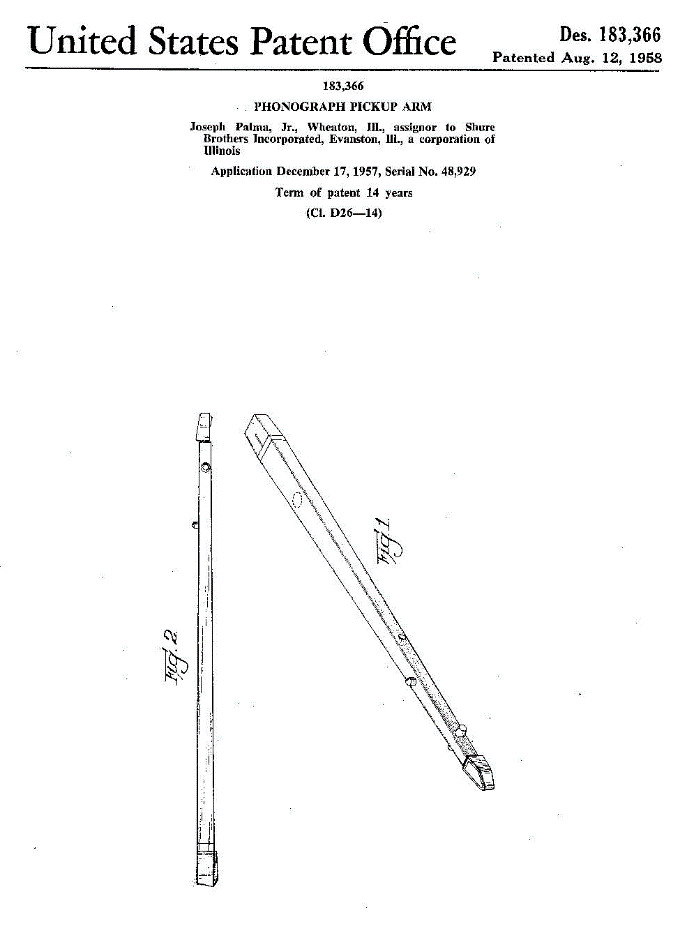
Design patent for the M-Series tone arm, 1958
***
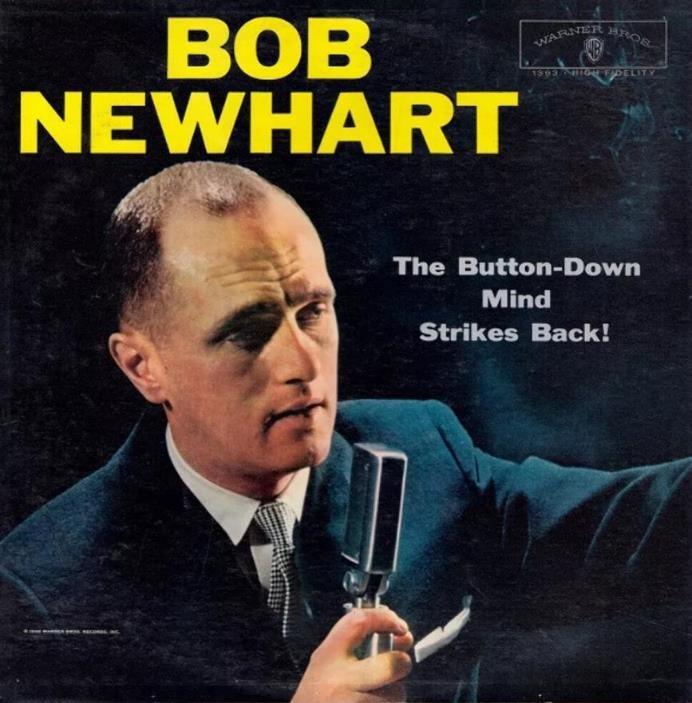
The wry comedian Bob Newhart passed away this month at age 94. Born in Oak Park, Illinois, a suburb of Chicago, Newhart’s first two LP records were smash hits. Below is the cover of his second record, The Button Down Mind Strikes Back. The microphone is a Shure Model 330 ribbon. A copy of this LP is kept in the Shure Archive as it was in the personal record collection of Mr. and Mrs. Shure.
Bob Newhart with the Shure Model 330 ribbon mic, 1960
