One of our most frequently read FAQ pages is: Understanding Earphone Specifications
While the audio quality of earphones is subjective – what sounds superb to me may not please you – the sensitivity rating is objective, i.e., inject a prescribed amount of electrical signal into the earphone, then measure the acoustical signal [loudness] created in the ear canal.
The sensitivity rating for the SE846 earphones is 114 dB SPL/mW @ 1 kHz.
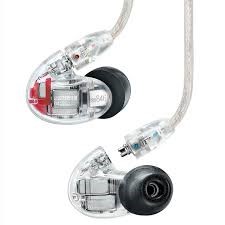
Say what?!? Gibberish and twaddle to most earphone users. Let’s demystify this sensitivity specification, starting on the right.
@ 1 kHz = “at 1,000 Hertz.” The audio frequency injected into the earphone is 1,000 Hz = one kilohertz or kHz. The note (or pitch) “B5” is 988 Hz, nearly 1,000 Hz. On a piano keyboard, B5 can be found by starting at the left end of the piano and counting to the 63rd key. It also is the note that is 13 white keys to the right of middle C. On guitar, B5 is on the high E string, 19th fret. 1,000 Hz is a very high note.
mW = “milliwatt” or “one-thousandths of a Watt.” The amount of signal power injected into the earphone is one milliwatt = 0.001 Watt = one mW. One milliwatt is a tiny signal indeed.
114 dB SPL = “one hundred and fourteen decibels of sound pressure level.” The level of loudness heard in the ear canal is 114 dB SPL. For comparison, 120 dB SPL is widely considered to be the ear’s pain threshold. 114 dB SPL is a very loud acoustical signal created by a very tiny electrical signal of one-milliwatt with a very high frequency of 1 kHz.
How does one pronounce 114 dB SPL/mW@1 kHz?
“One hundred fourteen D B S P L with a one-milliwatt input at one thousand Hertz.”
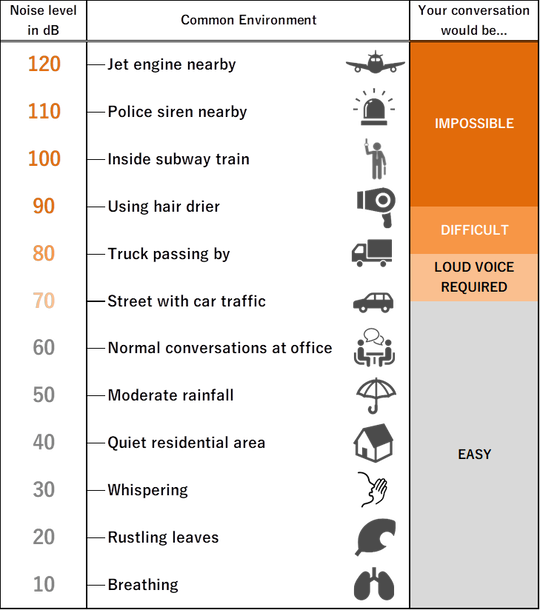
How much of a sensitivity difference is noticeable to the average listener? If the difference is less than 3 dB, the sensitivity disparity of two earphone models will be difficult to detect. A 3 dB difference will be noticed. A 6 dB difference will be quite noticeable. A 10 dB difference will be “twice as loud.”
Your author is regularly bemused by earphones “experts” arguing over differences of 1 dB or less. Who cares? Hearing a steady tone, a highly skilled listener might be able to perceive a change of 1 dB, while less skilled listeners need a 2 or 3 dB change before noticing a difference.
EXTRA! EXTRA! Read One Tech Tip– Get Two Tips! Everything above also applies to the SRH series of headphones.
Related information: How to clean earphones
Arcana – mysterious or specialized knowledge
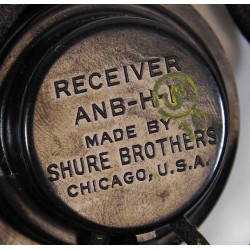
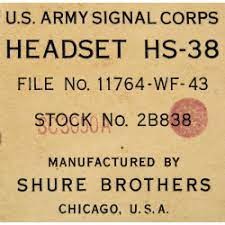
Shure first manufactured large quantities of a headphones and earphones in 1942 when we began producing the ANB-H1 driver for Allied military headsets. ANB-H = Army Navy British-Headphone. The ANB-H1 was used in the HS-38 military headset.
The transducer inside the ANB-H1 is a balanced armature, also called controlled magnetic or controlled reluctance. Though manufactured over 80 years ago, it is not unusual for a surviving ANB-H1 earphone to meet original specifications.