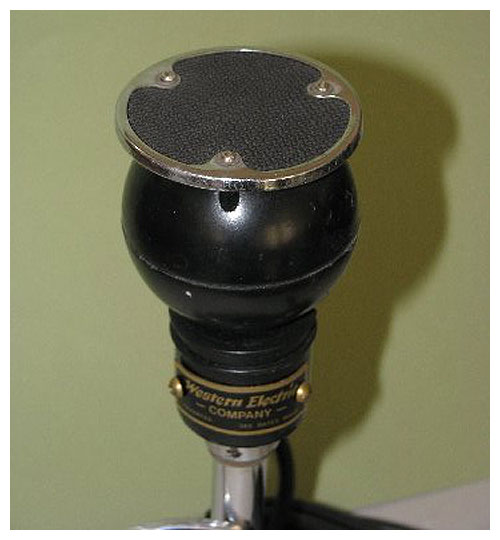
Shure introduced its first ball-shaped mic in 1935 – the Model 74 Spheroid Crystal Microphone. We were one of three companies to offer a ball-shaped mic during that era; Brush Development and Western Electric were the others.
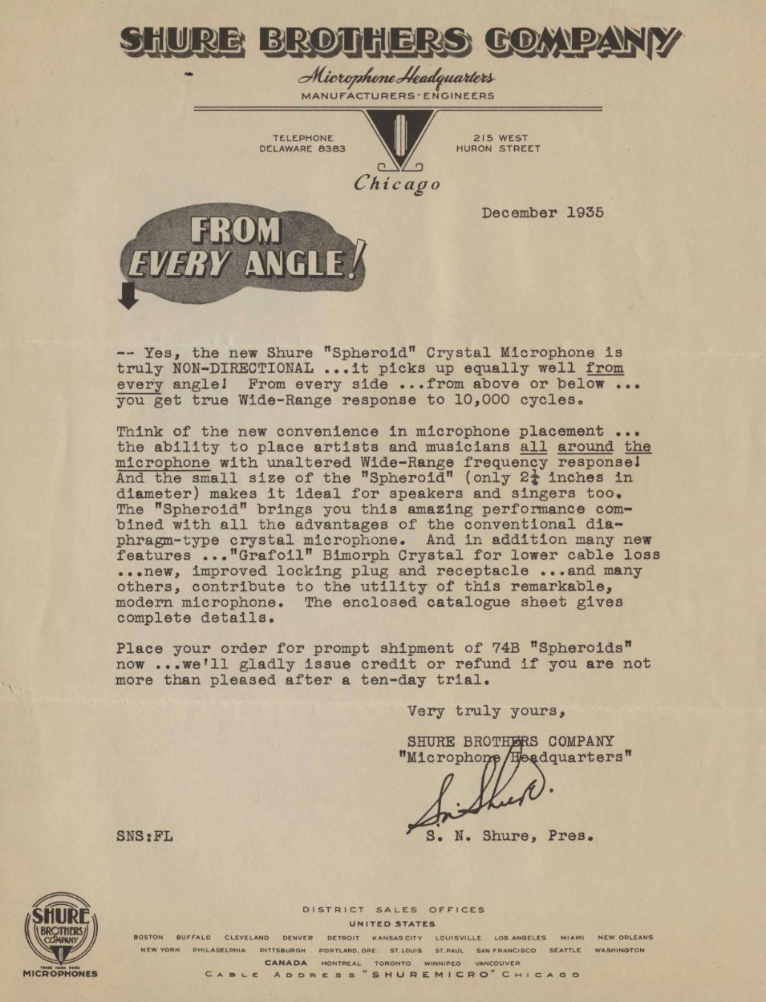
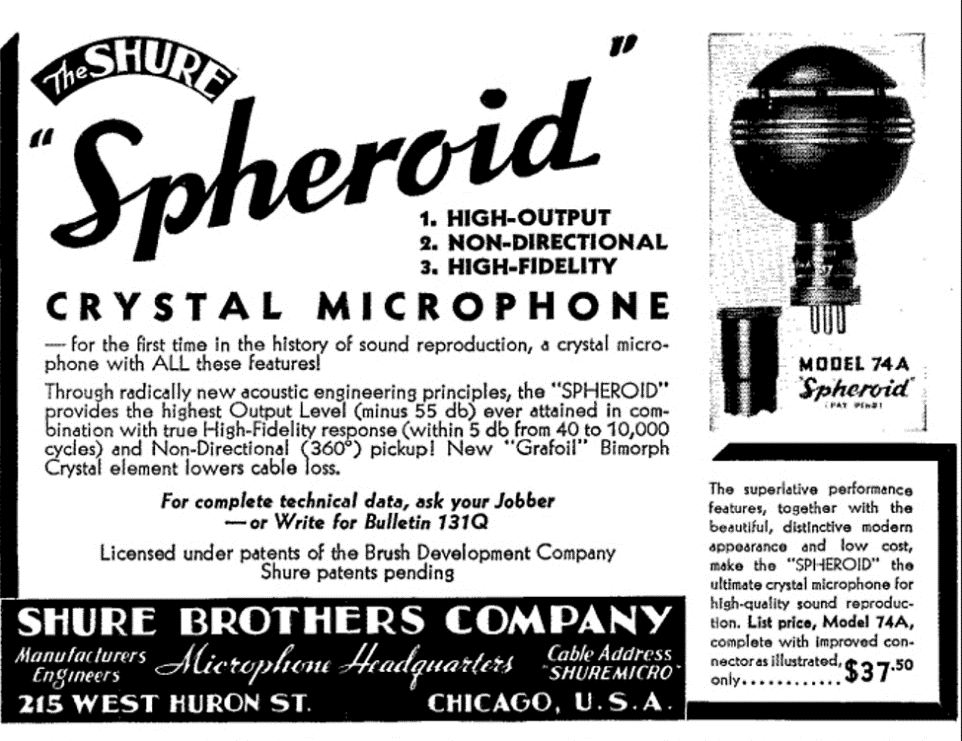
The Model 74 was $37.50 at introduction, the equivalent of $870 in 2025. The Spheroid mic grille diameter was 2.25“/ 5.7 cm – a tad larger than the SM58 grille. The mic weighed a hefty one pound / 454 grams. The three-pin connector type on the Model 74 is not identified but might be an early model from Amphenol.
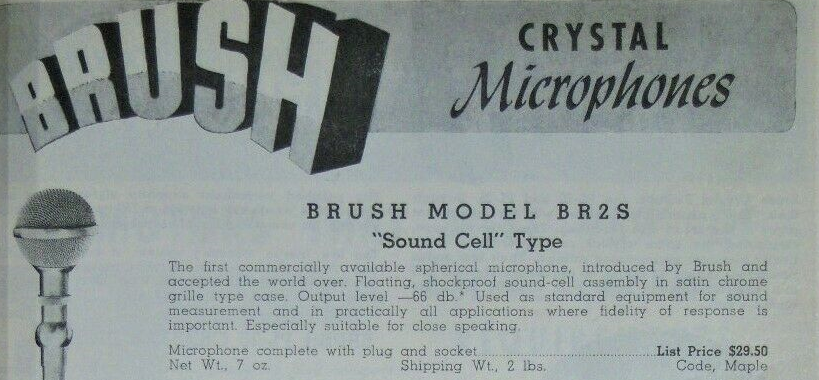
Like every crystal microphone manufactured by Shure, the technology of the Model 74 internal element was licensed from the Brush Development Company as it held numerous patents for Rochelle salt crystal transducers. As mentioned, Brush offered a ball-shaped mic. The catalog text below claims the Model BR2S was “the first commercially available spherical microphone.”
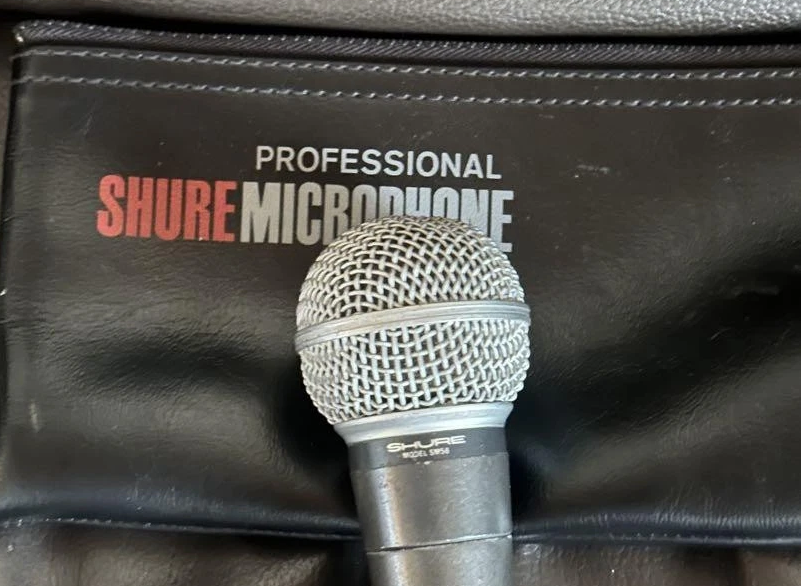
Ball-shaped microphones never caught on during the next three decades. This would change in 1966 with our Unidyne III SM58 and Unisphere I 565 – models that forever changed microphone industrial design.

Related information: Brush Development Company
1934 Bulletin on Crystal Microphones
Arcana – mysterious or specialized knowledge
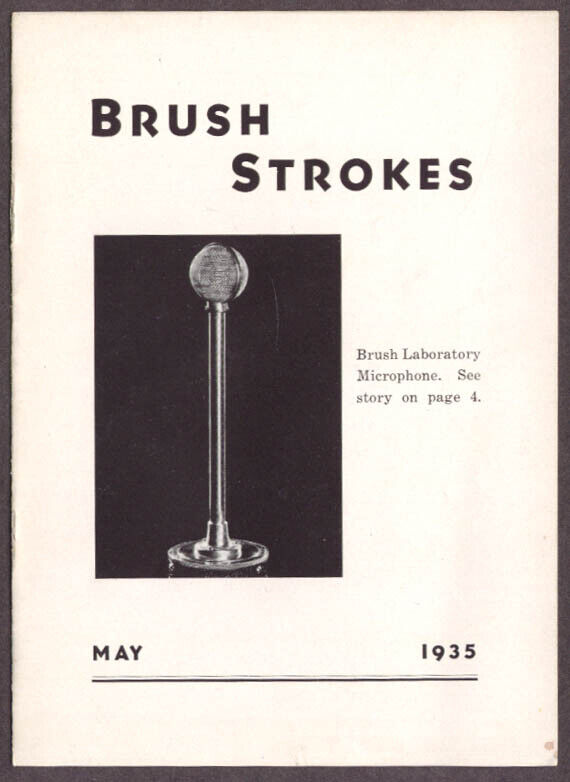
My vintage mic mentor and friend, Marco van den Hoeven, offered additional details about ball-shaped mics: “I consulted my Brush Development documents and found one picture of a Brush microphone with a ball shape that is prior to 1937. It is on the front page of their Brush Strokes magazine, dates from May 1935, and is described as a ‘laboratory microphone.’ The more common Brush mics having ball shapes were circa 1937 and later. Another 1930s era mic with a spherical shape is the Western Electric Model 630 Eight-Ball.”
***
Your author has long puzzled about why 5/8”-27 threads are found on microphone stands. This tubing diameter and the thread size are quite unusual. Why not ½” or ¾” tubing?
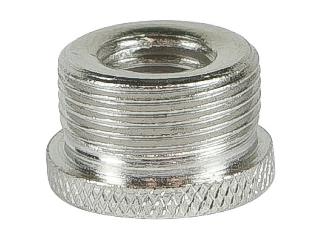
When mic stands were developed in the 1920s/30s, the manufacturers were also fabricators of floor lamps. The 5/8”-27 thread was common on floor lamps and lamp finials, so the companies re-used this thread size for microphone stands. I’ve yet been unable to determine why 5/8”-27 was employed for floor lamps.
Shure Design Engineering offered additional thoughts: Mic stand tubing has a thin wall because mics do not weigh too much, and a thin wall keeps the overall mass of the stand to a minimum. The 27 thread series is commonly used for thin-wall tubing having a nominal diameter of ¼ to 1 inch. The minimum recommended length of thread is 1/3 of the nominal diameter, plus five threads. These specifications are found in the Unified Standard Series. Early mic stands, such as offered by Eastern Mic Stands in 1936, used 5/8” tubing and other sizes such as ½” an ¾”.
***
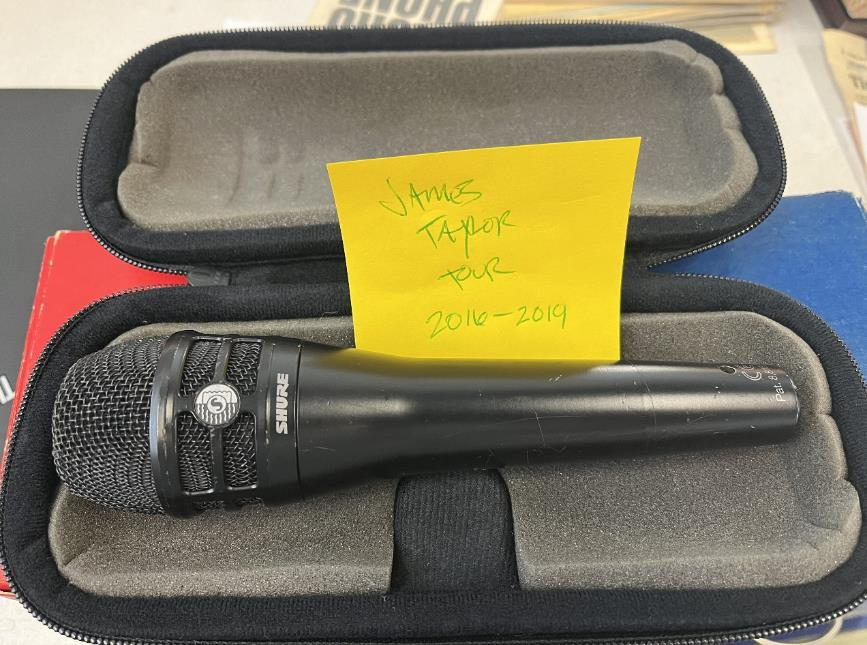
Fast-forward 80 years to 2016…the Shure Archive holds an artifact from singer James Taylor. It is his KSM8 microphone employed for tours from 2016 to 2019. Note the 1936 Shure logo on the mic grille.
***
Who else uses the KSM8? Pope Leo XIV – a Chicago boy by birth.