
Let us begin with a video demonstration of a Motiv Series Mid-Side mic:
The MV88 series of stereo microphones and the venerable VP88 stereo mic are Mid-Side designs. Mid-Side, abbreviated as “M-S,” requires two mic elements: one cardioid and one bi-directional, also known as a figure-8 pattern. The M-S technique combines the signal from the bi-directional mic with the signal from the cardioid mic to create a stereo image.
As a refresher, a cardioid mic picks up well from the North, not-so well from the East and West, and poorly from the South. A bi-directional mic picks up from both sides of the mic (North and South) but hardly at all from East and West. Thus, the bi-directional polar pattern looks like the number “8.”
To aid the following explanation, let’s employ the face of an analog clock:
- The Mid mic (cardioid) is at the center of the clock face and aimed at 12 o’clock.
- The Side mic (bi-directional) is also at the center of clock, proximate to the Mid mic, but is aimed at 9 o’clock and 3 o’clock. It is the number “8” lying on its side.
12 o’clock
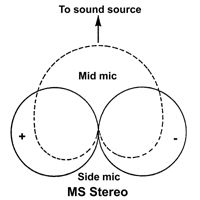
When a talker (or any sound source) is at 12 o’clock, she is “heard” quite well by the cardioid Mid mic because the Mid mic is aimed at the 12 o’clock position. But the talker at 12 o’clock is hardly heard by the Side mic because she is positioned in the “null” of the Side mic. The “null” is where a talker is barely heard by the mic.
Now, when a talker is at 9 o’clock or 3 o’clock, she is “heard” very well by the bi-directional Side mic because the Side mic is aimed at the 9 o’clock position and at the 3 o’clock position. However, the talker is “poorly heard” by the cardioid Mid mic because she is positioned “off-axis” of the Mid mic. Remember a cardioid mic, aimed at 12 o’clock, picks up poorly at 9 o’clock and 3 o’clock, and hardly at all at 6 o’clock.
When heard through a stereo system, 100% Mid signal and 0% Side signal “positions” the talker MID-way between the Left loudspeaker and Right loudspeaker.
100% Side signal and 0% Mid signal “positions” the talker to the SIDE, i.e., in the Left loudspeaker or in the Right loudspeaker.
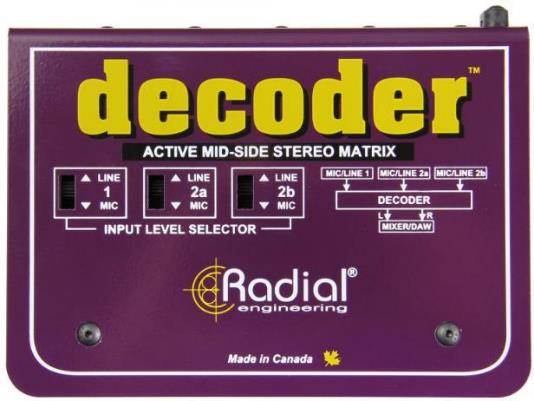
By electronically adding or subtracting the Side mic signal to the Mid mic signal, the talker can be positioned anywhere in the stereo image, e.g., far left, middle, far right, or anything in between. The addition/subtraction of the two mic signals is accomplished with an electronic mixing device called an “M-S Matrix Decoder,” or with an iPhone App that provides the function of the M-S Matrix Decoder.
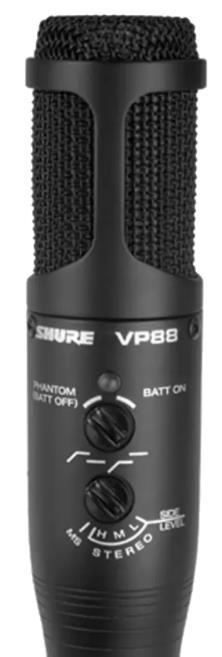
The Shure VP88 has a unique feature: an internal circuit that is an M-S Matrix Decoder. Each of its three switch settings creates a different stereo image.
A feature of M-S recording is that the Mid signal and the Side signal can be recorded as separate tracks and later decoded into stereo. The final stereo image can be decided upon months after the recording date. This is desirable for motion pictures; for example, a wide stereo aural image may be created to match a wide-angle visual image. Using an M-S microphone permits this artistic decision to be made during the post-production editing process by employing an M-S decoder.
Related information: Survey of Stereo Miking Techniques
Decca Tree Recording Technique
Tutorial on Mid-Side Recording with Audible Demos
Arcana – mysterious or specialized knowledge
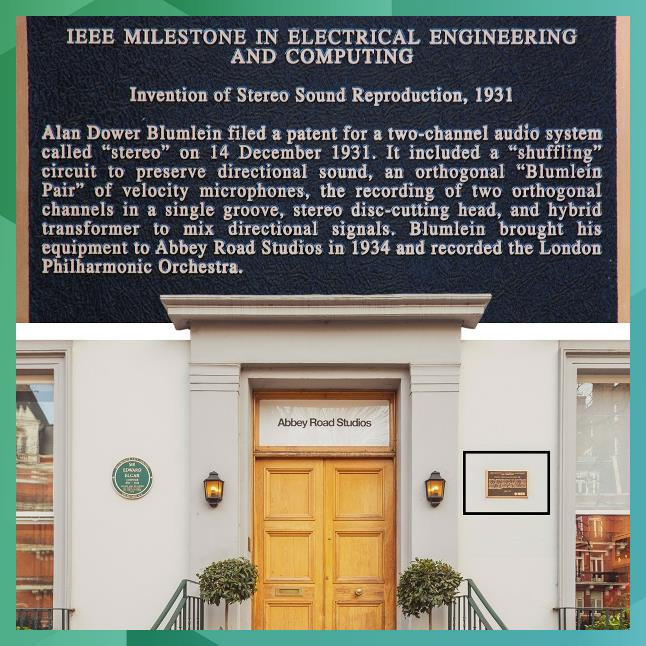
Can a stereo recording be created by using two bi-directional elements? Yes, indeed. This technique is known as a “Blumlein pair,” invented by Alan Blumlein in the 1930s.
Blumlein Pair Recording Technique

Alan Dower Blumlein (1903-1942) pioneered technologies such as stereo sound, television, and radar, before his untimely death during a top-secret wartime mission. As seen below, there is a plaque honoring him at the entrance of Abbey Road Studios in London.
***
The preferred pronunciation of “primer,” i.e., an elementary text, is prim-er. Short “i.”
