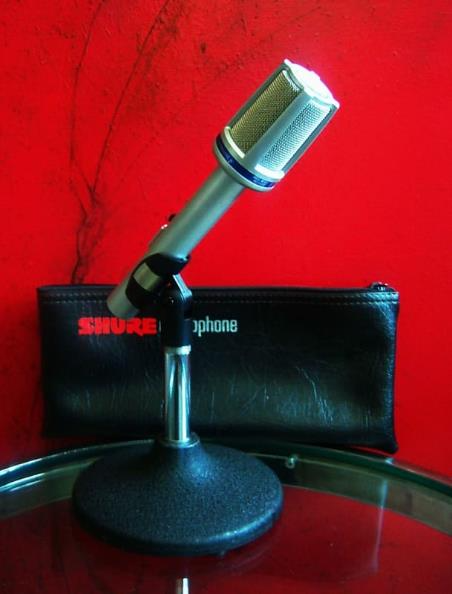
The Great Depression in the United States spanned from 1929 to 1941, with the crisis peak occurring in 1933. Beginning with the stock market crash of 1929, it was a difficult era for individuals and companies, particularly new firms like Shure, founded in April 1925.

S.N. Shure added microphones to his extensive inventory of distributed products in 1929. As the public was opting for manufactured radios in place of build-it-yourself radio kits, he needed to replace the sales dollars lost from the slowdown of radio parts.
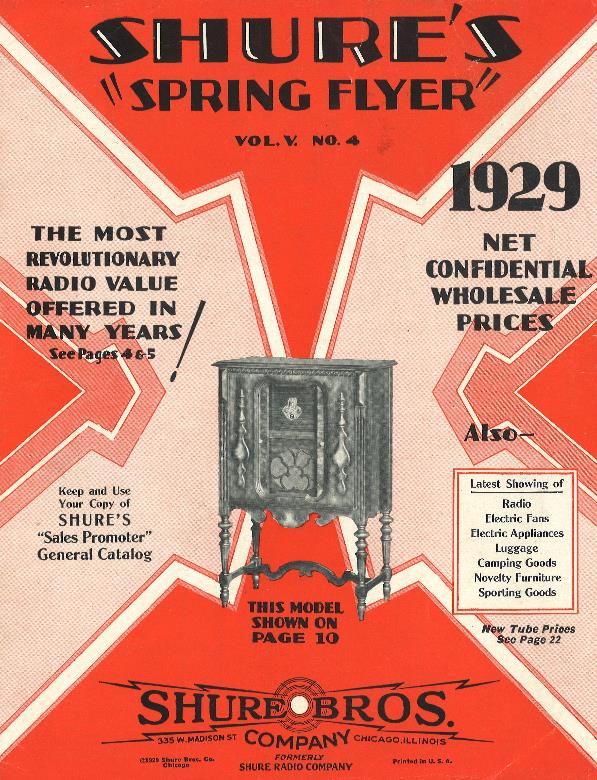
Below shows the microphones listed in our Spring 1929 sales flyer. Prior to this time, Shure Brothers Company had not sold mics. Our first two suppliers of microphones were Universal and Kellogg.
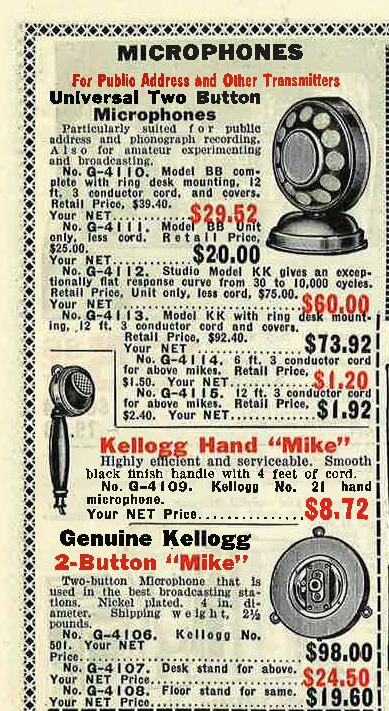
Universal Microphone Company Limited manufactured pro audio devices in addition to microphones. Universal started doing business in 1928; Shure was likely one of their original distributors. Note the price above of $60 for the Universal Model G-4112 microphone; this is the equivalent of $1,150 in 2025 currency! Professional quality mics were no bargain in the 1920s.

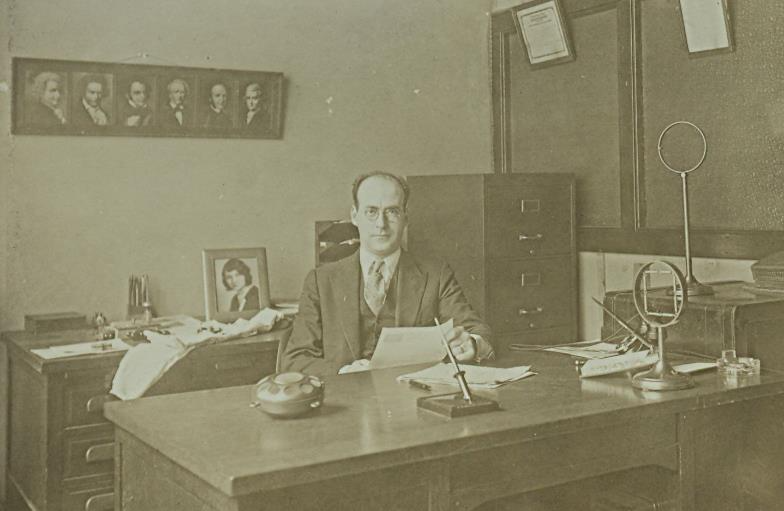
The archival photograph below is Mr. Shure, age 28. On his office desktop is a Universal microphone. Two mic supporting rings are shown in the photo, as is his first wife, Frances Shure nee Laufman, and six European composers of classical music – Bach, Beethoven, Schubert, Wagner, Mendelssohn, Mozart.
Kellogg Switchboard and Supply Company was a Chicago-based manufacturer of telephone equipment. Anticipating the expiration of the earliest Bell System patents, Milo G. Kellogg, an electrical engineer and inventor, founded his company in 1897 to produce telephone exchange equipment and other telephone devices. Kellogg Switchboard sold their products to small independent phone companies, while Western Electric supplied the vast Bell System network.

Carbon microphones, known as transmitters in the telephone business, were produced by Kellogg as part of their product line. It was straightforward for Kellogg engineers to create mic variations meant for public address, two-way radio, broadcast, and recording, but the Kellogg sales channels did not address these non-telephone customers. Along comes S.N. Shure who convinces Mr. Kellogg that Shure Brothers Company can reach these nascent markets for microphones. Mr. Shure likely employed a similar sales pitch to Ellis Electrical Laboratories in his quest to obtain distribution rights for their carbon mics… “You build them. I’ll sell them.”
By 1931, Mr. Shure was convinced microphones would be a growth market and decided to cease distributing mics and start manufacturing them. He hired our first degreed engineer, Ralph Glover, to manage transducer development in 1932. Glover received his undergraduate degree from the University of Cincinnati. This was fortuitous because Benjamin B. Bauer would enroll at the University of Cincinnati in 1935 and was tapped by Glover for a work-study program at Shure in 1936. Without this Cincinnati connection, the future of Shure Brothers Company might have been radically different, and likely not for the better.

Related information: 1929 Shure Brothers Company catalog
1933 Universal Microphone Company catalog
Shure Apps Tech Tip #431: Our First Microphone Catalog
Arcana – mysterious or specialized knowledge
In 1929, Shure Brothers Company at 335 West Madison St., Chicago was a mere 1.1 miles from Kellogg Switchboard at 1066 West Adams St.
***
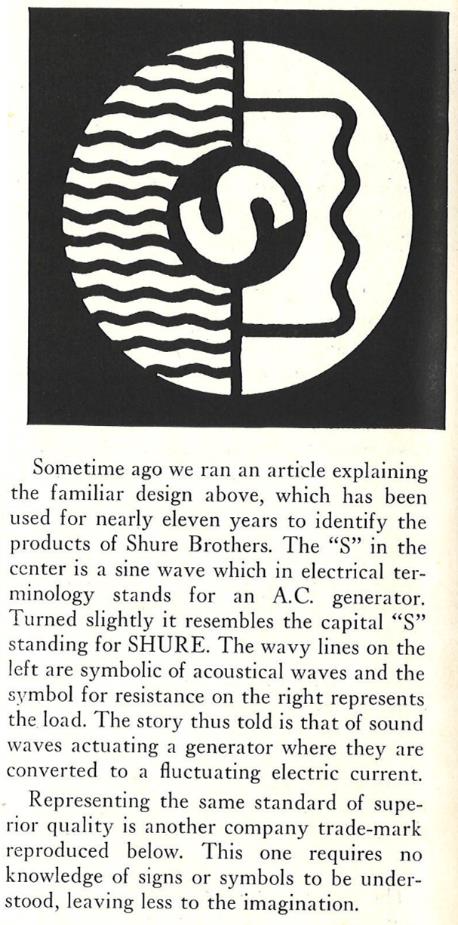
Our circle S logo was created in 1936.
***
Today’s Tech Tip shares its numerical designation with the Model 589 moving coil vocal mic. The Model 589 debuted in 1976 with a user net price of $55; it was discontinued by 1981. Advertised as “The Shape of Things To Come,” the industrial styling and “extra-efficient” pop filter were the selling points. As the mic remained on the market only five years, those features were not sufficient for success. To your author, the Model 589 looks like a Sony design.