During the Centennial of Shure Incorporated, Tech Tips are planned that document lesser-known aspects of our history. In this issue, readers will see how the Shure Radio Company marketed its offerings in 1927.
The Shure Radio Company opened on April 25, 1925, with S.N. Shure as president and sole employee. This nascent business sold wholesale to radio retailers, a model copied from the N. Shure Company – the household goods catalog house founded in 1888 by Nathan Shure, paternal uncle of S.N. Shure. The N. Shure Company did not sell to end users; it sold only to retail stores and outlets.
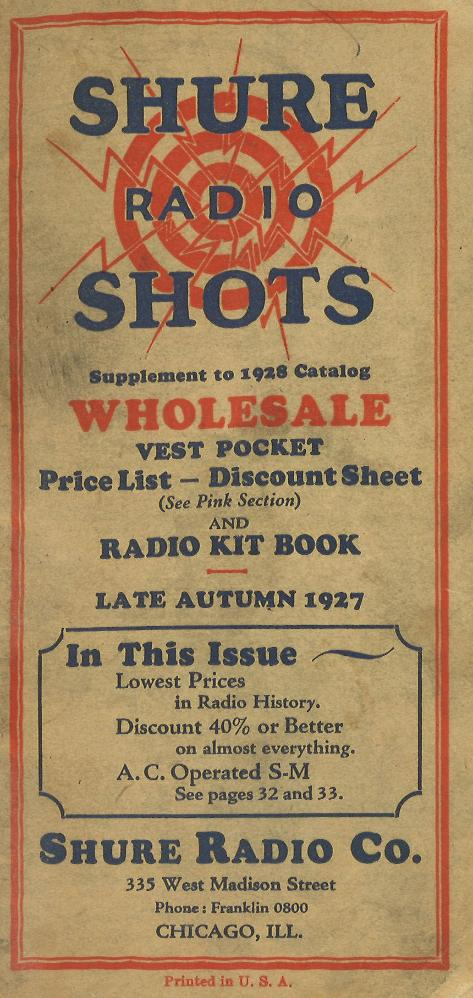
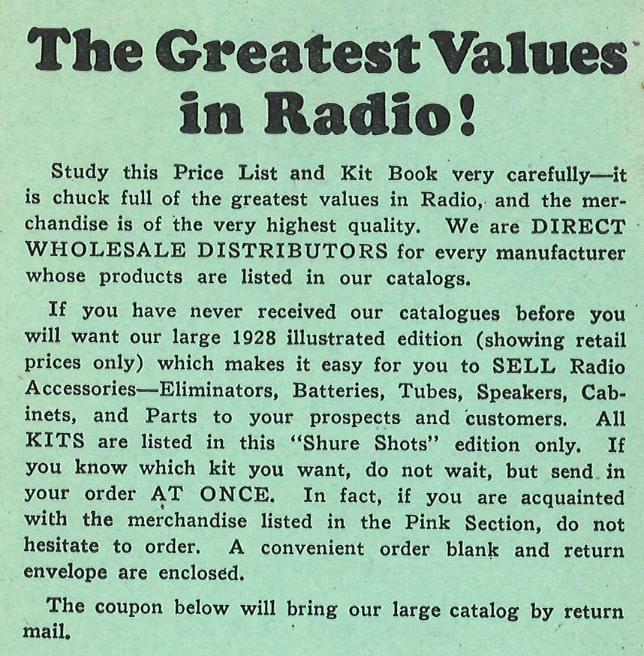
Like every wholesale distributor, the Shure Radio Company touted its low prices and quality merchandise.
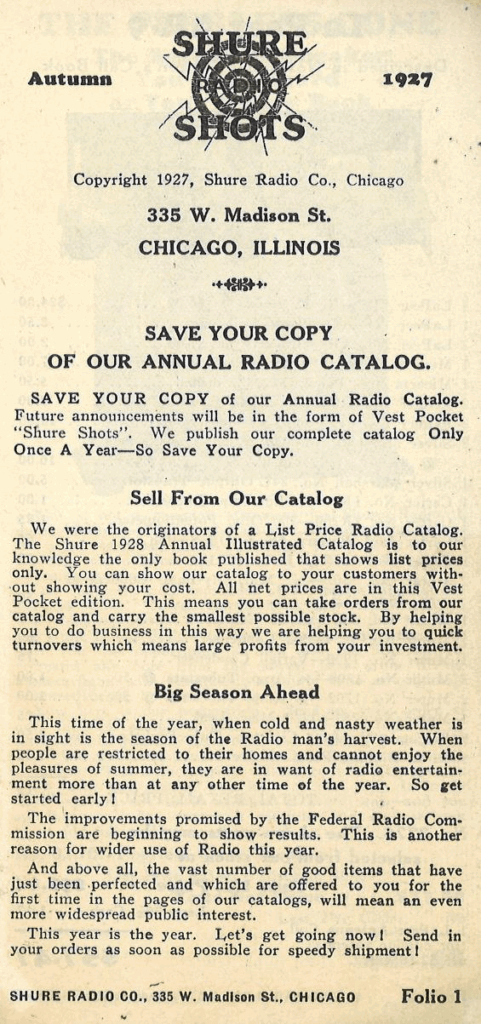
The page below contains an intriguing statement – The improvements promised by the Federal Radio Commission are beginning to show results. The Radio Act of 1927 was designed to fix the chaotic airwaves by giving authority to the Federal government to regulate broadcasting. This included:
- Eliminating signal interference: Restore order to the airwaves by establishing a system for frequency allocation and licensing.
- Adopting the “public interest” standard: To receive a license, radio stations must serve the public interest, convenience, or necessity.
- Developing a licensing system: Classify stations, assign frequencies, regulate technical standards, and set up geographic coverage zones. Require broadcasters to obtain a license for a specific frequency and power level.
- Equitable distribution of service: Ensure a fair and efficient distribution of radio service, including licenses, wavelengths, and power, to different states and communities based on population.
- Regulating station power: Limit the power output of stations to prevent them from overpowering other signals. Specific power limits will be based on the geographic area that a station intends to serve.
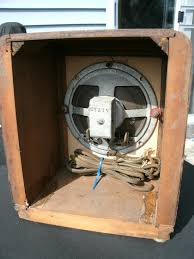
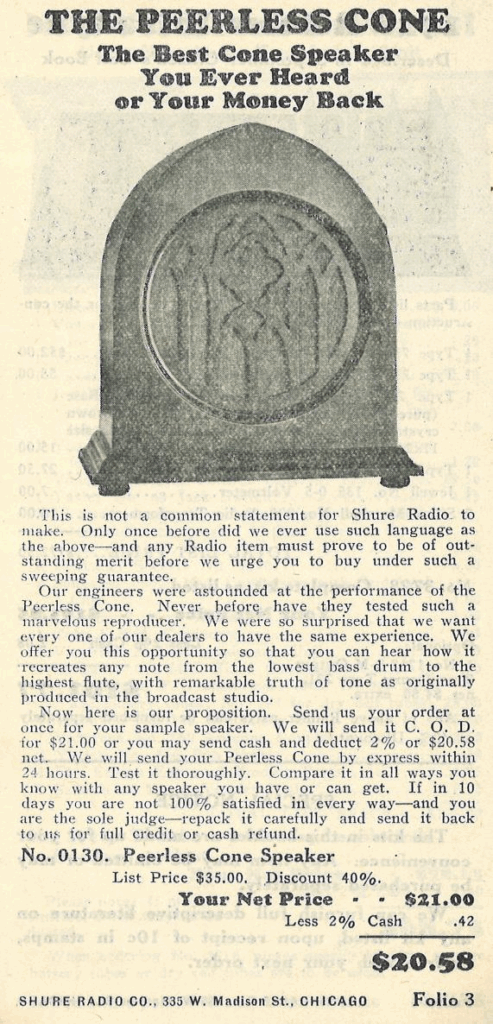
No microphones are in the Shure Radio Shots catalog of late autumn 1927, but there are loudspeakers, and one was “the best cone speaker you ever heard or your money back.”
Five years later in 1932, Shure Brothers Company would shift from wholesale product distribution to microphone manufacturing, forever changing professional audio.
Related information: 1929 Shure Brothers catalog
Arcana – mysterious or specialized knowledge
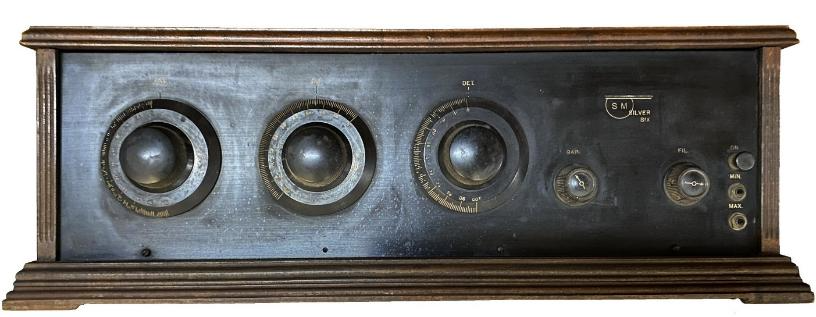
The cover of our 1927 vest pocket catalog reads “A.C. operated S-M.” “S-M” meant Silver Marshall, then a leading manufacturer of high-performance radio kits. “A.C. operated” was new as earlier radio kits required D.C. voltages from multiple batteries. In a vacuum tube radio circuit, A, B, and C batteries refer to different power supplies, not battery physical sizes like AA, C, or D. The A battery powered the tube filaments; the B battery powered the tube plates; the C battery provided bias voltage to the tube grids. The A battery supplied high-current, low-voltage power; the B battery supplied high-voltage, low-current power; the C battery supplied low-voltage, low-current power. The A-B-C system became obsolete once transistors replaced vacuum tubes.
***
McMurdo Silver, only 21 years old, started Chicago-based Silver Marshall Incorporated with his cousin John Marshall in 1924. They soon were selling kits to end users so they could build their own superheterodyne radios. RCA held the patents for the superheterodyne circuit and refused to license its patents to other radio manufacturers, thus creating a market for superheterodyne radio kits.
***
The Silver-Marshall Company was located at 116 S. Wabash, a mere ½ mile from The Shure Radio Company at 19 S. Wells.
***
Early loudspeakers often employed electro-magnets because permanent steel/iron magnets were expensive and not particularly powerful. This changed in the 1930s when Japanese inventor Tokushichi Mishima created an alloy of aluminum, nickel, and iron that had better magnetic properties than existing magnets. The addition of cobalt further improved the alloy, resulting in the ubiquitous Alnico [AL-uminum, NI-ckel, CO-balt] magnet.