
Each month features an updated reprise of a Tech Tip from ten years ago because many past Tech Tips are well worth review. Also, some will benefit from updating. Enjoy the thirty-third monthly Tech Tip reprise.
There are multiple examples of Shure microphones that were introduced with certain markets in mind, then end users discovered far better ways to employ the mics. The SM58 (Studio Microphone) was aimed at the television and radio market…but rock’ n’ roll live sound engineers had a better purpose. The Green Bullet Model 520 was targeted at the two-way radio market…but blues harmonica performers had a better use. Podcasters had a better idea for the SM7.
Then there was the SM10, introduced in 1975 and meant for live sports announcers and intercom…but the Doobie Brothers had a better concept.
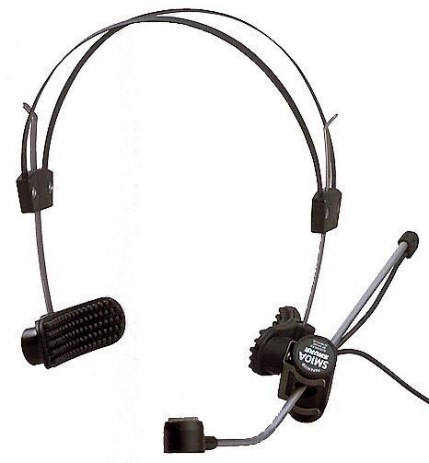
SM10A headworn mic
In 1979, your author attended a Doobie Brothers concert in Chicago. Using binoculars, I checked out the mics on stage. The vocal mics were the SM58; the guitar amp mics were the SM57, as were the drum mics that I could see. Then I noticed the lack of a mic stand and a boom arm for the drummer’s vocals. Upon extended observation, I saw a miniature boom arm extending from the drummer’s mane. When a spotlight lit drummer Keith Knudsen, I recognized the shape of the SM10 mic element.
“What a great idea,” I thought. “The drummer stays on mic no matter how he moves his head. There is no mic stand or boom arm to accidentally hit with drumsticks. The close-talk characteristic of the SM10 element reduces acoustic leakage from the drums and cymbals. Brilliant!”
The following week I approached Shure’s advertising manager with the idea of creating an ad touting the SM10 for singing drummers. My ad pitch was a lead balloon, or if you prefer, a Led Zeppelin. The manager, who was not a musician, thought this was the dumbest idea he had ever heard and that I should stick with being a regional sales manager, leaving marketing to the professionals.
Being of Norwegian heritage, thus stubborn, I persisted with the ad idea – finding photos of the Doobie Brothers drummer on stage, soliciting the support of other musicians at Shure, and bouncing the concept off music store owners. After months of whining, pestering, and cajoling, a one-page, black and white ad appeared in music magazines. Shown below, it touted the SM10 and the SM12 that featured an earpiece for monitoring.
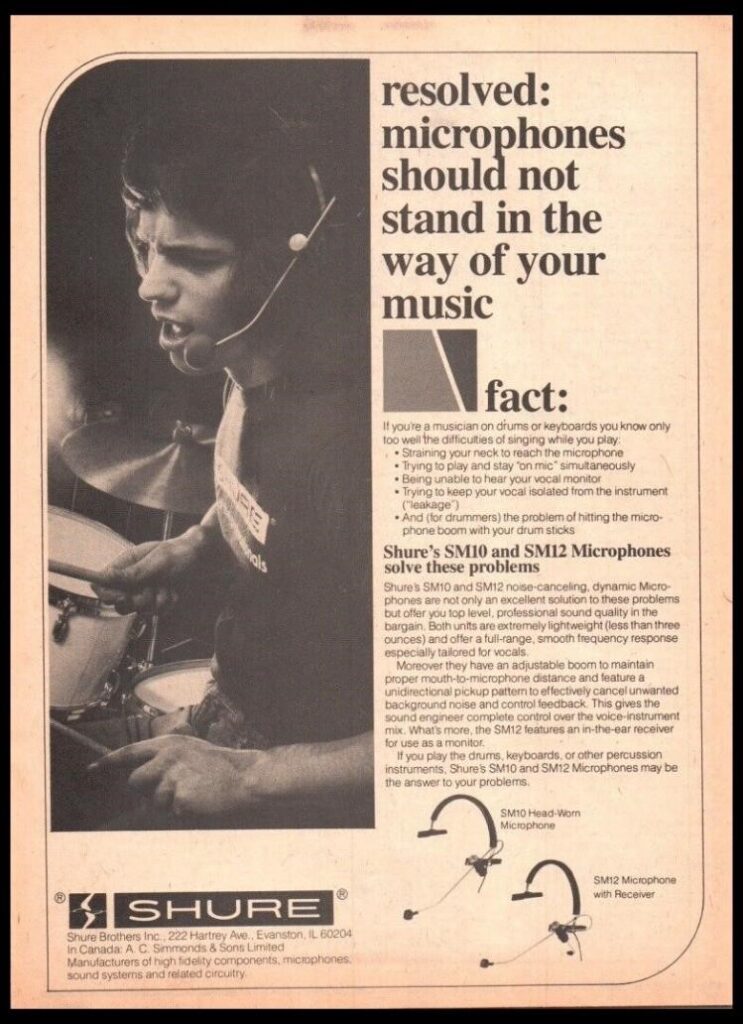
SM10/SM12 ad, 1980
One year later, the unit sales of the SM10 had increased tenfold. A music magazine review appeared with these two quotes:
“Now Shure Brothers has introduced a headset mic for drummers that effectively renders all stand-supported vocal mic systems obsolete.”
“I’d say that Shure is quite correct when they state that their headset unit may be the answer to a singing drummer’s problems. Now that I’ve use one, I honestly can’t conceive of using anything else again.”
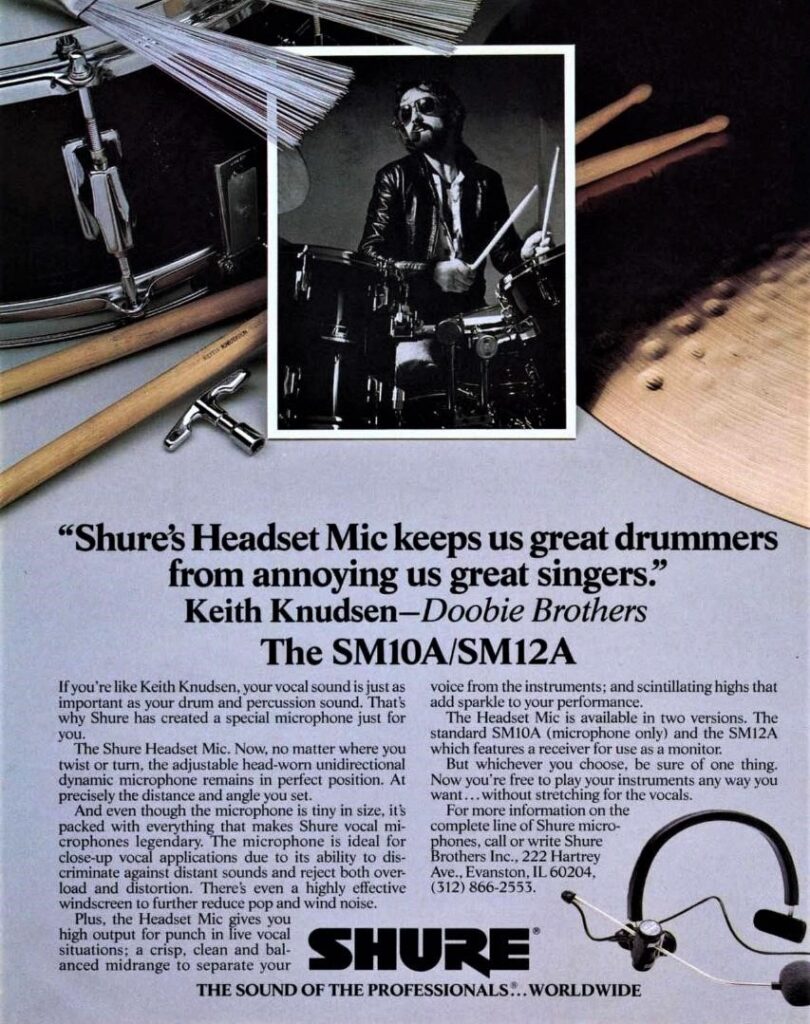
Keith Knudsen, SM10A/SM12A ad, 1982
In 1981, the catalog description ended, “The SM10 and the SM12 also provide excellent performance as vocal microphones for drummers and keyboard players.” By 1991, the catalog description began, “SM10A – The favorite of singing drummers, keyboardists, and guitarists who want complete freedom of movement on stage.”
Shure was first to market a headworn microphone for live performance. Today, a headworn mic on a performer is a common site; performers and audience members do not give it a second thought. But in 1979, this concept was revolutionary.
Related information: SM10A and WH20
