
The film “Oppenheimer” has piqued interest in the Manhattan Project, the labs at Los Alamos, the Trinity test, and the complex personalities responsible for creating the atomic bomb. Today’s Tech Tip links Shure to the Manhattan Project.
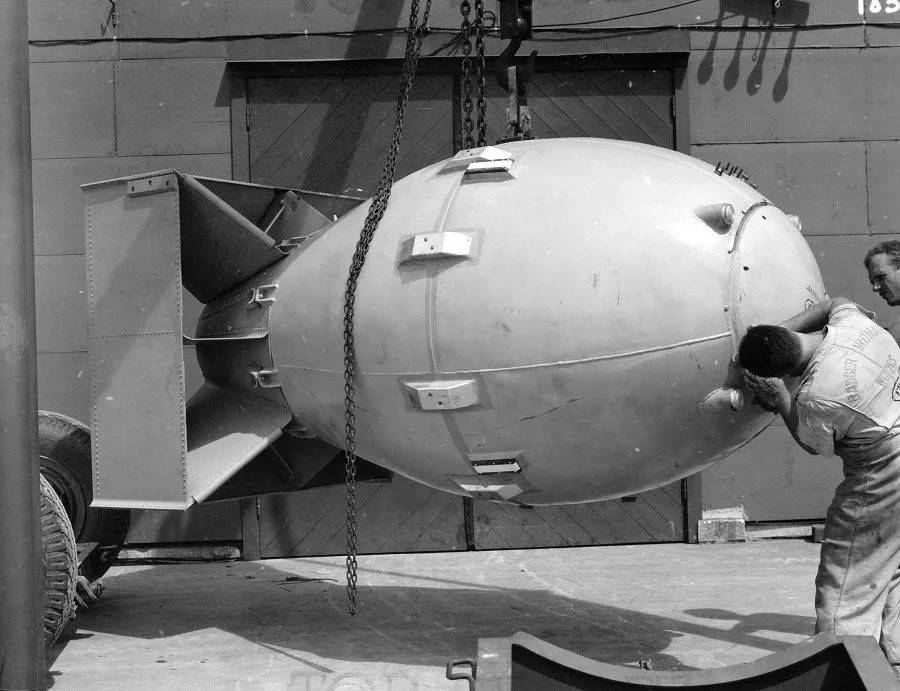
“Fat Man” bomb, detonated August 9, 1945
Shure microphones and military headphones were deployed at Los Alamos during World War Two. Our mics were used for two-way radio, intercom, direct-to-disc recording, and public address, though photographic evidence is difficult to obtain because of the top-secret nature of the facility. In the following rare photo look directly above the right foot of the seated man. Sitting on the table is what appears to be a Unidyne I Model 55 mounted to a Model S32D mic desk stand.
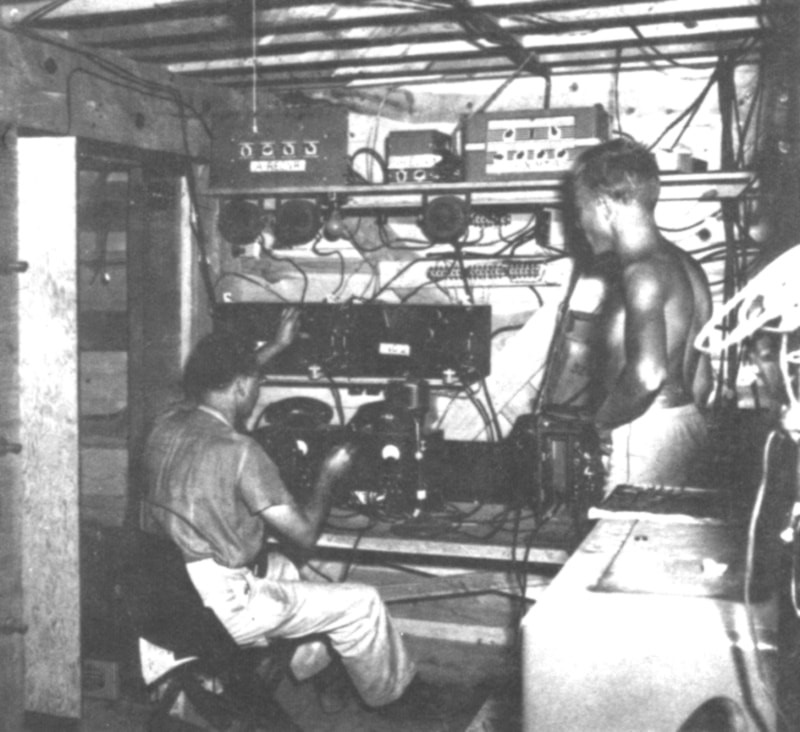
Trinity test site shelter, Los Alamos, New Mexico
Below, from the “Oppenheimer” film, is a press conference scene featuring a Shure Model 508 ribbon mic [left] and a Unidyne I Model 55 [right.] The middle mic is a moving coil Model U9S from the Turner Microphone Company, Cedar Rapids, Iowa. All three microphones are appropriate for the time period.
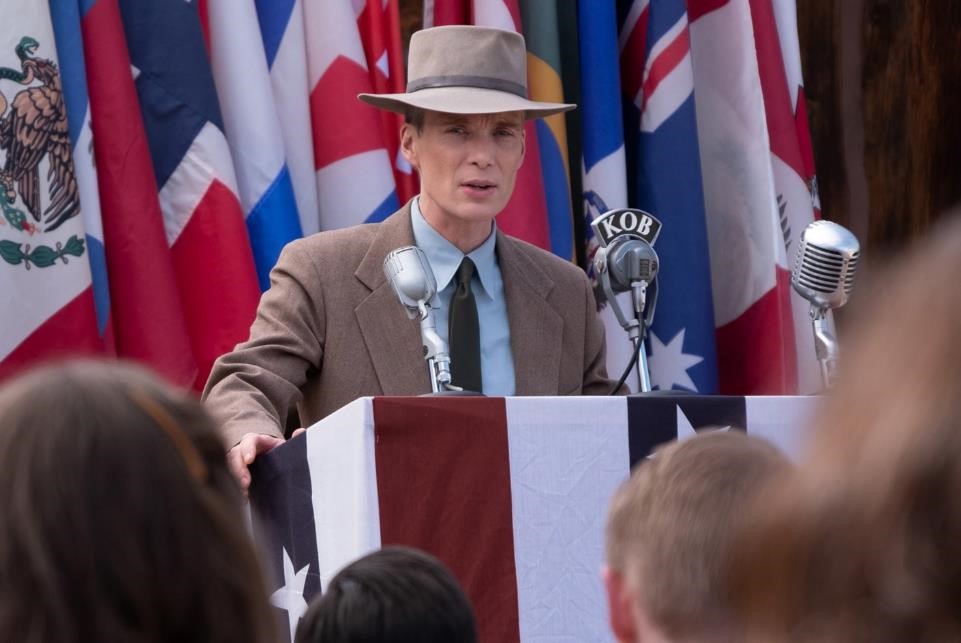
Scene from “Oppenheimer” with our Model 508 mic and Model 55 mic
In the 1960s, Oppenheimer frequently addressed scientific conferences. The following photo shows him at an American Physical Society press conference in New York City. Dr. Oppenheimer is using our Unidyne III Model 545 microphone.
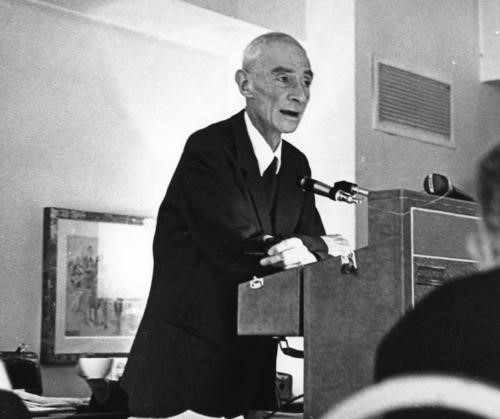
J. Robert Oppenheimer with a Model 545, New York, 1966
There was a personal connection between the Manhattan Project and S.N. Shure through his brother-in-law. First, some background information. In 1923, Mr. Shure graduated from the University of Chicago with a BA degree in Geography. He opened the Shure Radio Company April 25, 1925. In May 1929, Mr. Shure married his first wife, Frances Laufman. Her brother, Harold Laufman, also a University of Chicago graduate, had introduced Frances to Mr. Shure at a fraternity dance.
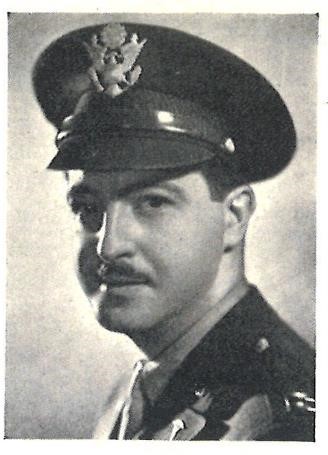
Dr. Harold Laufman, during his WWII military stint
Harold was a renaissance man – an accomplished artist, author, musician, and surgeon. In his autobiography, “One Man’s Century,” published 2006 [ISBN 978-1425-100292], he relates this fascinating tale:
In the late 1940s…
On the second floor of our Blackstone Avenue apartment building lived Enrico Fermi and Mrs. Fermi. Fermi was the great Italian physicist who won the Nobel Prize in physics in 1938 for his work in nuclear reactions brought about by slow neutrons. He had been brought to the University of Chicago to head up the wartime interdisciplinary collaboration with the Los Alamos laboratories in the development of the atom bomb. He joined other world-famous physicists to form the Institute for Nuclear Studies. Appointments to the new institute included Fermi, Cyril Smith, who had been the chief metallurgist at Los Alamos, and Samuel Allison.
Enrico Fermi (1901-1954)
Sam Allison was our third-floor neighbor. He became the director of the Institute, later renamed the Fermi Institute, when Fermi declined the directorship because he did not want to do administrative work. Allison, with his great modesty and dry humor, described his job as “the care, maintenance, and appeasement of eggheads.” Fermi and Allison not only collaborated in the pursuit of Institute matters but were close personal friends. A well-known story was about the announcement of the institute’s founding. Allison gave a speech in which he strongly attacked excessive secrecy and emphasized the necessity of the free exchange of scientific information. If research were to be hampered by military regulations, he believed research workers in America would leave the field of atomic energy and devote themselves to “studying the color of butterfly wings.” Fermi added to this point by saying, “It is not that we will not work for the government, but rather that we cannot work for the government. Unless research is free and outside of governmental control, the United States will lose its superiority in scientific pursuit.”
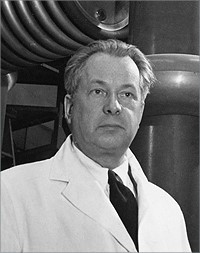
Sam Allison (1900-1965)
During the war, Sam Allison was a consultant to the National Defense Research Council and later became the director of the University of Chicago laboratory that achieved the first controlled release of nuclear energy. Allison exhibited extraordinary patience and insight during his administrative job at Los Alamos and kept his crew of geniuses focused on the main job – to achieve success before the Nazi scientists.
Allison was the voice of the countdown when the first atomic device was exploded in the New Mexico desert, July 1945. That countdown received a great deal of attention in descriptions of the event by press and radio. Sam quipped he was “the only scientist who became famous for his ability to count backwards.”
Despite the great worldwide fame of my two neighbors, we would meet, chat, and often take after dinner walks as a threesome along the University of Chicago Midway at dusk. We would discuss mundane subjects such as the Midway having been the site of the 1893 Chicago Columbian Exposition, when the sunken Midway areas, now covered with beautiful green lawns, served as the canal running down the main promenade of the Exhibition.
Neither Fermi nor Allison had children of their own. They both formed relationships with our children, playing with little Donnie and Laurien. Professor Fermi made it a special point of greeting Laurien when she was in her buggy. He would coo, speak to her in baby language, and tweak her chin. She would respond with baby language and smile. Not every infant can claim to have played with a Nobel Prize winner.
Related information: Shure Apps Tech Tip #477: Operation Crossroads – Shure Was There
- Tech Tip #477 documents the post-war atomic bomb tests at Bikini Atoll and how our mic models 702A and 708 played a role.
Harold Laufman – One Man’s Century with Pen, Brush, Fiddle, and Scalpel
