
As for me, I am tormented with an everlasting itch for things remote.”
― Ishmael, from Moby-Dick, or The Whale by Herman Melville

Loyal readers, avast and behold a great white whale that proved elusive for decades.
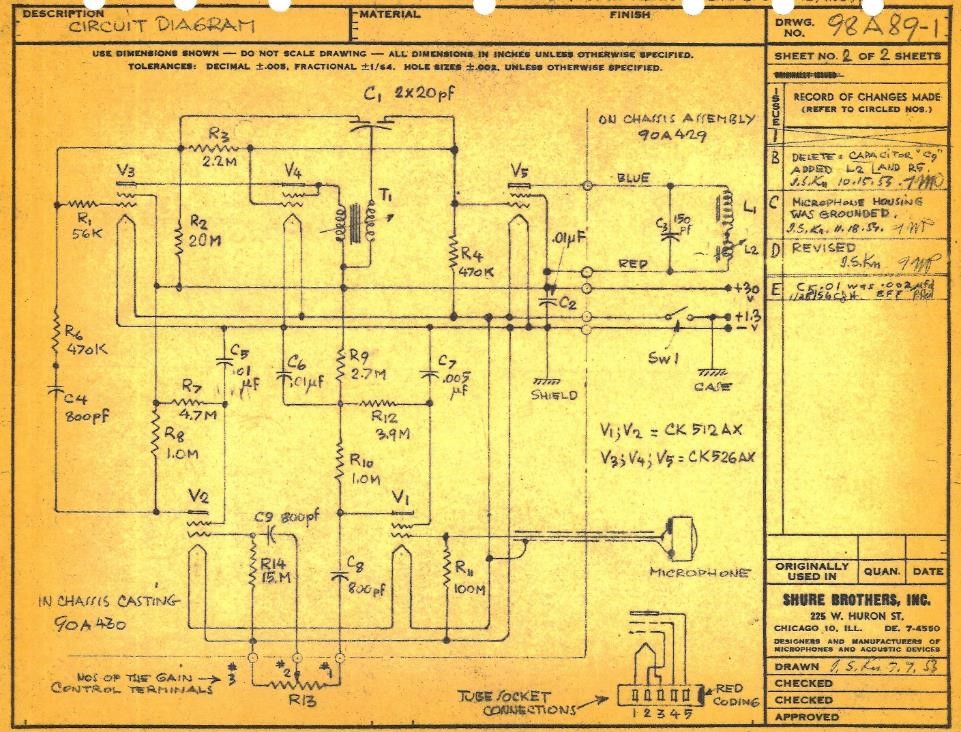
Vagabond 88 T schematic
Gaze upon the long-concealed 1953 circuit for our wireless Vagabond 88T transmitter – the world’s first handheld wireless microphone. This diagram, never available to the public, was found January 30, 2024, in a banker’s box stored offsite for over sixty years.
Interesting aspects of the Vagabond 88T circuit:
- Omnidirectional, ceramic mic element (lower right)
- V1, V2, V3, V4, V5 miniature vacuum tubes/valves
- R13 gain control for the mic element (lower left)
- 30 Vdc battery connection (middle right)
- Date of diagram, July 7, 1953 (lower right corner)
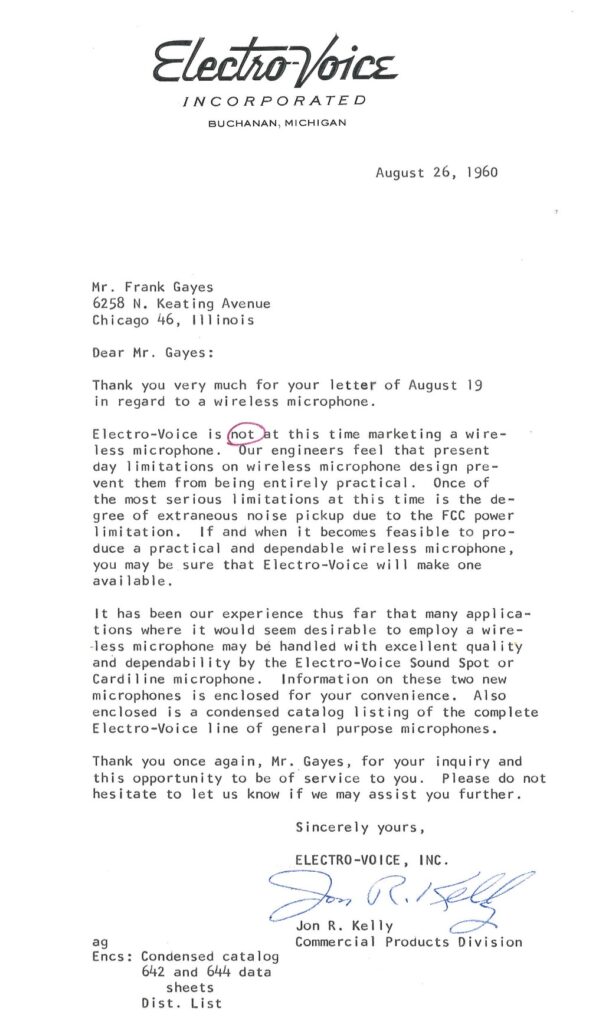
The banker’s box also held a binder documenting wireless microphone products from the 1950s; systems manufactured by Sony, Stephens Tru-Sonic, Budelman Radio, and Sacramento Industrial Television Corporation. These competitive wireless systems were meant for motion picture or television production. Our Vagabond 88 targeted public address/live performance venues, e.g., houses of worship, music clubs, and Las Vegas showrooms.
The binder contained letters from manufacturers explaining their stance on wireless microphones. For instance, “Electro-Voice is not at this time marketing a wireless microphone. Our engineers feel the present-day limitations on wireless microphone design prevent them from being entirely practical. One of the most serious factors at this time is the degree of extraneous noise pickup due to the FCC power limitation.” In the letter, Electro-Voice recommends using a Cardiline shotgun microphone for distant miking instead of a wireless mic.
To discourage reverse engineering, many of the Vagabond’s passive electronic components were embedded, and thus concealed, in an epoxy-like black substance positioned between the mic element and on/off switch. This embedding also limited damage when the transmitter was dropped.
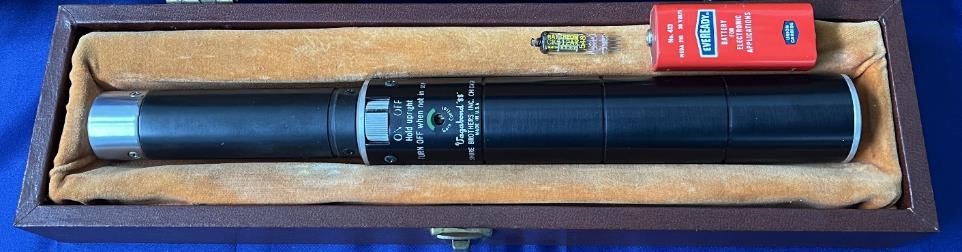
Shure Vagabond 88T transmitter, miniature vacuum tube, 30 Vdc battery
With the capture of the 88T schematic, your author’s incessant Vagabond itch is scratched…for now.
Related information: Vagabond 88 FAQ
1955 catalog with the Vagabond 88
“Moby Dick” or “The Whale” – online at Project Gutenberg
Arcana – mysterious or specialized knowledge
Printed on the reverse of the 88T schematic: “RESTRICTED – NOT TO LEAVE SHURE BROTHERS, INC.”
***

1954 magazine ad
***
The Vagabond 88 was newly discontinued in 1960 and the aforementioned binder held marketing research to determine if Shure would remain in the wireless mic market. Did Shure develop a transistorized wireless system in the 1960s? No, we did not. Demand for hi-fi components was exploding with stereo phono cartridges in high demand. Shure management decided to pursue the more profitable path: moving magnet phonograph cartridges. During the 1960s and 1970s, phonograph products accounted for > 65% of our total sales and >75% of our profits.
***
Shure engineer Elmer Carlson (1920-2003) developed the circuitry for the Vagabond 88 wireless system. He began this effort in March 1947. After leaving Shure in the late 1950s, Elmer enjoyed a distinguished career of forty years at Knowles Electronics.

Elmer Carlson – Shure development engineer
