
Originally posted October 2018, this updated Tech Tip #548 is reissued in homage of the Model 548.
Let’s begin with a brief history of the Unidyne family:
1939: Shure Model 55 Unidyne I – world’s first unidirectional, single element, moving coil dynamic microphone. A revolutionary breakthrough in the science of electroacoustics. Earns a patent for Ben Bauer in 1941. Garners the IEEE Milestone Award in 2014.
1951: Shure Model 55S Unidyne II – advertised as “The Microphone That Needs No Name” because of its immediate success. Still manufactured in 2024.
1959: Shure Model 545 Unidyne III – wellspring of the SM57, SM58, and Model 565. Direct ancestor of the Beta 56, Beta 57, and Beta 58. Secures a patent for Ernie Seeler in 1966. The world’s most popular microphone for live sound.
1968: Shure Model 548 Unidyne IV…What? Shure made a Unidyne IV? Why?
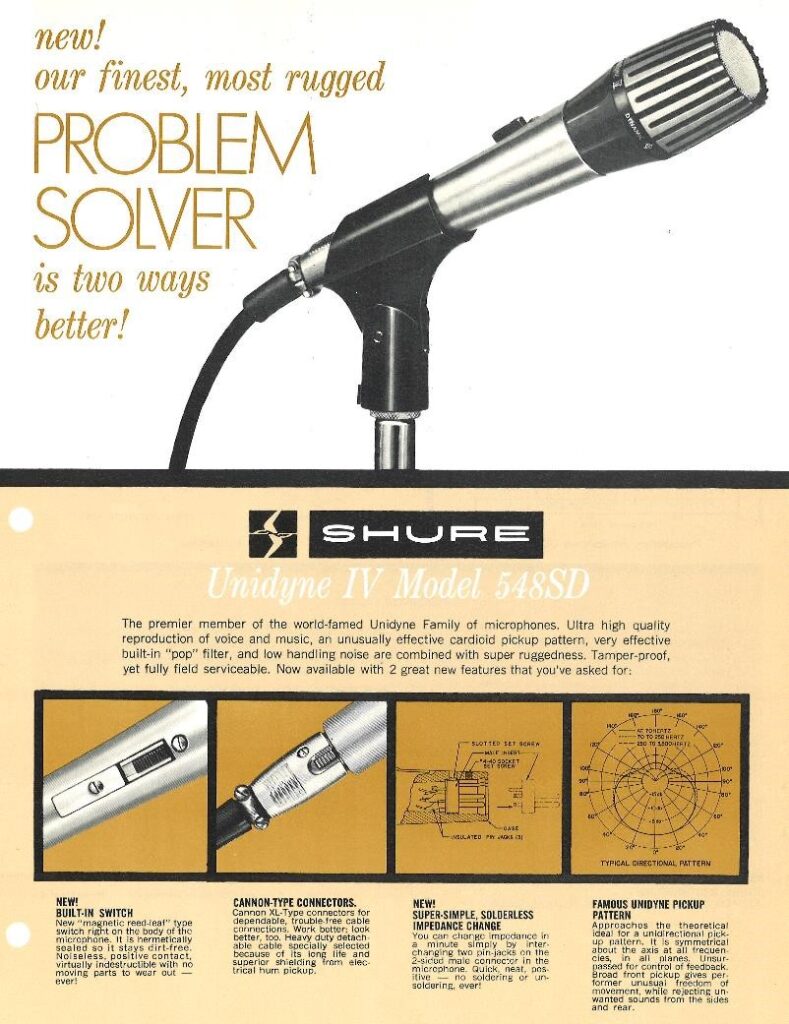
Unidyne IV Model 548 sales flyer, 1970
For years, the Unidyne IV haunted your author. As the Unidyne I, II, and III were significant developments in transducer technology, so it must have been with the Unidyne IV. The term “Unidyne IV” forcefully implied the next generation of microphone wizardry.
Having received numerous customer inquiries about “that odd mic that looks like the original Beta 57”, it was time to unmask the Unidyne IV.
As mentioned, Shure introduced the Model 545, the first Unidyne III, in 1959. By 1965, the 545 was a success in the live sound arena, particularly for rock, soul, and rhythm & blues. Shure Marketing learned that a more durable mic grille, i.e., all metal, would be a welcomed improvement as drumsticks, or rough handling, could damage the plastic/metal grille of the 545.
To address this issue, Shure designed a machined metal grille and a new closing ring, i.e., the section directly below the grille. In 1968, the Models 548, 548S, and 549 hit the market, nine years after the Model 545 debut. These new models carried the designation of Unidyne IV.
It was puzzling why a grille change warranted the venerable title of Unidyne IV. To investigate, I compared the 1970 Unidyne III sell sheet to the 1970 Unidyne IV sell sheet. The technical specifications were nearly identical, except for a slight frequency response deviation above 5 kHz attributed to the new metal grille. The Unidyne IV product description reads:
The premier member of the world-famed Unidyne family of microphones. Ultra-high-quality reproduction of voice and music, an unusually effective cardioid pickup pattern, very effective built-in “pop” filter (the new grille), and low handling noise are combined with super ruggedness. Tamper-proof (how?) yet fully field serviceable. Now available with the great features that you’ve asked for: Built-in switch (same as the Unidyne III), Cannon-type connectors (same as the Unidyne III), Super-simple solderless impedance change (same as the Unidyne III), Famous Unidyne pickup pattern (same at the Unidyne III).
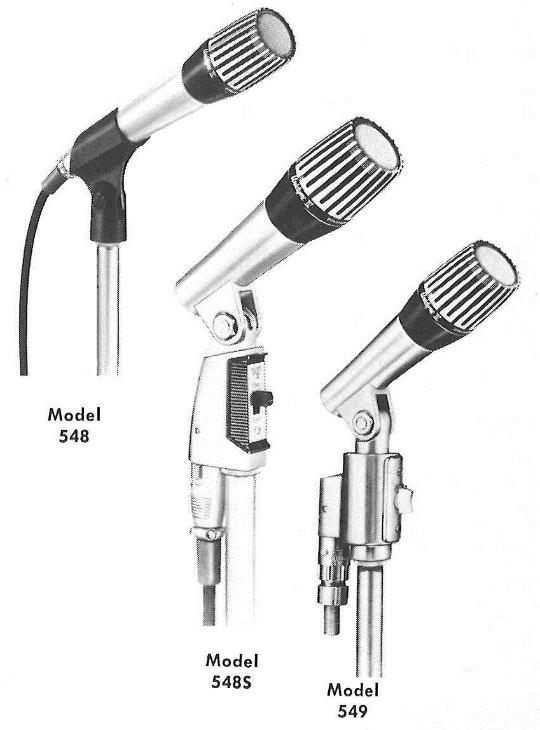
The Unidyne IV family
I could not ascertain any acoustical breakthroughs to merit the use of Unidyne IV, so I consulted with two Shure mic development engineers: Yuri Shulman, now retired, and Roger Grinnip. To assist our investigation, we methodically disassembled a Unidyne III manufactured in 1969 and a Unidyne IV manufactured in 1970. After an hour of Crime Scene Investigation scrutiny comparing the microphone interiors, Roger shrugged and opined, “To me, the Unidyne IV looks like a Unidyne III.” Yuri agreed. The Unidyne IV was a Unidyne III with a new grille and new closing ring…only this and nothing more.
Why would a grille redesign justify the Unidyne IV label? A hypothesis is that Shure sales management knew the Unidyne name had brand power and understood that the term Unidyne IV would help establish the Models 548, 548S, and 549 in the marketplace. I can envision the distress within Shure about employing Unidyne IV as a “sales pitch,” followed by arguments between Engineering (Lee Gunter) and Advertising (Howie Harwood).
Gunter: Unidyne has always connoted a notable advancement in microphone acoustical design. To use it for a grille change would demean the term. (Not to mention mislead a certain future Shure historian!)
Harwood: Lighten up, Lee. It’s just a word.
By 1981, the three Unidyne IV models were discontinued. Equivalent models in the SM line were never created. Lost in the mists of history are the reasons for the demise of the Models 548, 548S, and 549, but I suspect disappointing sales combined with high manufacturing costs.
Though the nomenclature of Unidyne IV did not live on, the industrial design of the 548 grille influenced the distinctive machined metal grille of the original Beta 57.
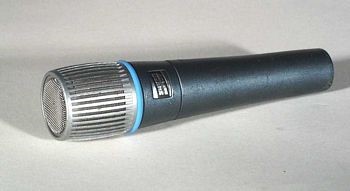
All-metal grille on the original Beta 57
And so, my dear Doctor Watson, the case of “The Unidyne IV Conundrum” is solved and closed.
Related information: Shure 1968 Catalog
Arcana – mysterious or specialized knowledge
The original Beta 57 grille was exceptionally rugged like the Unidyne IV grille. Why was the Beta 57 grille altered? First, the original grille was difficult to manufacture and therefore expensive. Second, when struck by a drumstick, the metal grille would resonate with an audible, cymbal-like, pitched tone – not a desirable feature for a professional microphone.
***
During the 1970s, Showco was a premier provider of sound reinforcement equipment and services to the fledgling arena concert touring industry. Showco took a liking to the Model 548 and placed the mic onstage with many acts. Showco, founded in Dallas, Texas, by Rusty Brutsche, Jack Calmes, and Jack Maxson, pioneered post-Woodstock Festival stadium rock concerts for major performers like Led Zeppelin, Paul McCartney & Wings, Eric Clapton, James Taylor, and many others. In 2000, Clair Brothers Global acquired Showco.
***
