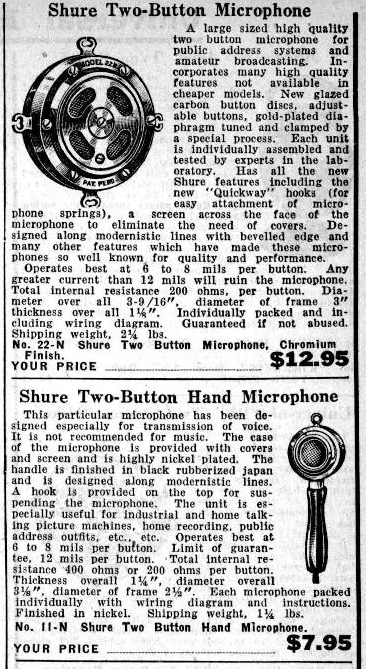
The 1930s were pivotal for Shure Brothers Company. We entered the decade as a distributor of products then exited as a manufacturer of innovative audio transducers. During this time, multiple market forces affected Shure. None were more important than the rapid development of smaller and affordable public address systems.

Here is a 1935 article that appeared in the catalog of the Radio Trading Company, New York City.
P.A. Systems — A New Field for the Service Man
Today, more than ever before, public address work offers money making opportunities for wide-awake service men who have the gumption to go out after business. Amplifiers and accessories are available in great variety to suit numerous purposes, and their prices have reached levels that were considered impossible only a few years ago. You can quote reasonable figures for even large installations and still make a profit.
You must not expect business to fall into your lap without effort on your part. Acquaint yourself with the various public places of your city and consider them all as prospects. Even in very small towns there are many promising possibilities. As prospects for permanent indoor installations of small or large size, jot down the names and addresses of all the local establishments of the following classifications: churches, dance halls, skating rinks, lunch wagons, restaurant, schools, factories, lodge halls, and auditoriums.
How to Get Business
Go after the churches first. Because of their size and architecture, their acoustics are usually poor, and many a good preacher finds himself handicapped by his inability to make his natural voice heard in the back rows and in the balcony. The use of a P.A. amplifier and a few judiciously placed loudspeakers has increased attendance at more than one house of worship.
Of course, you want to make sure that a particular church would benefit by the addition of a P.A. unit. Simply attend yourself and make personal observations on the spot. This is the only way to prepare yourself for any sales campaign. In business, as in war, preliminary preparation is half the battle.
Dance halls and skating rinks, which are the main places of amusement in many towns, are naturals for the service man. Look up the places that now use only three- or four-piece bands, or perhaps a radio receiver that is overloaded beyond the point of respectable quality. Talk to the owners and show how they can make their halls more attractive by playing selected, high-grade phonograph records, made by the most expensive bands in the country, instead of annoying the customer with a sour saxophone or an untuned piano.
Most communities are very proud of their schools and will spend considerable money on them in preference to other municipal undertakings. Therefore, by all means, approach the school board and present the idea of a public address amplifier for general use throughout the school building or buildings. In many schools, a microphone is permanently located on the principal’s desk, so that he can make announcements to all classes simultaneously through loudspeakers in the individual classrooms.
If the school auditorium is also the town meeting place and the center of political and social activities, you have even a stronger argument. Always emphasize the fact that lecturers, entertainers, et al, do not have to exert themselves in order to fill the hall; they merely speak or sing in their natural voices and the P.A. unit does the rest. Play up the microphone stuff. The mic has a magic, irresistible attraction that rarely fails to entice the people who step in front of it.
You may wonder why factories are included on the list of prospects. The answer is that they represent a veritable gold mine. While many plants are running at reduced capacity, there are plenty that are still busy, and there never has been any let up in some lines. For creating and maintaining employee morale, particularly in factories where the work is monotonous, there is nothing like a P.A. system reproducing phonograph music through a few scattered loudspeakers. Numerous companies are using this scheme and are finding it highly effective.
As in other fields of salesmanship, nothing is as effective as a demonstration. In the case of P.A. amplifiers you can make them talk for themselves. People who have had no experience with such devices do not fully appreciate their possibilities, and they must be made to talk into a microphone and also hear some real phonograph music. This means you must have an amplifier available and must be prepared to demonstrate it on the prospect’s own ground or in some other easily accessible area place. You must not expect a customer to buy something “sight unseen” or rather “sound unheard” in this case. Your purchase of one amplifier to start with represents your investment in a business. Once you have installed the first job you can then bring prospects around to hear it under actual working conditions, and things will be easier from then on.
Make sure the local papers know about the first installation. They are always anxious to get local news and may be able to give you extremely valuable publicity. Don’t be modest; call them up and tell them all about it. If you don’t blow your own horn, no one else will.
Before you open your sales attack, you want to have a pretty good idea of what kind and size of amplifier and how many loudspeakers will meet the particular requirements. You should figure on a microphone, a phonograph turntable with pick up, and plenty of outside wire. This latter detail is an important one, and many a service man has come to grief over it because he neglected to include it in his bill of materials. By the time you get finished draping wire around corners, up poles, over rooftops, and down buildings, you may need several hundred feet.
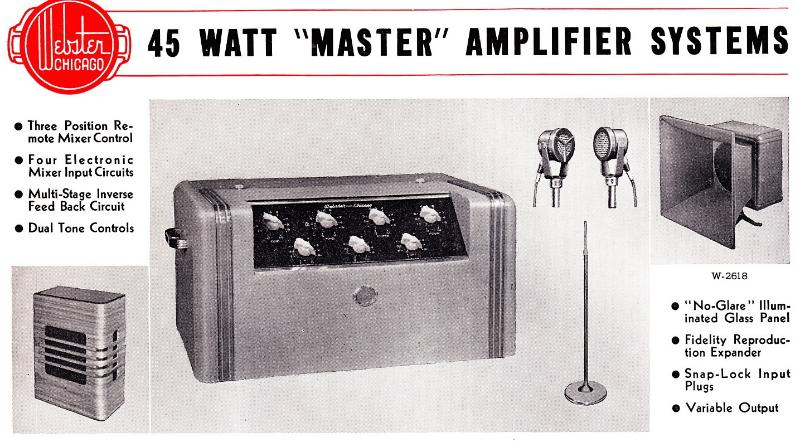
Installation Problems
Because the loudspeakers and sometimes the amplifiers themselves are used outdoors and are therefore liable to damage by the elements, the question of service and maintenance in outdoor PA work is of paramount importance. Exposed horns should be tilted mouth-downward to prevent rain and snow from accumulating. Dynamic loudspeakers with baffles should be carefully boxed up or protected by false tops. Connecting wires must have thoroughly waterproof insulation, and all soldered joints must be made with rosin-core sadder. The humid atmosphere around swimming pools, particularly saltwater pools, raises the very devil with poor connections and unprotected surfaces. If possible, install the amplifier, the microphone, and the phonograph turntable in the manager’s office, where it will not be tampered with. Encouraged the manager himself to make his announcements via the mic. He’ll probably soon learn to like his own voice, and you’ll have a strong local booster for P.A. systems.
Free Service
Since the outdoor season is comparatively short, you can offer free service on your installation the first year without losing all your profit. This will undoubtedly appeal to the prospect, as he doesn’t have to worry then about the apparatus, except for paying for it.
Nine decades later, Tech Tip readers may be bemused by the naive and rudimentary statements in the Radio Trading article. However, every germinal market requires explanation. Your author vividly recalls seeing an early Apple computer in a North Carolina electronics store circa 1978 and asking the shop owner, “Why would anyone need a computer at home?” After the owner explained, he advised, “Invest in Apple, son. It’s going to be big.” Oh, if only I had…

During the 1930s, S.N. Shure closely watched the burgeoning market for P.A. systems. Following the 1939 introduction of our revolutionary Uniplex Model 730 and Unidyne Model 55 unidirectional microphones, Shure Brothers issued the following statement in national trade magazines.
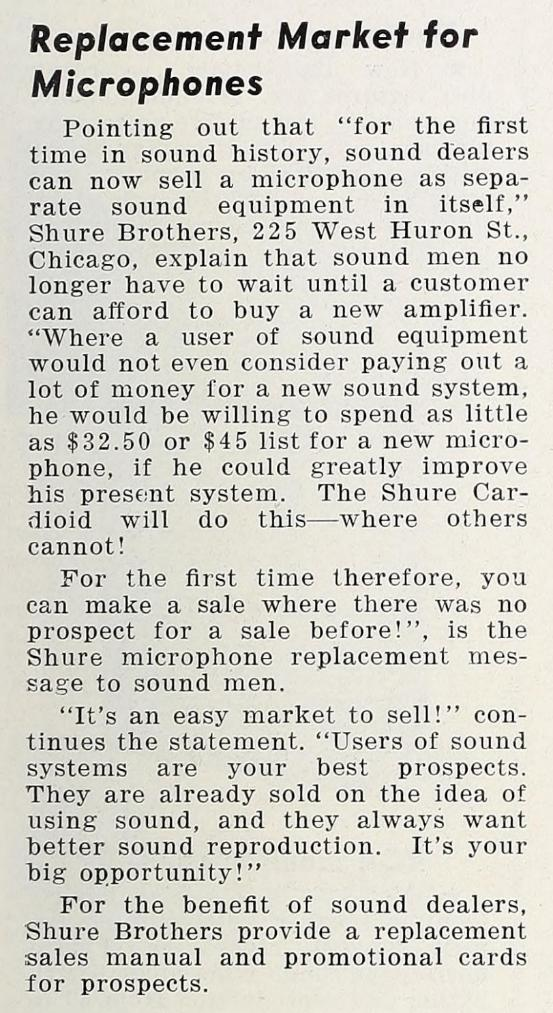
Mr. Shure foresaw a nascent opportunity where microphones were sold as aftermarket upgrades. This idea might seem axiomatic in 2026, but it was not so eighty-five years ago.
Related information: 1939 Shure catalog featuring the Uniplex and Unidyne models
A Brief History of P.A. Systems
Arcana – mysterious or specialized knowledge
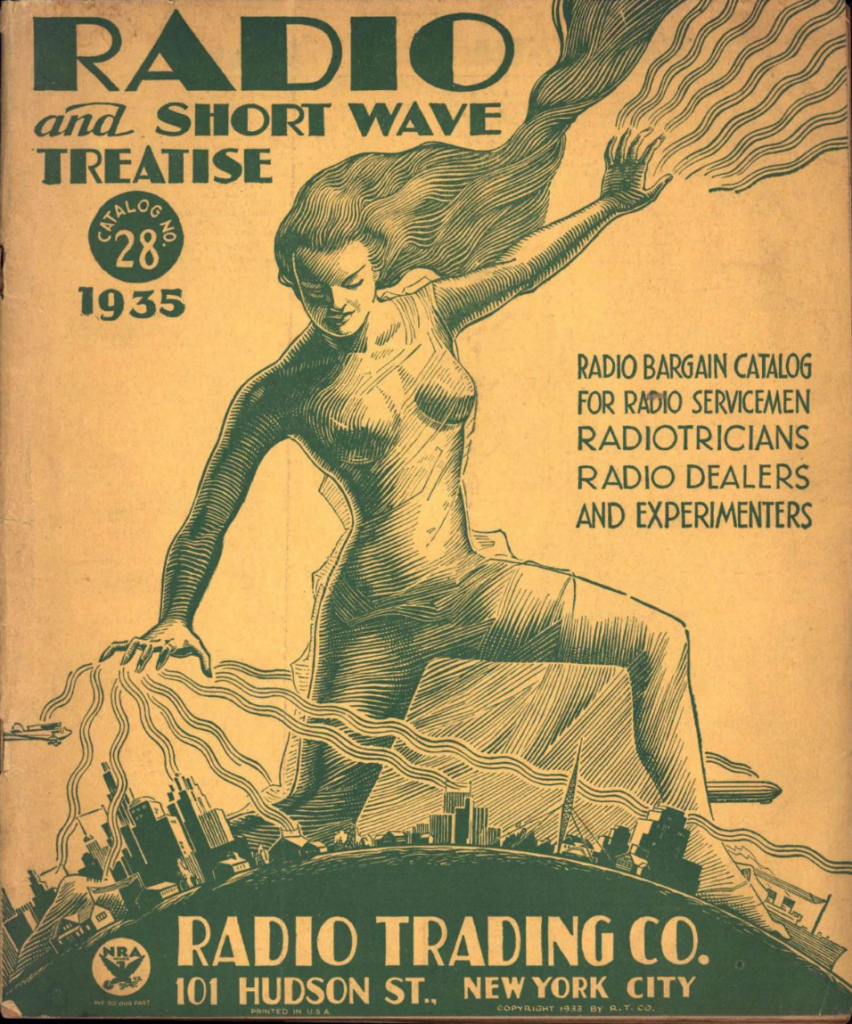
Here is the Art Deco inspired cover of the Radio Trading Company catalog.
***
Shure microphones listed in the 1935 Radio Trading Company catalog.