As this date is April Fools’ Day, let’s look back at arguably the most successful hoax in radio history: The War of the Worlds; Orson Welles’ hyper-realistic radio dramatization of Martians invading Earth.
Welles was twenty-three years old when his Mercury Theater On The Air company updated the H.G. Wells 19th-century science fiction classic, The War of the Worlds. Despite his youth, Welles had been in radio for several years, notably as the voice of The Shadow in the hit mystery program of the same name.
The War of the Worlds radio drama was not meant to deceive. Welles had little idea of how legendary it would eventually become. The show began on Sunday, October 30, 1938, at 8 p.m., Eastern time. The announcer intoned: “The Columbia Broadcasting System and its affiliated stations present Orson Welles and the Mercury Theater On The Air in The War of the Worlds by H.G. Wells.”
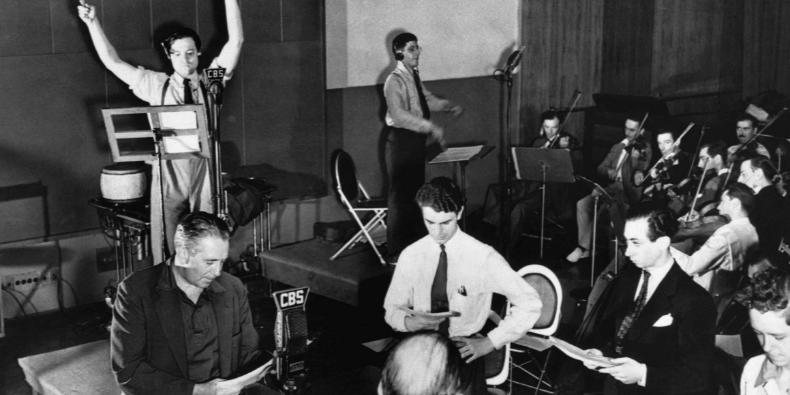
During the 1930s, Sunday evening was primetime in the golden age of radio. Millions of U.S. citizens were listening to their radios. Most heard ventriloquist Edgar Bergen and his dummy Charlie McCarthy on NBC, then tuned to CBS at 8:12 p.m. after Bergen’s comedy sketch ended and a little-known singer went on. Disoriented listeners stumbled onto the “Mercury Theatre on the Air” without having heard the disclaimer at the beginning of the radio play. They were thrust into the middle of an hour-long drama that left many believing that the country was under attack. In their minds, a Martian invasion was underway.
Welles opened his radio play with a spoken introduction, followed by a weather report. Seemingly abandoning the storyline, the announcer took listeners to “the Meridian Room in the Hotel Park Plaza in downtown New York, where you will be entertained by the music of Ramon Raquello and his orchestra.” Music played for some time before a news alert aired.
An announcer broke in to report that a Professor Farrell of the Mount Jenning Observatory had detected explosions on the planet Mars. The dance music resumed, followed by another interruption in which listeners heard that a large meteor had crashed in a farmer’s field near Grovers Mills, New Jersey.
A news reporter was soon (much too quickly) at the crash site describing a Martian emerging from a large metallic cylinder. “Good heavens, something’s wriggling out of the shadow like a gray snake. Now here’s another and another one and another one. They look like tentacles to me! I can see the thing’s body now. It’s large, large as a bear. It glistens like wet leather. But that face, it… it … ladies and gentlemen, it’s indescribable. I can hardly force myself to keep looking at it, it’s so awful. The eyes are black and gleam like a serpent. The mouth is kind of V-shaped with saliva dripping from its rimless lips that seem to quiver and pulsate.”
The Martians mounted walking war machines and fired heat-ray weapons at the curious humans gathered. The aliens then annihilated a force of 7,000 National Guardsman – who had also appeared too quickly. After an attack of artillery and bombs, the Martians released a poisonous gas into the air.
Terror crackled over the airwaves. Breathless reporters detailed the extraterrestrial army of squid-like figures that killed thousands as they steamrolled into New York City. Welles and the rest of the cast impersonated astronomers, state militia officials, and even the Secretary of the Interior, who sounded much like President Franklin D. Roosevelt.
Welles’ radio play was exceptionally realistic, employing sophisticated sound effects and convincing actors portraying terrified announcers and other characters. Onsite “observers” reported widespread panic in the vicinity of each landing, with thousands desperately trying to flee. In the end, it was human germs (COVID?) rather than human armies that did in the mythical Martian invaders – all within the time span of sixty minutes.
At the conclusion of his radio play the director told his audience, “This is Orson Welles, ladies and gentlemen, out of character to assure you that The War of the Worlds has no further significance than as the holiday offering (Halloween) it was intended to be. The Mercury Theatre’s own radio version of dressing up in a sheet, jumping out of a bush, and saying, Boo!”
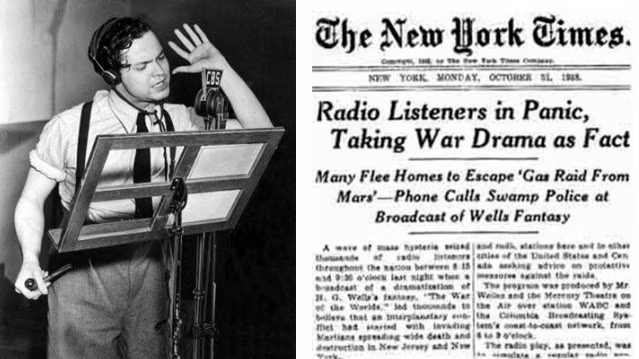
The fright Welles created in the United States was greater than he realized. Although the program included a disclaimer at intermission stating it was a dramatization, thousands of anxious and confused listeners believed it to be real. They besieged police departments, newspapers, and CBS Radio with phone calls. In New Jersey, Ground Zero for the fictitious invasion, National Guardsmen wanted to know where they should report for duty. In Providence, Rhode Island, hysterical callers begged the electric company to cut power to keep the city safe from the extraterrestrial invaders.
With threats of lawsuits swirling in the press, CBS went into damage control. At a press conference, Welles, with an innocent look on his face, displayed his theatrical acumen when expressing his remorse and shock at the public reaction, “I can’t imagine an invasion from Mars would find ready acceptance.”
Decades later, Welles admitted, “That kind of response was merrily anticipated by us all. The size of it, of course, was flabbergasting.”
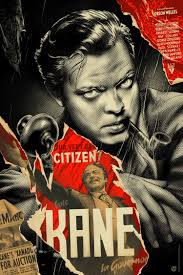
The Federal Communications Commission chose not to sanction CBS. Radio networks did agree to be more cautious in future programming. Orson Welles, the radio dramatist, quickly spun his Halloween trick into a treat. His radio program struck a lucrative sponsorship deal with Campbell’s Soup, and then Welles inked a deal to direct the movie “Citizen Kane” in 1941, named by the American Film Institute as the greatest motion picture of all time.
Related information: The War of the Worlds – the actual radio audio
Arcana – mysterious or specialized knowledge
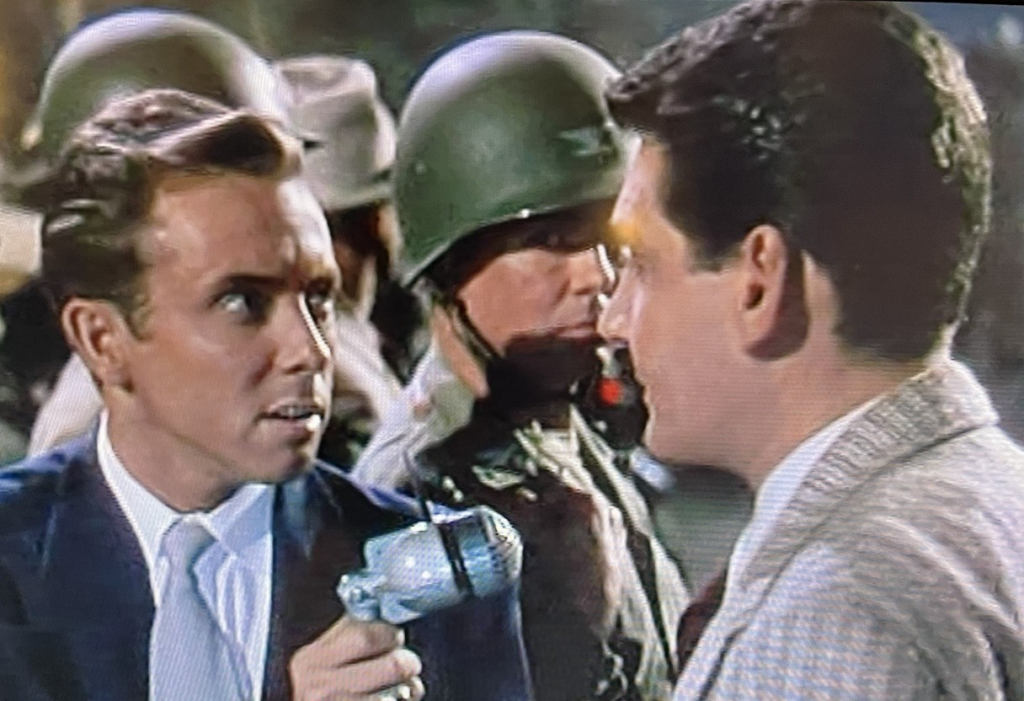
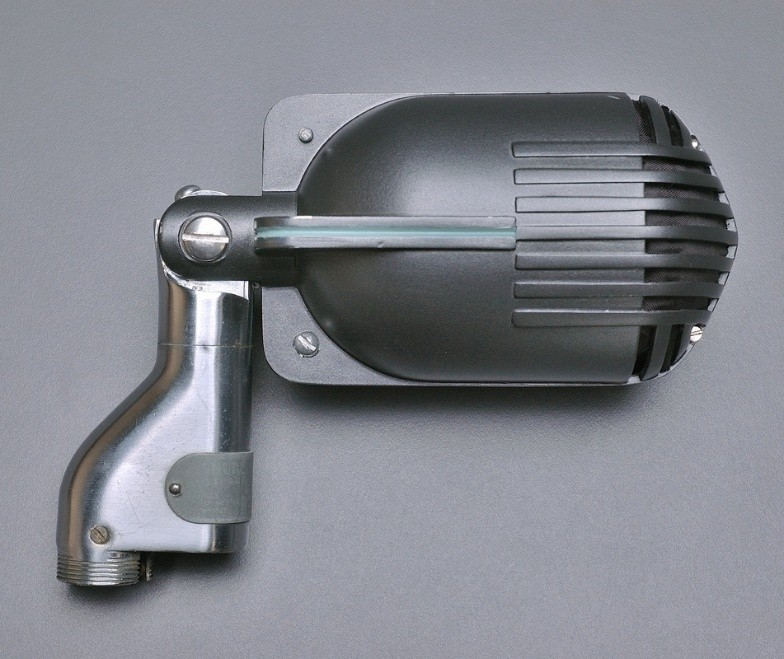
Examining the few photos of the radio studio employed by Welles has uncovered no Shure microphones in use – only Western Electric and RCA models. However, a Shure mic did appear in the 1953 film The War of the Worlds: our Stratoliner Model 708A with its distinct rocket profile.
***
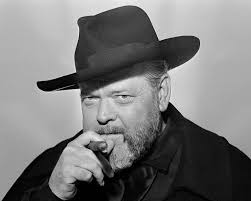
My mentor Frank Beacham, alas now departed, was a friend of Orson Welles. Frank authored a play about Orson entitled “Maverick.” Unfortunately, the New York theater critics were not impressed.
***
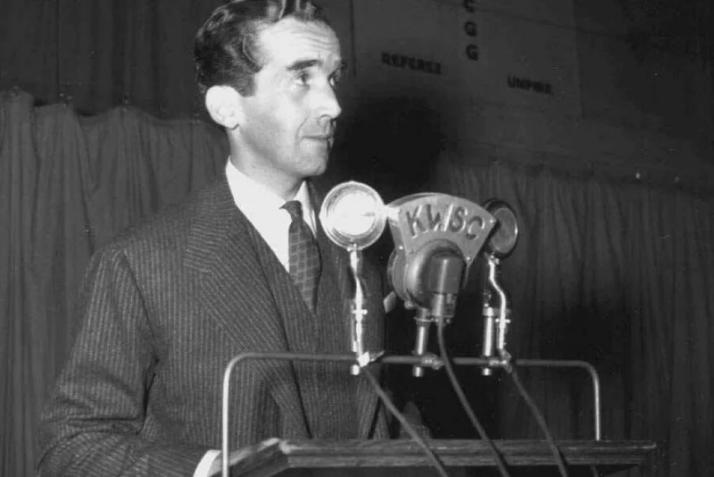
In a follow-up to Tech Tip #606, here is famed CBS Radio newsman Edward R. Murrow before a Western Electric Model 618 microphone flanked by two Shure Model 70H crystal mics.