Dear reader, have you ever wondered what accessory has been sold by Shure for the longest time and remained essentially the same? Your author has and is seeking psychological help.
The answer is a telescoping microphone stand, like today’s S15A stand, first sold ninety-three year ago.
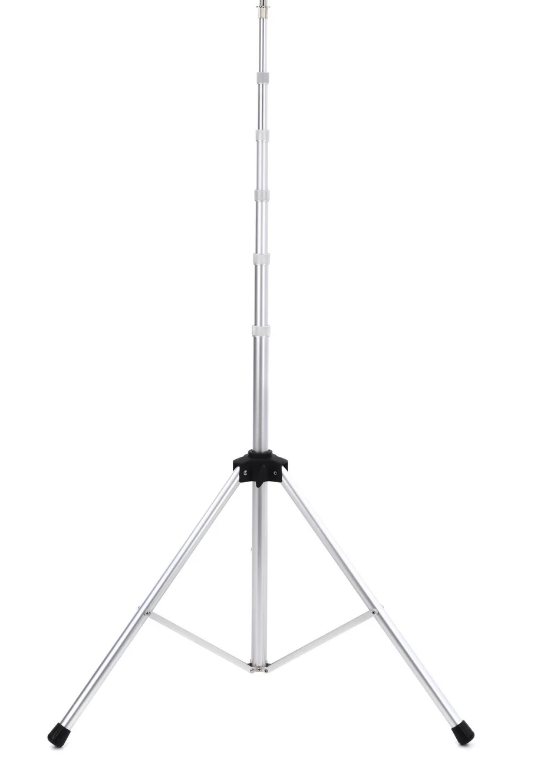
Our 1933 catalog lists the Model 55 collapsible floor stand: Designed for those that require a floor stand that is low in price and readily portable. The three legs of the base are adjustable to have it spread from 23 to 33 inches, assuring firm solid support for the stand under any circumstances. Two movable rods permit extension from a minimum of 43 inches to a maximum of 105 inches. When folded the legs and extensions are reduced to a length of only 31 inches. Chrome-Japan finish.
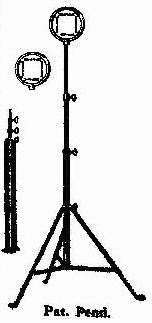
Our Model 55 retailed for $15, or $390 in 2026 currency, making the today’s S15A a bargain at $255 retail. Like the modern S15A, the male thread at the top of the Model 55 is 5/8”-27.
Also from the 1933 catalog: The new Chrome and Japan combination. No expense has been spared to finish the 1933 line of Shure microphone stands in accordance with the highest standards of beauty and durability. The new rubber-tone black, double-baked Japan for the bases and tubings, and the polished buffed nickel-brass chromium for the microphone rings present the combination that stands the hardest wear, never tarnishes, and always looks well in studio, church, or out-of-doors.
Your author also ponders who sagely recycled the 1933 “Model 55” nomenclature for use on the 1939 Unidyne I microphone. Was it S.N. Shure? Benjamin B. Bauer, our transducer genius? Or Jack A. Berman, our future sales manager? Another history mystery to solve.

Related information: 1933 Shure catalog
Arcana – mysterious or specialized knowledge
A Japan finish, or Japanning, was a thick, durable, black, baked-on protective coating used for metal goods like hand tools, sewing machines, and early automobiles. This finish requires a labor-intensive process. A heavy, tar-like liquid is brushed or dipped onto cast iron or steel. The coated metal is placed into an industrial oven and baked at 300°F to 400°F. The heat causes the Japanning liquid, comprised of linseed oil and asphaltum, to chemically bond tightly to the metal.
This process was often repeated multiple times for the sake of durability. As the black Japan finish demanded long curing time, baking and cooling multiple layers took hours or days. In the 1930s, industrial manufacturing required faster production speeds than traditional Japanning could offer. Quick-drying enamels permitted manufacturers to fabricate products faster and in a variety of colors. Japanning soon faded into history.