
In 1933, Shure started publishing The Shure Technical Bulletin, the earliest publication devoted to the “advancement of microphone technique,” which addressed audio reproduction and sound installation. Similar bulletins continue to be published by Shure in 2000, covering a broad range of topics involving the application of sound technology.
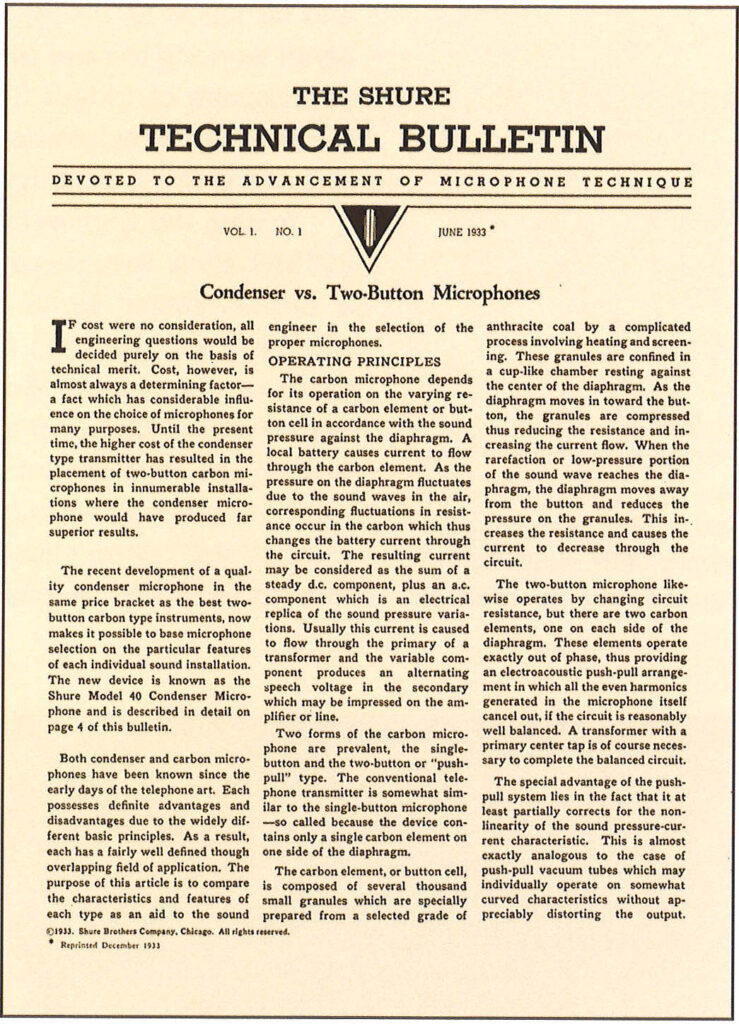
Ralph Glover, Shure’s Chief Engineer in the 1930s, was the principal author of the earliest bulletins. His ability to discuss technical issues while defining the importance of sound as a cultural and economic force was instrumental in positioning Shure as the expert in the science and engineering of audio equipment. The Bulletin also succeeded in advancing broadcast and recorded sound as an industry.
In one of his first issues of the Bulletin, Glover wrote: “The study of sound is extremely important, for hearing ranks along with vision in importance as a channel for the reception of human intelligence. Some sounds, such as those in speech, are essential. Others, as in music, may be pleasurable, but a third type of sound—noise—actually constitutes a menace to human well-being. It is self-evident that we can only improve the nature of desirable sounds and eliminate the harmful ones through scientific measurements carried out with precision instruments.

“The human ear, although important, is a very poor measuring instrument. Individuals differ widely in ability to hear faint sounds, and high-pitched tones readily apparent to one auditor are not perceived at all by another.
“Obviously, then, something better than the ear is required for anything approaching precision in sound measurements; and in practically all such work, the microphone serves as the electrical ear of the measuring system.”
