
For Shure engineers in the 1960s, creating a better phonograph cartridge required finding an album that would test the ability of a cartridge to retrieve all the sound, or “information,” contained in the grooves of a record. A good “test” record would provide a wide range of sound—loud and soft as well as low frequencies and high frequencies— allowing the engineers to quantitatively measure the maximum velocity at which the stylus tip could trace the audio signal before it started to skip. Unable to find a record that would meet their exacting specifications, Shure engineers decided to get into the recording business and make their own test record.
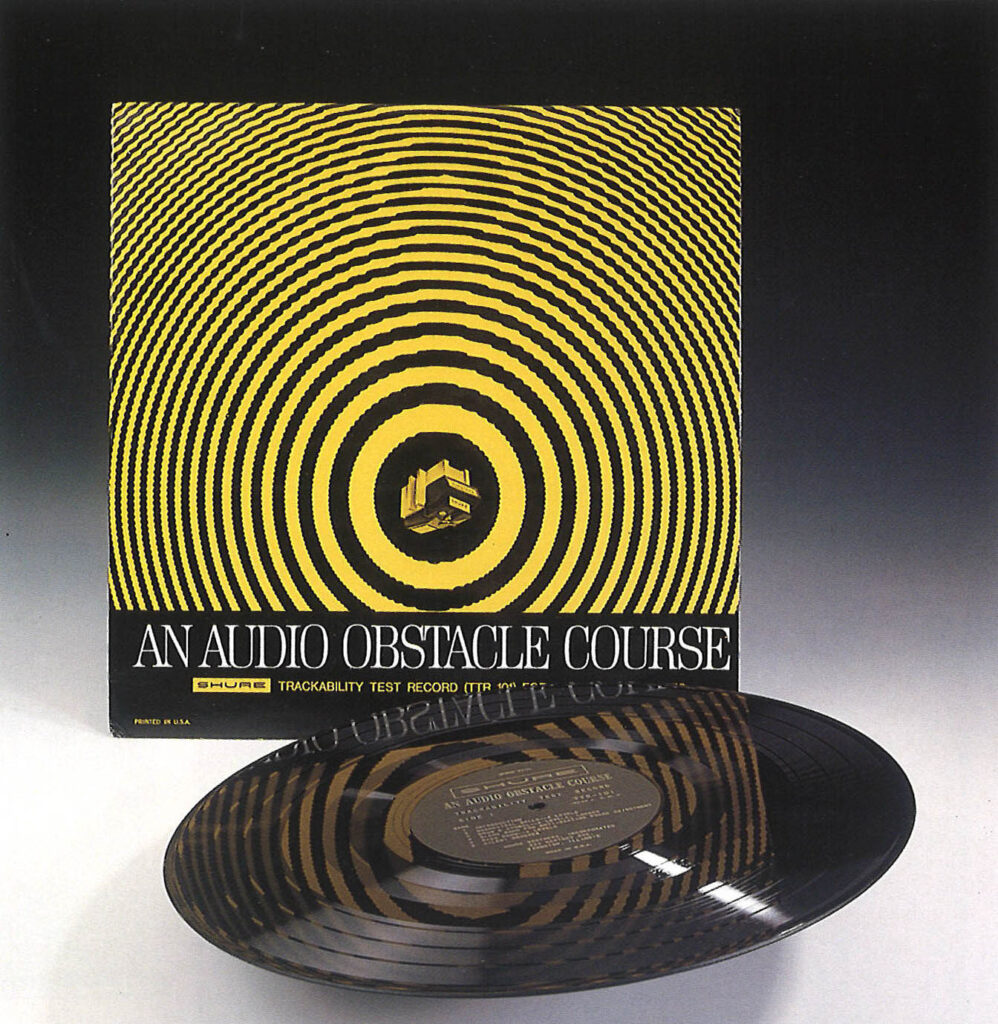
“Our album included the kinds of sounds that other phono cartridges reproduced imperfectly, including selections from harpsichord, organ, accordion, and glockenspiel,” recalled Roger Anderson, former Senior Staff Engineer. “Most of the performances on the album were done by people connected to Shure. Bernie Jakobs [a Shure engineer at the time] played accordion and organ, and I narrated the album.”
The album was used in the development of the Shure V-15 Type II, considered the first high-trackability phonograph cartridge. “This type of record was a first in the industry, and the cartridge reproduced the sound perfectly. In a sense, we set up a standard that only our cartridges could meet,” said Bernie Jakobs, who was Senior Vice President of Engineering when he retired. “It also allowed us to advance the issue of ‘trackability’ and define it as an important quality that any high-fidelity cartridge should have.”
