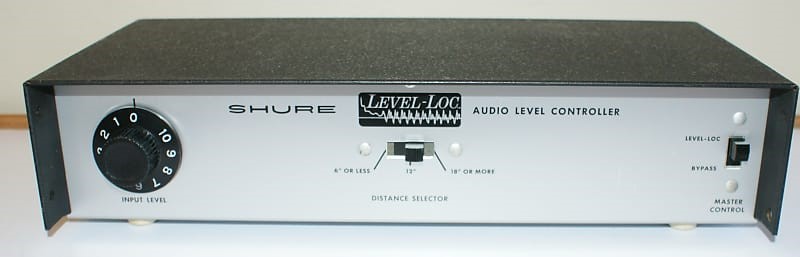
Introduced in 1967, the M62 Level-Loc promised to solve audio problems caused by loud and soft talkers. Placed between the microphone output and the mixer input, the unit was set up as follows: To use the M62 in a Public Address system, increase the volume control on the PA system to the point where the system is at the threshold of feedback with no signal being transmitted through the microphone. Used in this manner, the total volume is reduced by the M62 as microphone signal is applied and the PA system will be more stable during loud parts of the program. Should acoustic feedback occur, the M62 will prevent it from becoming ear-splitting or damaging the loudspeakers.
Today, we would call the M62 a “downward compressor.” Low-level mic signals pass through the unit with no additional gain, while higher-level mic signals are reduced, i.e., compressed. A 40 dB increase of the mic signal is squashed to a mere 6 dB increase at the M62 output.
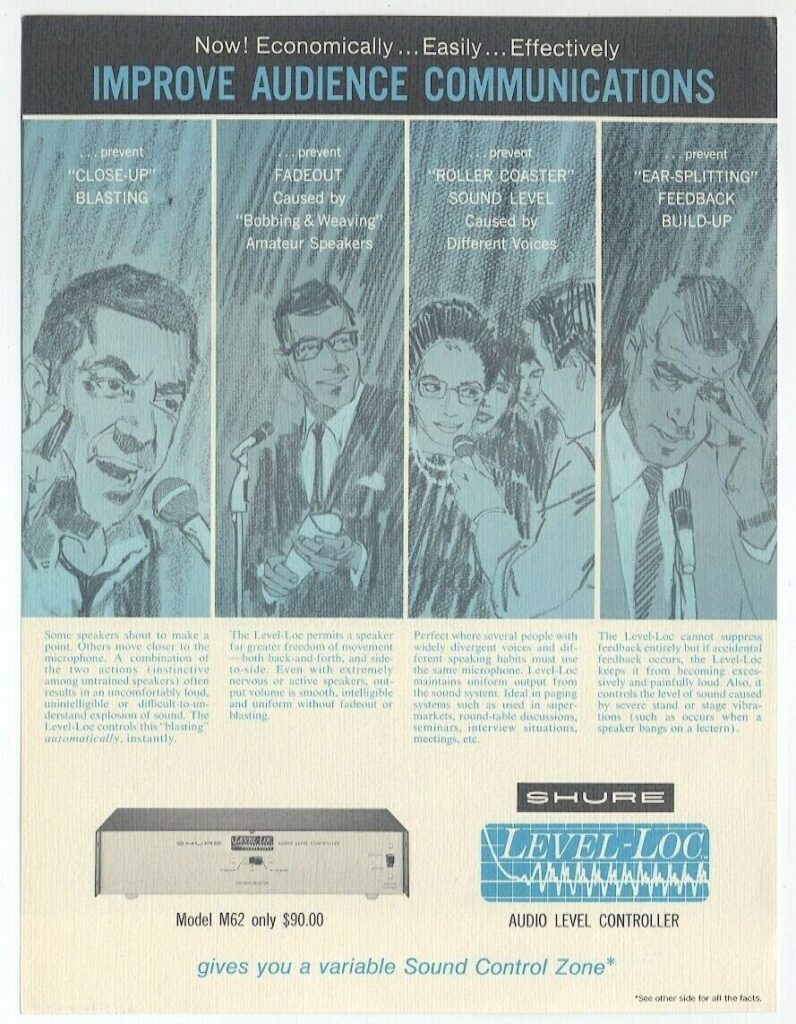
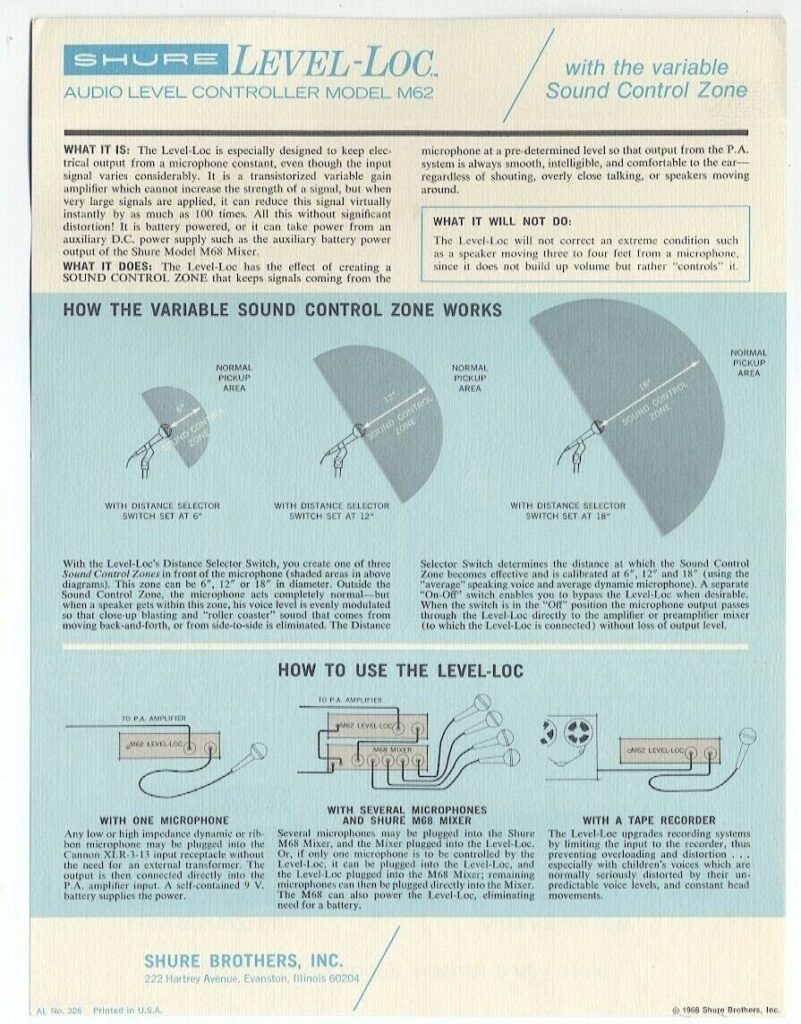
A single 9Vdc battery powered the Level-Loc for 250 hours or it could also operate using the 28 Vdc voltage source provided at the rear panel of a Shure Model M67 or M68 mixer. A “Master Control” switch on the M62 front panel bypassed the electronics and disconnected the battery. The XLR female audio input was transformer balanced as was the XLR male audio output. Each XLR had its own low/high impedance switch
The front panel “Distance Selector” switch was an unusual feature. It had three positions: 6” or less / 12” / 18” or more. The switch was set to match the distance from the mic to the talker’s mouth. Electronically, each switch position altered the compressor activation threshold by 6 dB. From the M62 User Guide: When recording in quiet surroundings, the 18” setting of the Distance Selector may be used to obtain maximum control of the recorded level. This is especially advantageous when recording sound sources where the volume is not predictable.
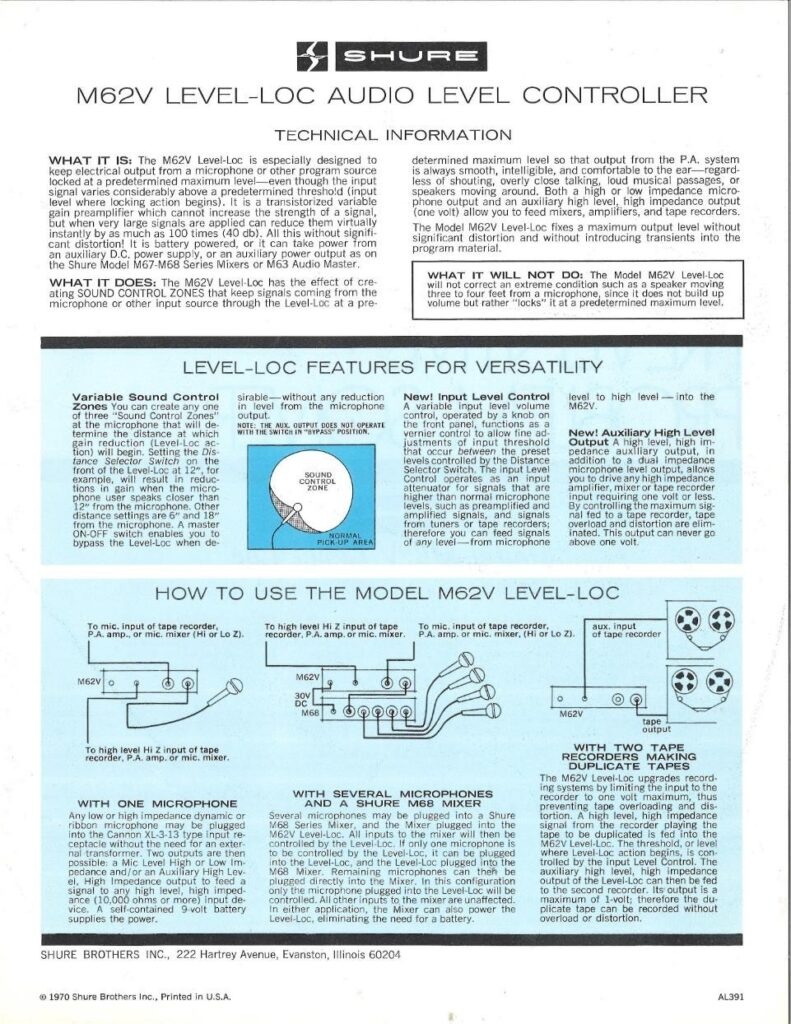
The M62V Level-Loc replaced the M62. Introduced in 1969, the M62V (“V” for Volume control) featured two improvements: 1) an input level potentiometer, 2) an Aux level output on an RCA phono jack.
For many M62 users, the coarse adjustment offered by the three-position “Distance Selector” switch was unsatisfactory. The new input level potentiometer on the M62V allowed precise adjustments, and the new Aux output could feed a tape recorder or the Aux input on a Shure mixer.
The User Guide warned: Remember that the M62V Level-Loc is a device that provides a constant output level after a predetermined input level (threshold) is reached. Therefore, if more gain is needed in a PA system, or a higher recording level is desired for a tape recording, DO NOT INCREASE THE INPUT LEVEL GOING INTO THE LEVEL LOC. Once the input threshold has been reached, the M62V output level becomes fixed – IT CANNOT GO ANY HIGHER. For more system gain, increase the gain control of the amplifier, preamplifier, or tape recorder that is fed from the M62V.
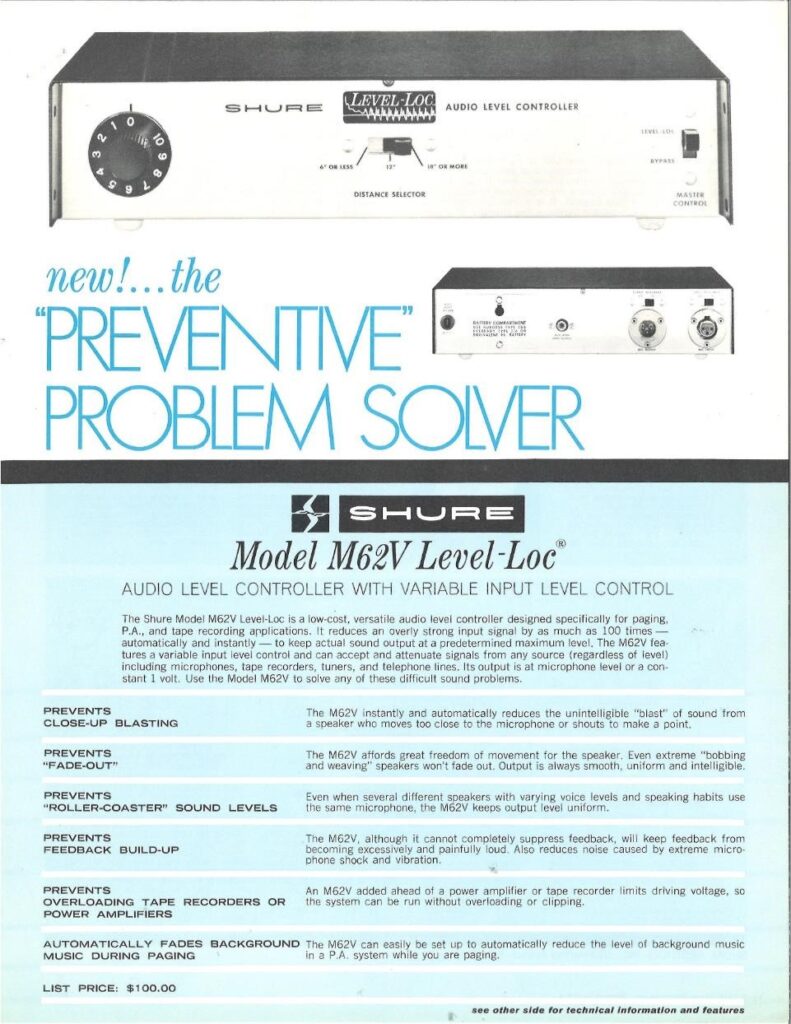
By 1977, Shure had discontinued the M62V; however, it was not yet dead.
Decades later, recording engineers discovered the Level-Loc provided a unique sonic quality when used on drums. According to one engineer, “The vintage Shure M62V Level-Loc has become a much sought-after unit in recording studios. Its limiter is being (ab)used for distorting drums, and then that distorted signal is summed with the original undistorted drum signal, beefing up the timbre and giving the drum set an edge to its sound.”
The character of the Level-Loc attack and release is the sound that appeals to recording engineers. The sonic impact created is the result of the front panel settings. Switching between 6″, 12″, or 18″ alters the attack and release characteristics, with the 18″ setting offering the slowest release. A typical setup is to connect a room/ambient microphone for the drums to the Level-Loc, and then drive the input of Level-Loc until the desired distortion/effect is achieved.
Ironically, the original goal of the Level-Loc was to minimize distortion and artifacts, not to create them, but that is how the unit is being used today. Yet another story of our creative customers using a Shure product for a completely unrelated reason.
Related information: M62V User Guide and Schematic
M62 Circuit Schematic
Arcana – mysterious or specialized knowledge
For readers not comfortable with the decibel, a 40 dB signal level change is a factor of 100; a 6 dB signal level change is a factor of 2. The Level-Loc reduces/squashes/compresses a signal that is 100 times stronger to a signal that is only 2 times stronger.
***
The M62 User Guide touted a maximum distortion of only 3% (!), a specification that is laughably unacceptable today. Yet it is this distortion that is prized in the Level-Loc sonic timbre.
***
When a Level-Loc does appear on an Internet auction site, the asking price is typically $700 to $1,000. The original M62 price of $90 in 1967 equals $865 in 2025.