
Volts, amps, ohms are words heard daily in professional audio, yet many of us only have a vague notion about these terms. There is an analogy between electricity and water. Though not 100% accurate, it is close enough for most audio needs.
The volt is a unit of electrical “pressure;” similar to water pressure within a hose.
The ampere (shortened to amp) is a unit of electrical current; similar to the quantity of water flowing out of a hose.
The ohm is a unit of electrical resistance; similar to the inner diameter of a hose. Resistance can also be called impedance because it “impedes” the flow of water or the flow of electricity.
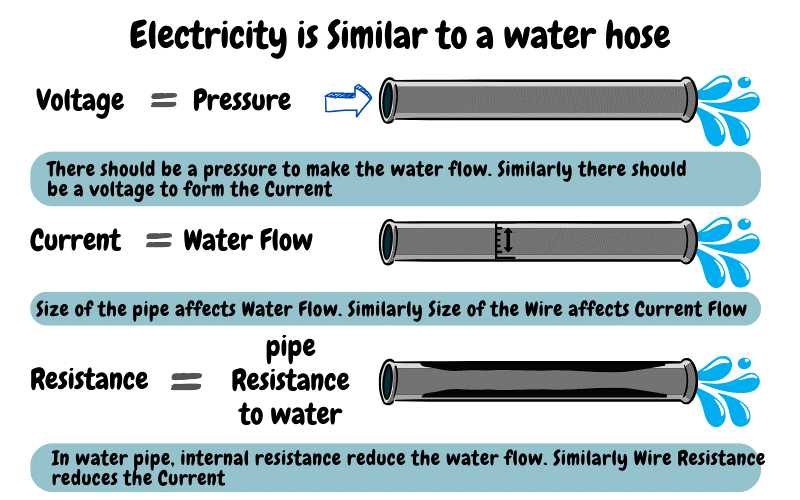
Example A – Volts or Pressure:
Put your thumb over the end of the hose. This makes it more difficult for the water to leave the hose. By increasing the resistance (ohms) to the water flow, less water (amps) leaves the hose but it sprays out with more pressure (volts). Does this work for electricity? Indeed, it does:
Equation #1: Pressure = Flow multiplied by Resistance
Equation #1A: Volts = Amps x Ohms
If a mic has two impedance (ohms) settings, the higher impedance setting provides a greater output voltage.
Example B – Amps or Current:
Enlarge the diameter of the hose (ohms) to decrease the resistance and the water flow (amps) increases. Does this work for electricity? Indeed, it does:
Equation #2: Flow = Pressure divided by Resistance
Equation #2A: Amps = Volts / Ohms
A flashlight bulb with a resistance of 10 ohms drains a battery of current (amps) faster than a bulb with a resistance of 100 ohms.
Example C – Ohms or Resistance:
Increase the water pressure (volts) and the flow resistance (ohms) in the hose increases. Does this work for electricity? Indeed, it does:
Equation #3: Resistance = Pressure divided by Flow
Equation #3A: Ohms = Volts / Amps
Useful Conversions
In pro audio we use the term millivolt. This is one-thousandths of a volt, so 1 volt equals 1,000 millivolts. Convert milliamps to volts by dividing by 1,000: 45 millivolts equals 0.045 volts. Millivolt is abbreviated as mV or mv.
We also use the term milliamp. This is one-thousandths of an amp, so 1 amp equals 1,000 milliamps. Convert milliamps into amps by dividing by 1,000: 215 milliamps equals 0.215 amps. Milliamp is abbreviated as mA or ma.
Though it exists, we rarely use the term milliohm. However, it is common to see the letter “k” which stands for “kilo” and means multiply by 1,000; so 15k ohms equals 15,000 ohms. When you encounter “k,” substitute three zeros: 52k ohms equals 52,000 ohms.
Ohm is abbreviated with the Greek letter Omega – it looks like a horseshoe with feet.
Related information: http://hyperphysics.phy-astr.gsu.edu/hbase/electric/watcir.html
Arcana – mysterious or specialized knowledge
During December 2024, your author took two weeks of holiday, planning to not think about microphones. The plan was foiled by a local PBS station. While viewing a 1947 movie about the Dorsey Brothers (band leaders of the swing era), the images below appeared.


***
Our Unidyne microphone is so iconic that we frequently benefit from countless pages of free advertising in print and online. Below is a recent example.

***
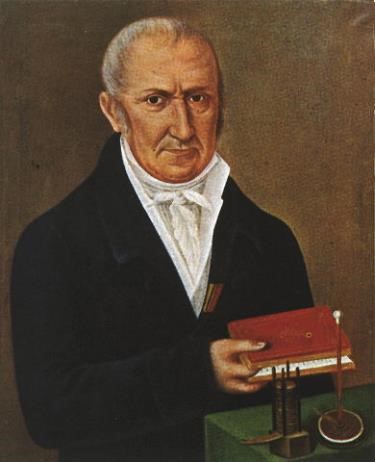
The unit of electrical pressure, the volt, was named in honor of Alessandro Volta, an Italian scientist.
The unit of electrical current, the ampere, was named in honor of Andre-Marie Ampere, a French mathematician.

The unit of electrical resistance, the ohm, was named in honor of Georg Ohm, a German physicist and teacher.

The unit of cantankerousness, the pett, was named in honor of your author. One pett proved so unbearably annoying that it led to the creation of the smaller and more useful decipett, 1/10 of a pett, abbreviated as dP.

Photo by Stuart Van Dorn
