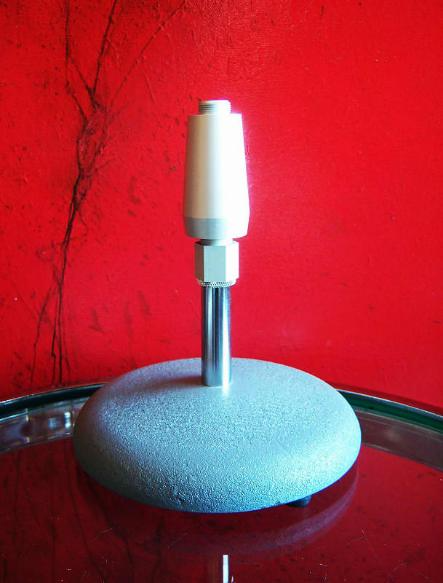
In the early 1930s, Shure Brothers Company was not known as a microphone manufacturer, or anything else for that matter. S.N. Shure set his sights on changing that perception. He created a tagline for his company – Microphone Headquarters. He hired our first chief engineer, Ralph Glover, a University of Cincinnati graduate. Glover wrote a series of Technical Bulletins to teach end users, dealers, and distributors about microphone science. Mr. Shure believed that an informed customer would be loyal to the company providing the education.
Volume 1, Number 1, of The Shure Technical Bulletin was published June 1933. The banner read “Devoted To The Advancement Of Microphone Technique.” The topic of the premiere issue was “Condenser versus Two-Button [Carbon] Microphones.”
Below are excerpts from this 1933 newsletter.
If cost were no consideration, all engineering questions would be decided purely on the basis of technical merit. Cost, however, is almost always a determining factor – a fact which has considerable influence on the choice of microphones for many purposes. Until the present time, the high cost of the condenser type transmitter has resulted in the placement of two button carbon microphones in innumerable installations where the condenser microphone would have produced far superior results.
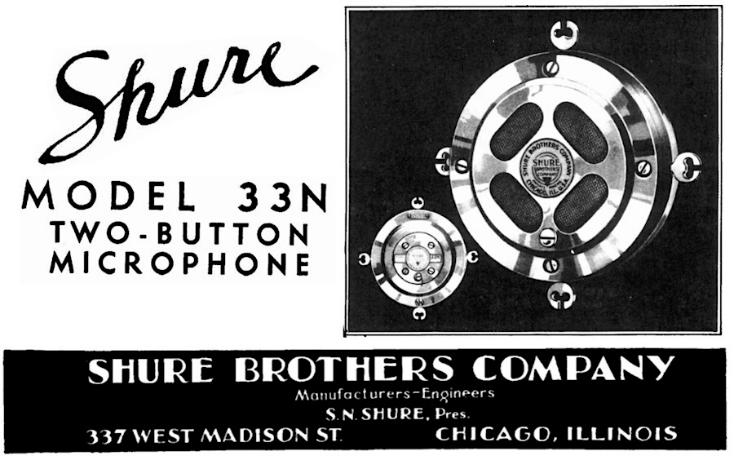
The recent development of a quality condenser microphone in the same price bracket as the best two-button carbon type instruments now makes it possible to base microphone selection on the particular features of each individual sound installation. The new device is known as the Shure Model 40 Condenser Microphone and is described in detail on page 4 of this bulletin.
Both condenser and carbon microphones have been known since the early days of the telephone art. Each possesses definite advantages and disadvantages due to the widely different basic principles. As a result, each has a fairly well defined, though overlapping, field of application. The purpose of this article is to compare the characteristics of features of each type as an aid to the sound engineer in the selection of the proper microphones.
***
Frequency characteristic curves on microphones seldom portray the true performance under working conditions. There are a number of reasons for these discrepancies. Tests are generally made under standard acoustic conditions and these conditions are almost never duplicated in actual practice. For instance, the results obtained from measurements when the microphone and sound source are located in an acoustic transmission line, or “tunnel,” would hardly hold for the case of a microphone located in free space. It is never possible to assume that a variable frequency sound source of constant pressure would deliver a constant sound pressure at the microphone diaphragm, for reflection, absorption, and resonance due to surrounding acoustic conditions always introduce an unknown element. It should be remembered, however, that the human ear, if it were located at the pickup point, would likewise sense the effects of the acoustic conditions, so that these facts in no way imply improper functioning of the microphone itself.
***
The carbon microphone is especially well adapted for portable equipment. This is due to the fact that the device is complete in itself and only requires one, two, or three dry cell batteries for current supply. The carbon microphone is also light and takes up little space.
The condenser microphone, however, requires a high voltage supply for polarizing the diaphragm and for the [vacuum tube] amplifier plate supply, and a low voltage source to operate the amplifier tube filaments. These accessories add to the weight and to the bulk of the complete equipment. The transmitter unit requires more space than the carbon microphone due to the space occupied by the integral microphone [pre]amplifier. As a result, the condenser microphone is less readily portable than the carbon microphone. For this reason, two-button carbon microphones are widely used for portable remote control broadcast pickups, and for a great deal of public address work where the equipment is frequently moved from place to place.

To summarize - the principal advantage of the two-button carbon microphone is in its portability. To offset its relatively greater bulk, the condenser microphone offers among its advantages - little background noise, permanence of calibration, and relative freedom from maintenance difficulties.
To read the entire Shure Technical Bulletin from June 1933, click on the link below.
Related information: Download The Shure Technical Bulletin June 1933
Early Shure Condenser Microphones
Arcana – mysterious or specialized knowledge
Was your author familiar with the 1930s Technical Bulletins before launching Shure Apps Tech Tips in June 2011? Maybe…
***
In the late 1800s and early 1900s, “transmitter” and “microphone” were interchangeable terms. In a telephone, the microphone provides the first step for the transmission of audio, thus it was a “transmitter.”
***
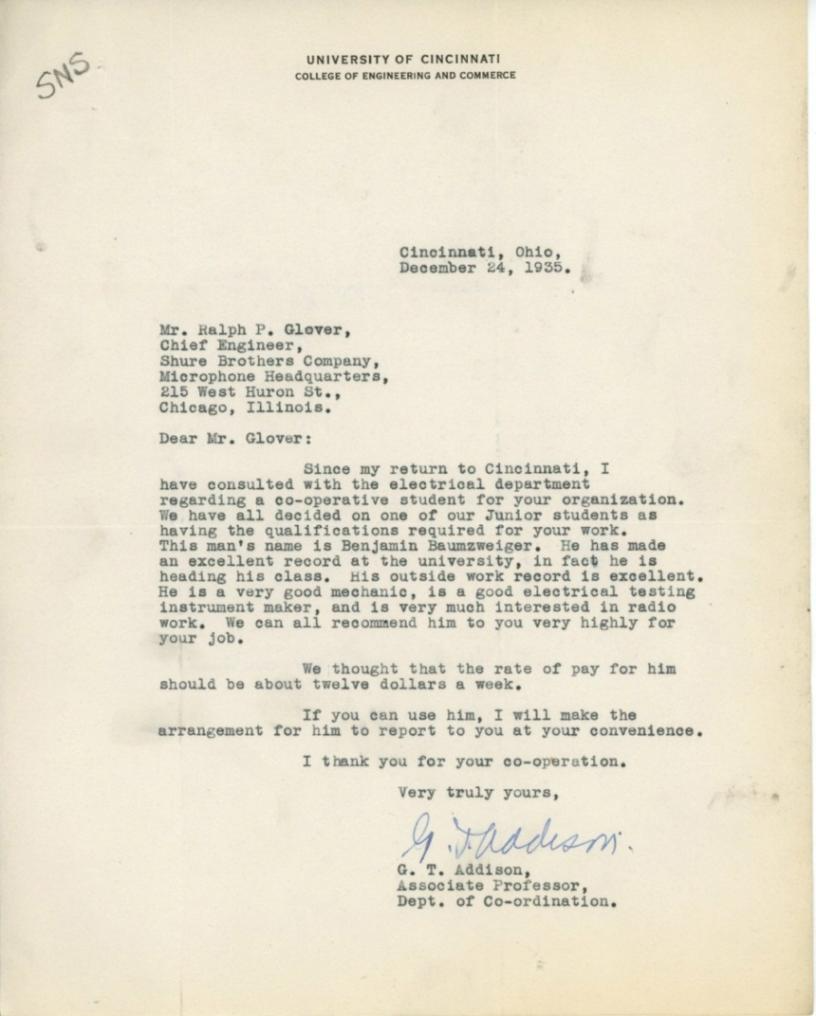
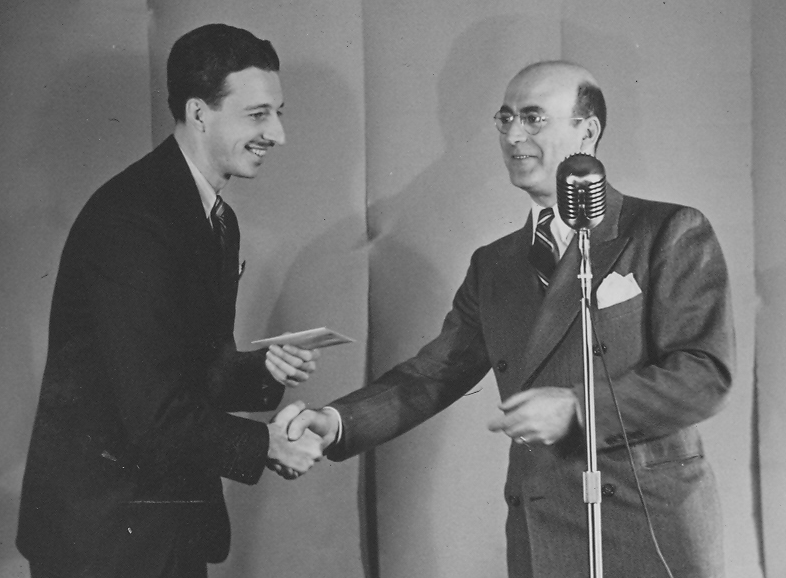
As mentioned above, Ralph Glover attended the University of Cincinnati. Post graduation, he kept in touch with his electrical engineering professors. Through these contacts, Glover learned of an exceptionally talented undergraduate at the university…that student was Benjamin B. Baumzweiger, later known as Ben Bauer, inventor of our Unidyne I and Unidyne II microphones.
***
Ben Bauer, the Shure Unidyne Model 55, and the University of Cincinnati
***
On August 20, 1965, 60 years ago today, The Beatles performed two concerts at Comiskey Park baseball stadium in Chicago, drawing large crowds for both the afternoon and evening shows. These concerts were part of their larger US tour and significant events in Chicago’s musical history. Shure loaned twelve Unidyne III Model 545 microphones to Beatle management for the tour. Each Model 545 mic on stage was fitted with a foam windscreen…secured with a rubber band!


In the photo above, note the Shure A45 quick disconnect mic isolation unit mounted on the mic stand. The A45 provided protection from vibration and permitted the mic to be quickly removed from the stand.