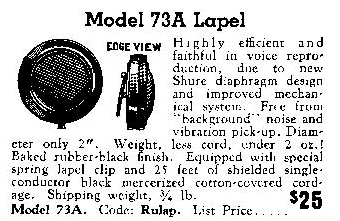
Chest-worn lapel and lavalier microphones date back to the 1930s. The Shure 1936 catalog features the Model 73A crystal lapel mic: Highly efficient and faithful in voice reproduction due to the new Shure diaphragm design and improved mechanical system.
In the 1950s, as television production techniques developed, omnidirectional moving coil microphones suspended by a cloth cord and hung around the presenter’s neck became feasible due to smaller, stronger magnets. “The Today Show” on NBC was an early adopter of the lavalier microphone. Using a lavalier kept the mic at a semi-constant distance from the presenter’s mouth and freed up the hands. For broadcast applications, the lavalier mic proved satisfactory.
However, the lavalier mic was never intended for sound reinforcement or public address use. First, it is not positioned close to the mouth which is desirable for sound reinforcement. Second, it is typically omnidirectional which is often undesirable for sound reinforcement. Third, it does not “track” the presenter’s head movement which is most definitely desirable for sound reinforcement. A sound reinforcement mic should be located at a proximate and consistent distance from the presenter’s mouth.
In the dusty corners of history, a well-meaning but ill-informed audio person first exclaimed, “Hey, let’s use a lavalier mic for the presenters giving talks today! The theater seats five hundred so their voices must be amplified. TV networks use lavalier mics – they must be good.” Thus began the misuse and abuse of the lavalier (lav) microphone.
Knotty issues arise when using a lav mic for a sound reinforcement system:
Issue 1: The distance from the talker’s mouth to the mic is too great. If the mouth-to-mic distance is ten inches (mic on chest at pocket level) instead of one inch, the PA system must be turned up by 20 dB to compensate. Many PA systems do not have 20 dB of available gain-before-feedback. The system could feed back (squeal) before an adequate level is reached for the listeners.
Issue 2: The lavalier mic is omnidirectional. This is not necessarily undesirable, but a unidirectional mic will typically offer about 6 dB of additional gain-before-feedback compared to an omnidirectional mic. Yes, there are unidirectional lav mics, but these have serious drawbacks: more handling/cable noise, more “P” popping, reduced intelligibility due to proximity effect (excessive bass), and a narrow pick-up angle for the talker’s speech.
Issue 3: The lav mic does not move with the talker’s head. A well-trained TV newscaster will keep her chin centered over the lav mic to keep the mic-to-mouth distance constant. But very few presenters do this, particularly when using a PowerPoint presentation. The torso, and therefore the mic, face the audience, while the head turns left or right to look at the PowerPoint screen. The result? A noticeable drop in audio level because the talker’s speech is no longer directed toward the mic.
Issue 4: PA loudspeakers often are distributed throughout the room on a flat ceiling. The lav mic is pointed upward at the talker’s mouth and unfortunately also pointed at the loudspeakers in the ceiling. The result is acoustic feedback (squealing.)
So why are lav mics chosen for sound reinforcement? Because they are small and visually unobtrusive. Because they are easy to attach to most clothing. Because TV newscasters use them so they must be really, really good! Reasons – yes. The right reasons – no.
The recommended hands-free choice for a presenter using a sound reinforcement system is an earworn omnidirectional mic, like the Shure Model MX153. The mic element is near the mouth; the mic moves with the presenter’s head; the omni element provides a clear, crisp speech signal with no proximity effect. All reasons for sound reinforcement success.
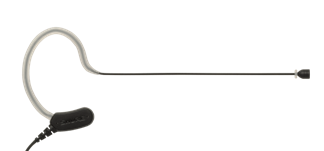
If a presenter insists upon a lav mic, impress upon this person the importance of keeping their chin centered over the lav mic to maintain a consistent audio level. Good luck with that…
Related information: Using lav mics in the theatre
Shure Apps Tech Tip #409: Lavalliere? Lavaliere? Lavalier? Lav?
Arcana – mysterious or specialized knowledge
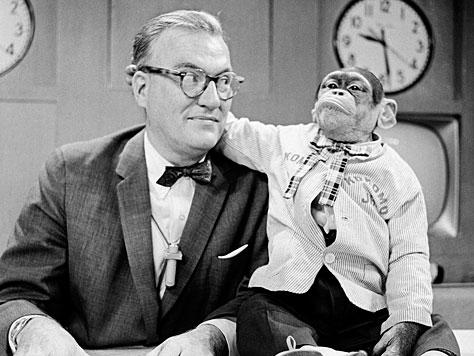
A lavalier, or lavaliere, is jewelry having a pendant dangling from a necklace. The first lavalier microphones were suspended from neck cords made of cloth. In this 1950s photo, note the lav mic worn by affable NBC “Today” host, Dave Garroway (left), while Kokomo Junior, the imperious chimpanzee (right), refused to be miked.
***
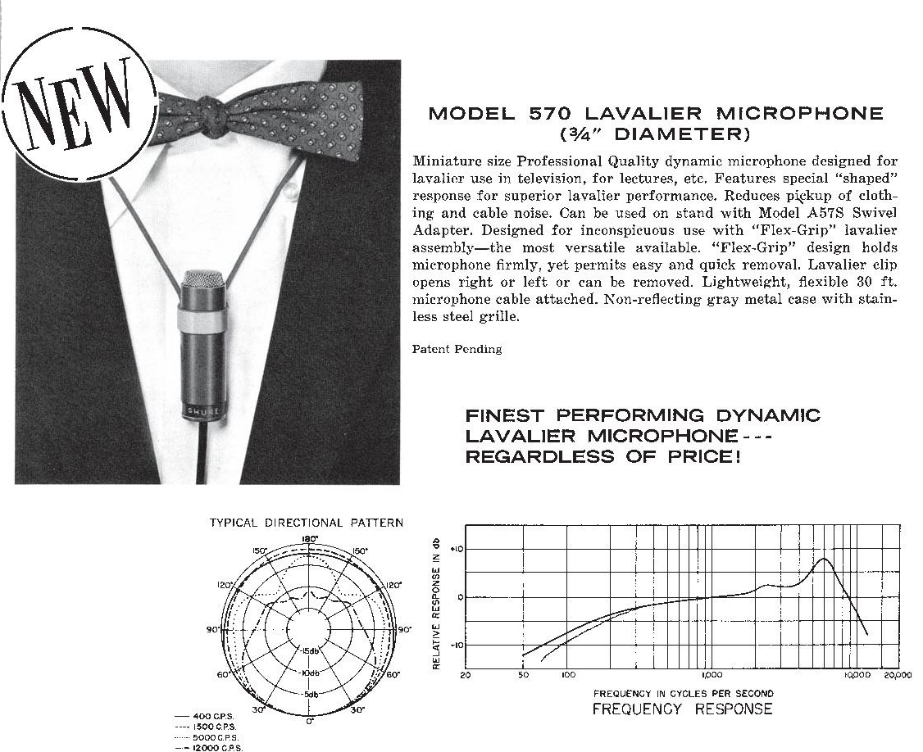
Our first moving coil lavalier mic appeared in the 1964 catalog. The Model 570 carried a list price of $95; that is $995 in 2025 currency!