
June 6, 2024, marks the 80th anniversary of the D-Day invasion at Normandy during World War II. Nearly 160,000 Allied troops landed on French beaches. Of those, 73,000 were from the United States, 83,000 from Britain and Canada. Forces from other countries were also involved, including French troops fighting with General Charles de Gaulle. The Allied forces faced around 50,000 German soldiers. Less than one year later, the war in Europe was over.
From 1942 through 1945, Shure Brothers Company primarily produced military audio transducers – microphones and headphones. Our factory operated six days a week with two shifts. In 1942 alone, the number of employees grew for 150 to over 1,000.
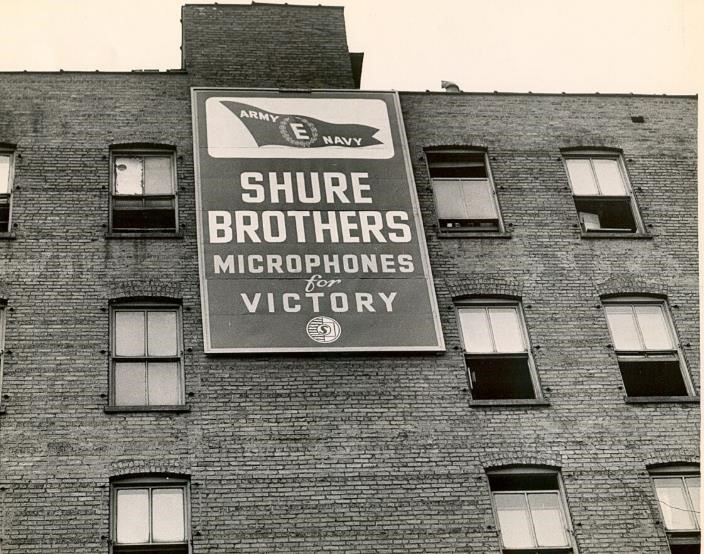
225 West Huron Street, Chicago – Shure Brothers Company site, 1944
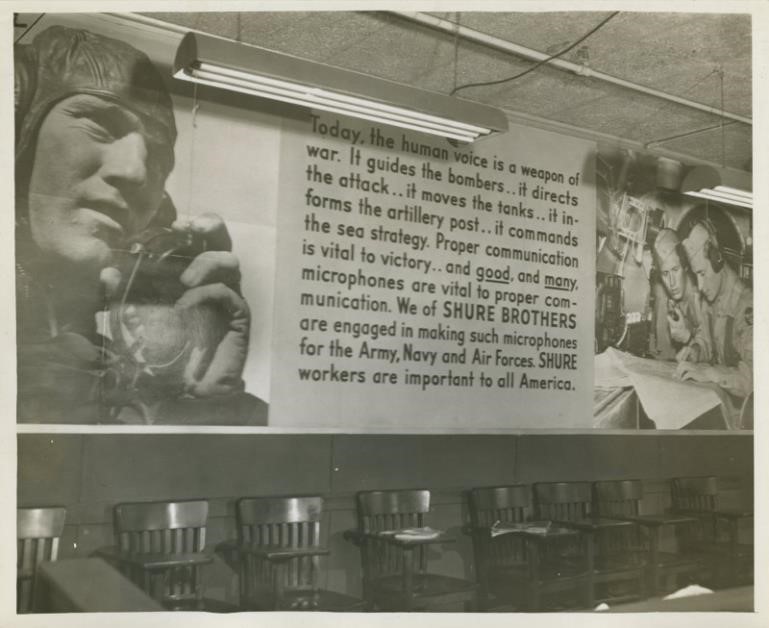
Mural inside Shure Brothers Company, 1943
As the D-Day invasion force consisted of ships, airplanes, and tanks, Shure products were most certainly in use that momentous day. Shure engineers had solved numerous technical issues to make a transducer more reliable and durable for battle use. One particularly difficult problem was “blast pressures,” the damaging sound pressures caused by an explosion or by the firing of a massive gun. In February 1944, this Shure ad appeared in radio engineering magazines:
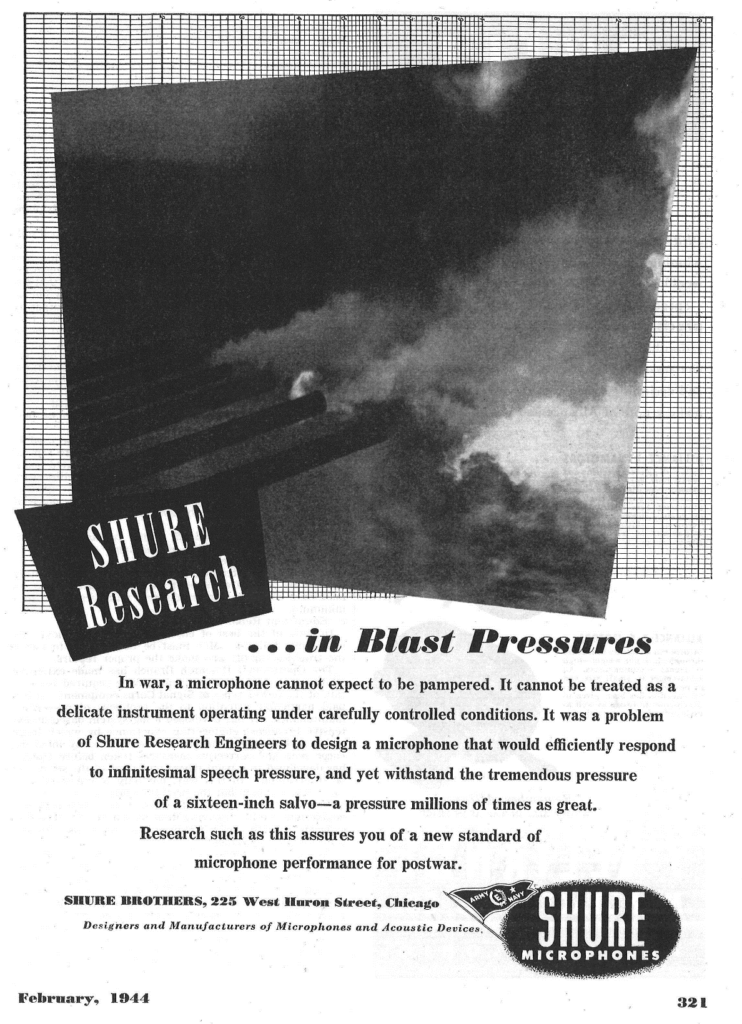
Shure ad during World War Two
For the war effort, Shure manufactured carbon microphones, controlled reluctance (CR) headphone drivers, and CR microphones. Carbon microphones could withstand blast pressures; CR mics could not. However, CR mics were preferred because of better speech intelligibility. Shure chief development engineer, Ben Bauer, was determined to make a CR mic that could withstand blast pressures.
To understand the brilliance of Bauer’s solution, one first needs background information:
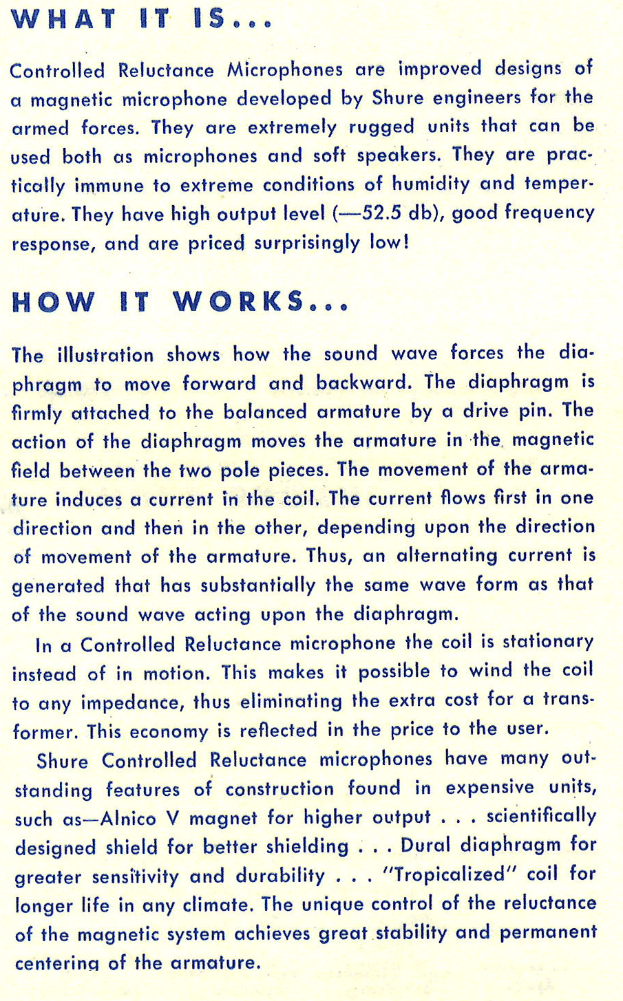
Explanation of a CR microphone
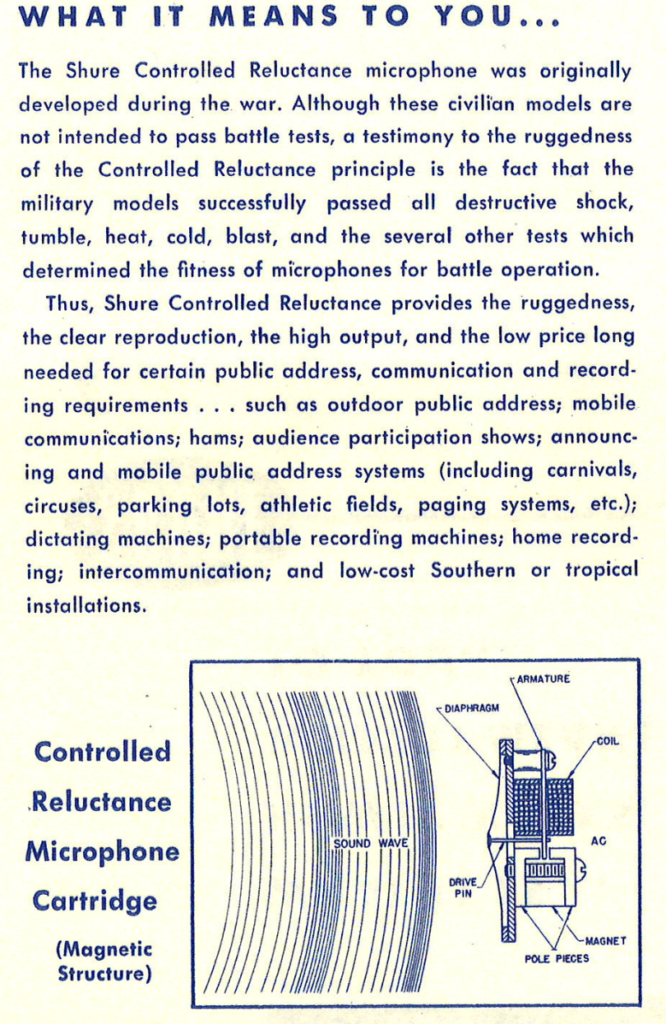
Diagram of a CR microphone
After deliberately damaging a bucketful of CR microphones by placing them proximate to a Navy battleship gun firing sixteen-inch diameter shells, Bauer examined every unit and found the blast pressures were bending the drive pin. He set to work to solve this issue. A lab notebook from the early 1940s documented that it took weeks of thought and experimentation until Bauer found an elegant, yet simple, solution: replacing the solid drive pin with a stiff spring. With the insignificant sound pressures of speech, the spring acted like a solid drive pin. During the extreme sound pressures from an explosive blast, the spring compressed for milliseconds, did not bend, then returned to acting like a solid pin. Bauer had fabricated a CR microphone that could consistently withstand blast pressures.
“Simplicity is the ultimate sophistication.” – Leonardo da Vinci
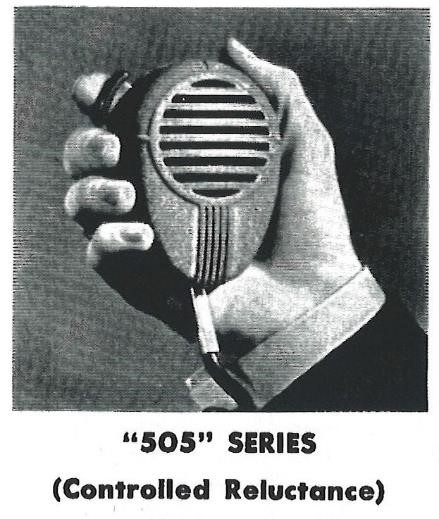
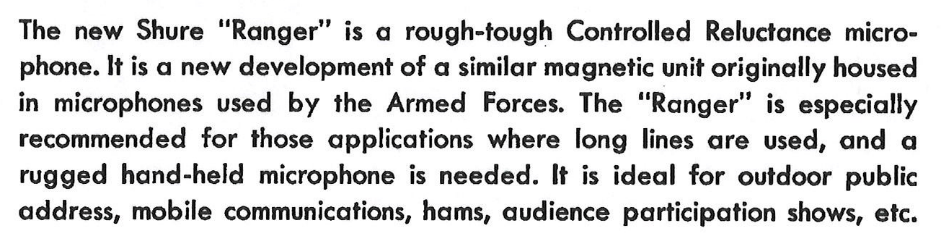
From the 1949 Shure Catalog – a postwar CR microphone
We manufactured a range of transducers during the war. The following is a summary of the devices.
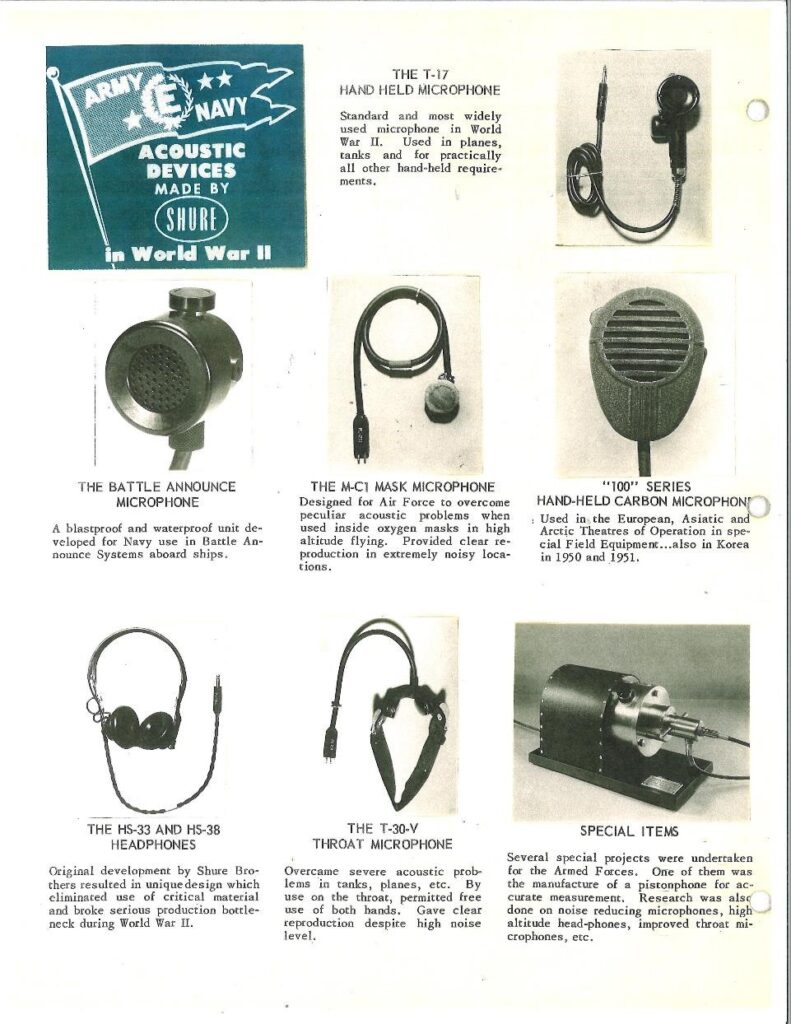
Shure was the only audio transducer manufacturer to win the coveted Army-Navy “E for Excellence” award four times.
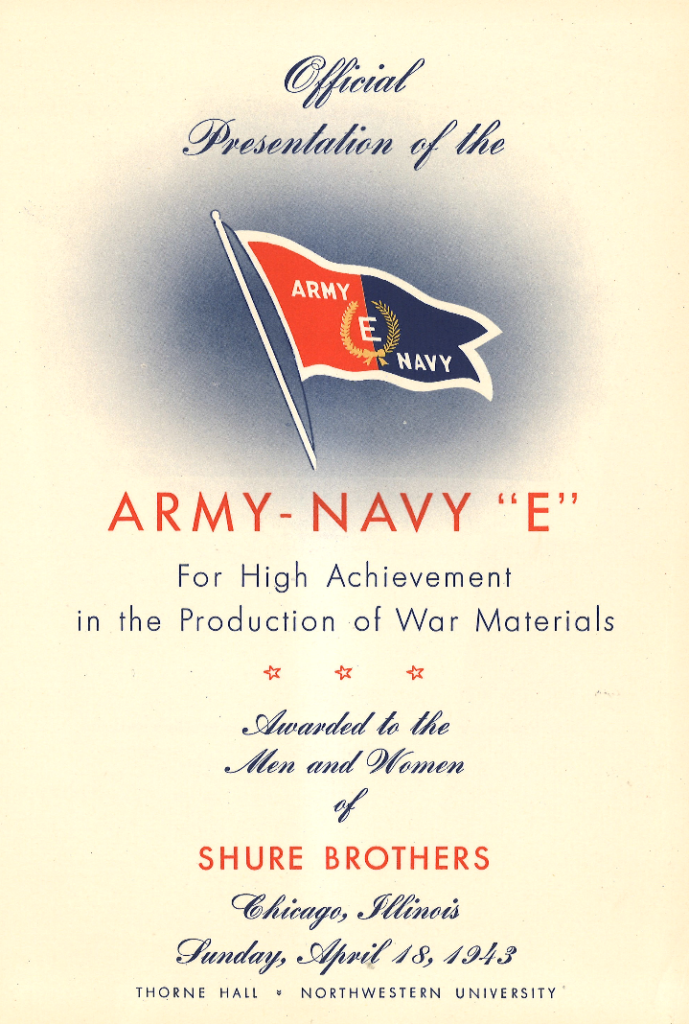
Program from our first Army-Navy E Award ceremony
Because of practical lessons learned during World War Two, Mr. Shure made the momentous decision to use military specifications for quality and reliability when post-war manufacturing resumed. Why is the SM58 so rugged? Now you know the reason.
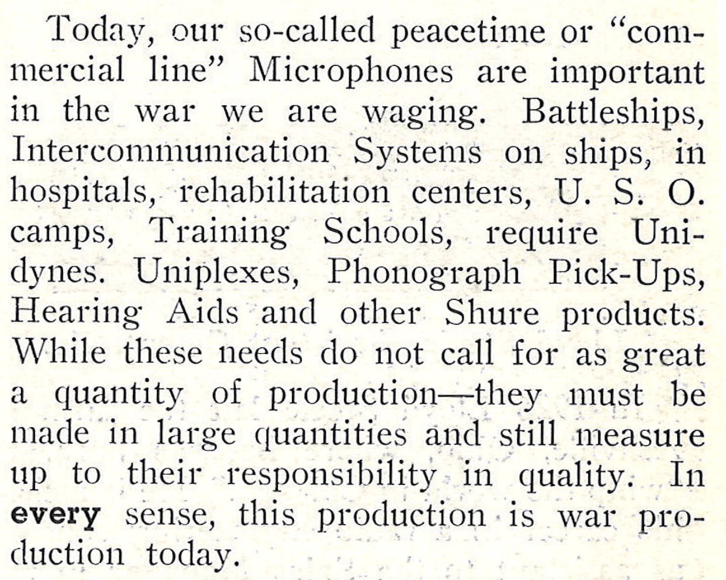
S.N. Shure statement to employees, 1945
Related information: Military aircraft microphones
Binaural Audio in World War Two
Arcana – mysterious or specialized knowledge
At peak efficiency, Shure produced 5,000 T-30-V throat mics within a 16-hour workday. There were more than twenty variations of the T-30. Different manufacturers were indicated by a suffix code letter:
T-30-A Western Electric T-30-B Western Electric
T-30-C Micro Co. Univ CA. T-30-F Western Elec
T-30-H Kellogg T-30-M Universal Microphone
T-30-Q Western Electric T-30-R Kellogg
T-30-S Universal Microphone T-30-V Shure Brothers Company
The T-30 was the most common microphone used in an armored tank and was also standard issue for the U.S. Army Air Force. The unit was strapped around the wearer’s neck, with two round transducers, one inch in diameter, encased with black rubber, pressed against the throat near the Adam’s apple. Anchored by an elastic strap, these transducers transmitted vocal vibrations as the wearer spoke, allowing speech to be heard over background battle noise. The T-30 featured a two-pronged PL-291 plug, which connected to a JK-48 jack located on a SW-141 push-to-talk switch.
***
Plane to plane communication and plane to ground communication became a critical issue as World War II intensified. The noise in the warplane cockpit made it difficult for the pilot to hear incoming messages and tainted outgoing messages. The U.S. Government sought out technical assistance from the Cruft Laboratory at Harvard University. One of the Lab experts in acoustics was a young Leo Beranek (1914-2016) – later the founder of consulting firm Bolt, Beranek, and Newman, and arguably the most important acoustician of the 20th century: http://en.wikipedia.org/wiki/Leo_Beranek
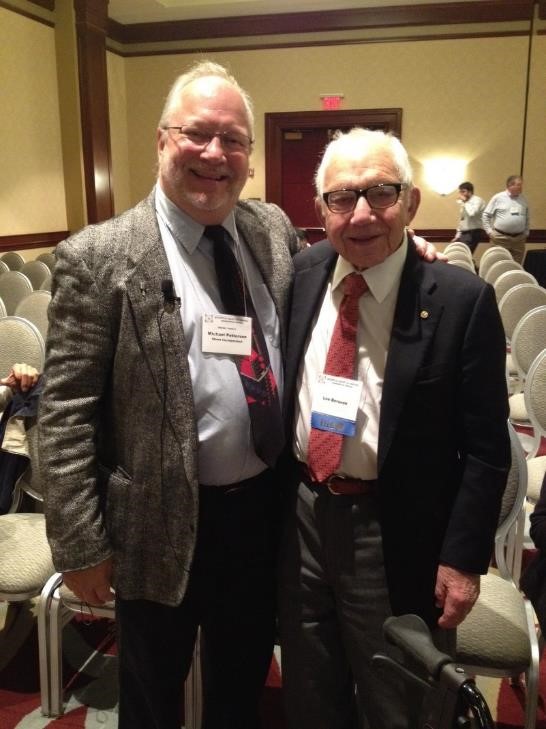
Dr. Leo Beranek with your author, ASA meeting, October 2014
Research from Beranek and others at Cruft Laboratory led to critical advancements in speech intelligibility for war aircraft communications. The T-30 throat microphone was developed, as was the ANB-M-C1, i.e., Army Navy British Microphone Carbon One. Both devices were manufactured by Shure and others. Also developed at Cruft was the M369 fabric cover that kept the ANB-M-C1 microphone dry, clean, and operating efficiently.
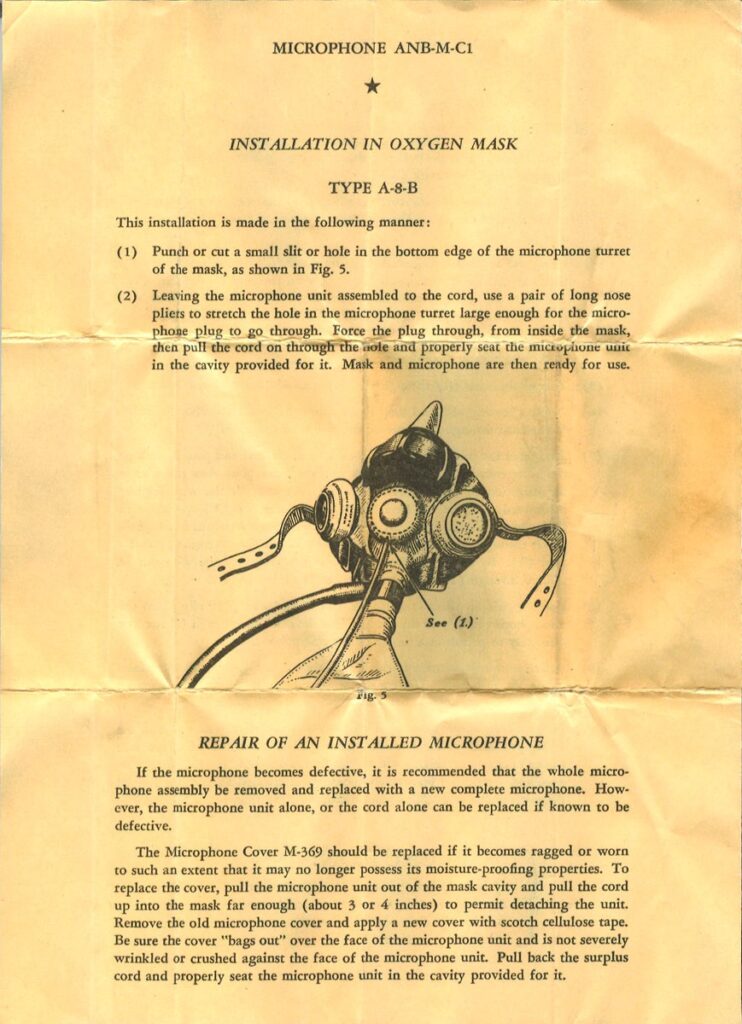
Installation of the ANB-M-C1 mic into a pilot’s oxygen mask is described below.
From Shure Shots, our internal newsletter, dated November 15, 1943: Captain Merle Else visited Shure for our Armistice Day Factory Meeting. Captain Else is a veteran of 119 combat missions, wears the air medal, and is in line for the Distinguished Flying Cross. Fondly handling our T-30 Throat Microphone, the youthful Captain made the thrilling statement that the T-30 has saved more lives of fighter pilots than any other piece of equipment besides guns. Said he of the T-30, “I have never heard of one failing.” ANB-M-C1 Mask Microphones are also widely used by his squadron.
The ANB-M-C1 was a carbon microphone. A carbon element was chosen because it was durable, reliable, inexpensive to manufacture, did not require scarce metals/materials, and produced a very “hot” signal level that would drive the pilot’s radio to full modulation. Seventy years later, ANB transducers still operate and meet the published specifications.
***
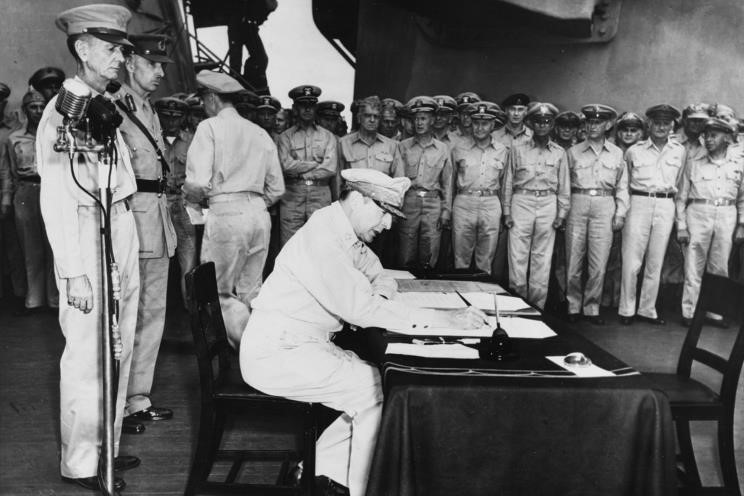
Our Unidyne I witnesses the official end of World War Two, September 1945
***
Ghost Army receives Congressional Gold Medal
With inflatable tanks, radio trickery, costume uniforms, and acting, American military units, known as the Ghost Army, outwitted the enemy during World War II. Their mission was kept secret for decades, but in March 2024 the Ghost Army stepped out of the shadows and was awarded the Congressional Gold Medal at a ceremony in Washington, D.C. The Ghost Army included about 1,100 soldiers in the 23rd Headquarters Special Troops, which carried out over twenty battlefield deceptions in France, Luxembourg, Belgium, and Germany, and around 200 soldiers in the 3133rd Signal Company Special, which created radio deceptions in Italy. Shure microphones were employed by Ghost Army units. See Tech Tip #494, September 21, 2022.
