
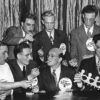
Company Holiday Event – The Frontlines of Fun
In the early years at Shure, employees took the opportunity at Company parties to poke fun at the men and women in management. “Shure Shenanigans” were elaborate productions, fully scripted and performed by employees, featuring skits and musical numbers. For a twist on the usual format, one year the executives of the Company performed the employee-written skits. One act featured a group of employees trying to get in to see an executive, only to be told he was “in conference.”… -more-

Salesforce Winter ’25 Release
On October 12th, 2024, our Salesforce instance will get updated to the Winter ’25 release.
Salesforce has 3 major releases a year.
Besides a new picture with Astro and Zig the Zebra showing up on the start-up screen, nothing should change immediately. You’re friendly Customer Success group will work behind the scenes to gently turn on any new features that can help our processes.
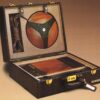
Shure Apps Tech Tip #160: Shure Teleconferencing Division
From 1984 until 1996, Shure Brothers Incorporated had a Teleconferencing Division. Managed by Vice-President Lee Gunter, this division introduced over fifty innovative products and accessories during its twelve years of existence. The initial product was the ST6000 teleconferencing system – a two-rack space console with a six-input automatic mic mixer, a small power amp for tabletop loudspeakers, a telephone keypad, and a telephone line interface. The STM microphones were variations of the Shure AMS (Automatic Microphone System) models, i.e., inside… -more-

This microphone needs no name
“In 1950 we developed a print ad that dramatically illustrated the dominance within the industry that the Unidyne held around the globe,” recalled former Shure Marketing Manager Howie Harwood in 1999. “The ad was titled ‘Used the World Over More Than Any Other Microphone.’ The subhead read simply ‘The Microphone That Needs No Name.’ Underneath the headings we ran a large photo of the Unidyne. The name or model of the microphone didn’t appear anywhere.
“One of the reasons we… -more-

Shure Apps Tech Tip #563: Up On The Roof
On the roof it’s peaceful as can be…and there the world below can’t bother me.
So wrote Carole King and Gerry Goffin in 1962, but for one SM81 mic, the roof was not a peaceful place. The story begins when Shure decided to develop and market electret condenser microphones.
In 1978, we introduced our first modern studio-quality condenser mic, the SM81. Designed to be as rugged, durable, and reliable as the SM58, the SM81 encountered a few skeptics in the… -more-
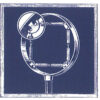
Shure’s First Patent: The Ring
The first known patent awarded to Shure was for a ring support for microphones that was considered “new, original, and ornamental.” The patent was applied for by Sidney N. Shure on December 9, 1935, and was granted on August 18, 1936.
In developing the stylish and functional support, Shure had an accessory that would complement the dramatic styling of its carbon microphone, introduced in 1932. The Shure carbon microphone set new standards in design with its elegant chrome plating and… -more-
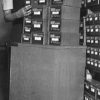
Finding a better way, every day
“Eliminate the negative. Simplify and improve the positive.” That was the philosophy that swept through Shure in 1946 with the introduction of Job Methods Training, or JMT. JMT was designed to “break down each job to determine why it is being done a certain way and find better ways of doing things.” It encouraged everyone in the Company to take a fresh look at how things were being done and ask: “Is there a better way?”
The training was conducted… -more-
That’s a great idea!
Starting in the 1940s, Shure began developing a source for an inexhaustible supply of valuable ideas for improvements throughout the Company. This source was employees. In 1943, Sidney N. Shure organized a Labor-Management Committee, bringing together representatives from various departments in the Company to “manage suggestions; to make recommendations; and to handle any and all ideas employees have to improve production, morale, and working conditions.”
In announcing the program, Mr. Shure wrote: “This is your committee. Let’s make this a… -more-
Family Day-“So this is where you work!”
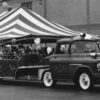
In the early 1960s, Shure initiated another eventful program: Shure Family Day, “a day-long program to educate and entertain.” In 1964, more than 1,500 people attended the Family Day, which was held in and around the Evanston plant. In addition to employees and their families, Shure invited city officials and people who lived in the immediate vicinity.
A fire engine provides rides for guests at Shure Family Day in Evanston, 1969.
Tours were offered throughout the day, allowing guests to… -more-

Bring the whole family
As the Company expanded, night shifts became a necessity, and there was a concern that this development would diminish the sense of family nurtured by Sidney N. Shure over the first 15 years of the Company. Mr. Shure took many steps to address this issue, including an employee newsletter, service pins, Company-sponsored sporting events, and touring the factory every Friday to converse with each employee.
The results of the pie-eating contest at the first Shure Picnic, held at Caldwell Woods… -more-