
Category: Historical

Capturing the sounds of war
One of the earliest accounts of Shure microphones used by reporters on the frontlines of military action came in 1943. During World War II, the United States Marines landed at Empress Augusta Bay on Bougainville Island and began an air and naval bombardment of enemy territory. Marine Sergeant Lloyd Maypole stood on the deck of a transport a short distance offshore; and in the midst of the intense blasting around him, he began to describe what was happening. Using a… -more-
A deceptive sound that changed history
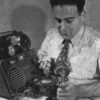
The Shure Uniplex Microphone, used with a magnetic wire recorder, is shown with wire recorder inventor Marvin Camras in 1944. A similar microphone and recorder setup was used to record the landing of the United States Marines on Bougainville Island on November 1, 1943.
Several months later, Mr. Camras’ recorder played an important role in the critical World War II D-Day invasion. On June 6, 1944, the Allied Forces used a portable machine to play recorded, amplified battle sounds at… -more-

Going to the front of the line
In 1944, the production line for the Shure Headset Department had grown from four people to more than 80. The assembly was complicated and exacting, requiring the women and men on the line to configure precisely the many specialized parts that made up the equipment. Each part of the headset cartridge was washed in a special machine. Complete cleanliness was assured by assembling the microphone cartridge in a dust-free, air-conditioned room. Shure was known for meeting the wartime demand for… -more-
“Mom, I’m with you all the way.”
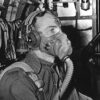
A letter from Lieutenant Marshall Levin, son of Lena Levin, who was assembling microphones for oxygen masks on the Pilot Line in 1944, read:
Dearest Mom:It was sure a surprise to hear that you are working at a war job. If that is what you want to do, and it isn’t too hard on you, I say more power to you. My oxygen mask has a Shure microphone in it. When I got it, I wondered how it would stand… -more-
Pilots praise the T-30 Throat Microphone
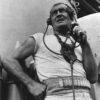
Inside the cockpit of a World War II military plane, the noise was deafening. Whirling propellers and roaring engines made it all but impossible for the flight crew to communicate with each other as well as with other aircraft and military command centers. Conventional microphones could not easily distinguish the background noise from the voices of the crew. The solution was an innovative throat microphone, the T-30, that Shure began manufacturing in 1942. These small, sensitive devices were sewn into… -more-

Eisenhower salutes a Medal of Honor winner
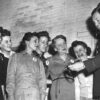
On July 5, 1952, General Dwight D. Eisenhower, then Supreme Commander of NATO forces, came to Chicago to present Sergeant Leonard A. Funk with a Medal of Honor at a luncheon. In the photo, General Eisenhower salutes Sergeant Funk, a member of the 83rd Airborne Division. A Medal of Honor winner and the President of the United States are the only persons who rate a salute from a five-star general.
The primary microphone used in the ceremony was the Unidyne.… -more-
Shure becomes Military Supplier-WWII
When United States Signal Corps inspectors approved the T-17 Microphone made by Shure in 1942, Shure officially “joined the Army.” The change was aptly described as “the factory taking office civilians and putting on an Army uniform.” Shure production lines were redesigned for new products and higher production levels. New equipment was installed for designing, testing, and manufacturing new products. Company policies and regulations all reflected the new military discipline. This paved the way for the Shure T-17 to roll… -more-
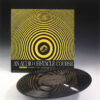
Setting records by making records
For Shure engineers in the 1960s, creating a better phonograph cartridge required finding an album that would test the ability of a cartridge to retrieve all the sound, or “information,” contained in the grooves of a record. A good “test” record would provide a wide range of sound—loud and soft as well as low frequencies and high frequencies— allowing the engineers to quantitatively measure the maximum velocity at which the stylus tip could trace the audio signal before it started… -more-
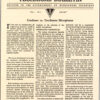
The first publication to make sound a science
In 1933, Shure started publishing The Shure Technical Bulletin, the earliest publication devoted to the “advancement of microphone technique,” which addressed audio reproduction and sound installation. Similar bulletins continue to be published by Shure in 2000, covering a broad range of topics involving the application of sound technology.
The first issue of The Shure Technical Bulletin, published in 1933, compares condenser microphones with the two-button carbon microphone.
Ralph Glover, Shure’s Chief Engineer in the 1930s, was the principal author of… -more-
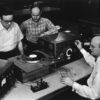
A tradition of engineering excellence
Behind some of the most recognized products in the world are people who are the most respected in their fields. From Shure’s first Chief Engineer, Ralph Glover, who helped pioneer Shure’s Two-Button Carbon Microphone, to the Shure Blue Ribbon product development teams initiated in the 1990s, the Company has recruited, developed, and championed talented people in acoustic design, digital and radio frequency technology, research, and engineering.
Shure engineers (left to right) Ernie Seeler, Johann Von Leer, and Lee Gunter conduct… -more-