
Category: Tech Topic

Apps Tech Tip #205: The Misuse and Abuse of the Lavalier Microphone
Chest-worn lapel and lavalier microphones date back to the 1930s. The Shure 1936 catalog features the Model 73A crystal lapel mic: Highly efficient and faithful in voice reproduction due to the new Shure diaphragm design and improved mechanical system.
Model 73A in 1936 catalog
In the 1950s, as television production techniques developed, omnidirectional moving coil microphones suspended by a cloth cord and hung around the presenter’s neck became feasible due to smaller, stronger magnets. “The Today Show” on NBC was an… -more-
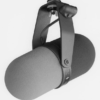
Apps Tech Tip #598: Is the SM5 Superman? Or merely Clark Kent?
During the Centennial of Shure Incorporated, Tech Tips are planned that document lesser-known aspects of our history. In this issue, readers will learn about the SM5 boom microphone and its relationship to the SM57.
SM5 magazine ad, 1965
The SM5 boom microphone debuted in 1964. Its User Guide claimed:
The SM5 has been painstakingly developed to uniquely satisfy the existing requirements for boom operation, and to provide a new degree of reproduction quality and flexibility of application in television and… -more-
Apps Tech Tip #597: The Advent Of The Condenser Recording Microphone
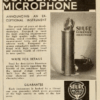
During the Centennial of Shure Incorporated, Tech Tips are planned that document lesser-known aspects of our history. In this issue, readers will learn about the earliest days of electrical recording and the role of the condenser microphone.
The migration from acoustic recording studios to electrical recording studios began in 1925. Responding to the growing number of electrical studios, Shure Brothers Company marketed its first condenser microphone for recording, the Model 44, in 1932. Here is our January 1932 ad in Projection… -more-

Apps Tech Tip #596: The Shure Radio Company in 1927
During the Centennial of Shure Incorporated, Tech Tips are planned that document lesser-known aspects of our history. In this issue, readers will see how the Shure Radio Company marketed its offerings in 1927.
The Shure Radio Company opened on April 25, 1925, with S.N. Shure as president and sole employee. This nascent business sold wholesale to radio retailers, a model copied from the N. Shure Company – the household goods catalog house founded in 1888 by Nathan Shure, paternal uncle… -more-
Apps Tech Tip #595: A Short History of the V15 Phonograph Cartridge Series
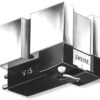
During the Centennial of Shure Incorporated, Tech Tips are planned that document lesser-known aspects of our history. In this issue, readers will learn about 40 years of V15 innovations.
Critics and end users alike considered our V15 series as the finest moving magnet cartridges ever manufactured. Announced in 1964, the V15 series was our premier cartridge line.
Timeline of the V15 series:
V15 1964-1966 V15 Type II 1966-1972 V15 Type III 1972-1978
V15 Type IV 1978-1982 V15 Type V 1982-1985 … -more-
Apps Tech Tip #200: Home Recording in the 1940s
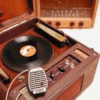
Neither the wire recorder nor the tape recorder was available to the public until the late 1940s. So how did a hobbyist save a favorite radio broadcast in the early 1940s? By cutting a record at home using a magnetic disc cutter head, mounted on a unique tone arm attached to a special turntable.
Three 78 rpm discs cut on a home disc recorder
These recordings were called “transcriptions.” Mr. Shure owned a disc transcription device, kept in his home,… -more-
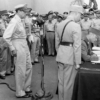
Apps Tech Tip #594: Shure Was There As World War Two Concluded – 1945/1946
Eighty years ago, the demand for military mics and headphones waned as World War II neared a resolution. Mr. Shure issued a statement in the February 1945 Shure Shots newsletter, “Today, our so-called peace time, or commercial line, microphones are important in the war we are waging. Battleships, intercommunication systems on ships, hospital rehabilitation centers, U.S.O. camps, and training schools require Unidynes, Uniplexes, phonograph pickups, and other Shure products. While these needs do not call for as great a quantity… -more-
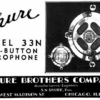
Apps Tech Tip #593: The First Shure Technical Bulletin – 1933
In the early 1930s, Shure Brothers Company was not known as a microphone manufacturer, or anything else for that matter. S.N. Shure set his sights on changing that perception. He created a tagline for his company – Microphone Headquarters. He hired our first chief engineer, Ralph Glover, a University of Cincinnati graduate. Glover wrote a series of Technical Bulletins to teach end users, dealers, and distributors about microphone science. Mr. Shure believed that an informed customer would be loyal to the… -more-
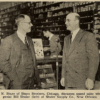
Apps Tech Tip #592: A Brief History of the Company – 1936
In May 1936, Mr. Shure put pen to paper and recalled the first decade of Shure Brothers Company. Our archive holds the original document. In the text below, the blue font indicates editorial remarks for clarity.
S.N. Shure, late 1930s
Brief History of the CompanyBy S.N. Shure – May 13, 1936
The Company was founded eleven years ago by the present manager, who has been in charge of all departments throughout the history of the Company. During his years in… -more-
Shure Apps Tech Tip #195: PSM as IFB…please ease up on the acronyms
A Personal Stereo Monitor (PSM) system may be employed as an Interruptible Fold Back (IFB) system for live or recorded broadcast programming. An on-air newscaster often wears one earphone. From this earphone, she hears the broadcast audio signal, minus her own voice, but also hears a director providing instructions, such as, “There is a breaking story. We will cut away in five seconds.”
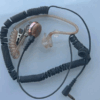
Typical IFB earphone
Because the broadcast audio is “folded back” into the newscaster’s ear and the director… -more-