
Category: Tech Topic

Apps Tech Tip #591: A Portrait of S.N. Shure as a Young Man
During the Centennial of Shure Incorporated, Tech Tips are planned that document lesser-known aspects of our history. In this Tech Tip, readers will see rare images of Sidney Natkin Shure and his family from the era before he started the Shure Radio Company in 1925.
Let’s first remember Mr. Shure at age 59. The photo below, taken in 1961, was the favorite of Mrs. Shure. This is an image familiar to many readers.
S.N. Shure, Evanston, 1961
S.N. Shure (his… -more-
Apps Tech Tip #590: The Shure Condenser Microphone – 1932
Tech Tip #589 explained how Shure Brothers Company entered the microphone market in 1929 by distributing transducers manufactured by Universal, Kellogg, and Ellis. Mr. Shure became convinced microphones would be a growing and profitable market, so he set about to create Shure branded units.
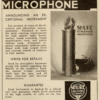
In January 1932, the following advertisement appeared in the magazine Projection Engineering. To date, this is the earliest ad known featuring a Shure branded microphone.
Shure ad in Projection Engineering, January 1932
Enlargement of the ad shown… -more-

Apps Tech Tip #589: Shure Enters the Microphone Market – 1929
The Great Depression in the United States spanned from 1929 to 1941, with the crisis peak occurring in 1933. Beginning with the stock market crash of 1929, it was a difficult era for individuals and companies, particularly new firms like Shure, founded in April 1925.
S.N. Shure added microphones to his extensive inventory of distributed products in 1929. As the public was opting for manufactured radios in place of build-it-yourself radio kits, he needed to replace the sales dollars lost… -more-
Shure Apps Tech Tip #193: Mid-Side Microphone Operation – A Primer
Let us begin with a video demonstration of a Motiv Series Mid-Side mic:
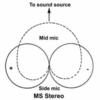
The MV88 series of stereo microphones and the venerable VP88 stereo mic are Mid-Side designs. Mid-Side, abbreviated as “M-S,” requires two mic elements: one cardioid and one bi-directional, also known as a figure-8 pattern. The M-S technique combines the signal from the bi-directional mic with the signal from the cardioid mic to create a stereo image.
As a refresher, a cardioid mic picks up well from the… -more-
Tech Tip #588: Shure in Las Vegas
It is feasible that the city of Las Vegas has more Shure product per square foot than any other city in the world. How did this happen? It was not by happenstance. Shure products were first used in Las Vegas over 70 years ago…
The long-awaited premiere and tests-in-action of the Shure Brothers Incorporated Vagabond 88 wireless microphone took place recently at the Flamingo Hotel. The system responded and performed excellently during all phases of a typical nightclub production. Utilized… -more-
Tech Tip #587: What is a Sound-Powered Telephone?
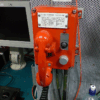
A sound-powered telephone permits users to communicate via handsets, or handheld mics and headphones, without the need for external power. This technology has been employed since World War Two for routine and emergency communication onboard ships, providing voice communication between key locations when power is unavailable.
A sound-powered telephone system can have two or more stations on the same circuit. The voice circuit is always active. A user simply begins talking rather than dialing to reach another station.
Sound powered… -more-

Apps Tech Tip #187: Army Air Force Mask Microphone for Pilots
This Tech Tip is dedicated to those who served on D-Day, June 6, 1944.
Plane-to-plane communication and plane-to-ground communication became a critical issue as World War II intensified. The acoustical noise in a warplane cockpit made it difficult for the pilot to hear incoming messages and tainted outgoing messages. The U.S. Government sought out technical assistance from the Cruft Laboratory at Harvard University. One of the Cruft experts in acoustics was a young Leo Beranek – later the founder of… -more-
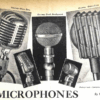
Tech Tip #586: A Hypothesis about the Model Number “55”
Allow me to begin with a statement: Today’s Tech Tip is purely hypothesis, created to explain why “55” was used as the model number for the Unidyne microphone introduced in 1939. I encourage readers to poke holes in this hypothesis with facts I may have overlooked.
One of the questions most frequently asked of the Shure Corporate Historian (me) is: Why was 55 used as the Unidyne model number?
The candid answer is – I don’t know. I’ve never found… -more-
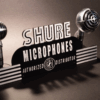
Tech Tip #585: Art Deco Point-Of-Purchase Display
This unique project began following a conversation with Mike May, the model maker at Shure. We were discussing the Company’s Centennial; Mike asked if our archive lacked important historical artifacts.
I replied, “Only a few. There is one item I have only seen in a photograph. It is a beautiful Art Deco point-of-purchase display from around 1940. My hunch is the desperate need for metal during World War Two made these displays valuable and all were scrapped.”
I showed the… -more-
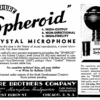
Tech Tip #584: Origins of the Ball-Shaped Microphone
Shure introduced its first ball-shaped mic in 1935 – the Model 74 Spheroid Crystal Microphone. We were one of three companies to offer a ball-shaped mic during that era; Brush Development and Western Electric were the others.
Letter to Shure distributors, 1935
Magazine ad for the Model 74 Spheroid, 1936
The Model 74 was $37.50 at introduction, the equivalent of $870 in 2025. The Spheroid mic grille diameter was 2.25“/ 5.7 cm – a tad larger than the SM58 grille. The mic weighed a… -more-